Another day, another podcast…

frontierBrenner

I’ll be appearing on “Uncle Tee’s Cool Pool Party,” a podcast at 8 p.m. EDST Monday on STLR Media in Sarasota. This is the same time slot as “The Twysted Tyrants Show” with Johnny Christ BayBay that I was on about a month ago, but Johnny is gone and it’s a new show. Host Cat Welch has promised me we’ll be able to talk about other things than my love affair with a dolphin, things like my family’s involvement with the crazy pseudo-science of the late Dr. Wilhelm Reich, the 20 years I spent practicing Wicca, the decade I spent reporting on the Navajos and Zunis, or my attempts to understand the elusive nature of the UFO, starting when I was a child. (Photo of me defending the First Amendment outside the trailer of the Farmington Daily Times in Shiprock, N.M. Photo by Chas Clifton.)

Pandemonium in the Porpoise Pens!

Zachary Zimmerman, our 19-year-old protagonist, has just met Elaine Ingersoll, a cute young woman he wants to impress. What better way than to take her swimming with Ruby, a dolphin at Florida Funland, where Zack is fulfilling a college contract to photograph the park’s dolphins for a local author’s book? What could possibly go wrong?

Chapter XIV:
Pandemonium in the Porpoise Pens!

Unless a female has a calf, she usually does not become very aggressive, but she may even kill a recently introduced animal if she has been permitted exclusive control over one area for several years. –David and Melba Caldwell, Bottlenose Dolphin, ibid.

“Oh, this is so exciting,” Elaine cried as we sped south on the Tamiami Trail. “I’ve never swum with a real live dolphin before! What’s it like?”
I groped for a word to describe my experiences with Ruby that wouldn’t totally pulverize my relationship with Elaine. “Wet,” I finally said. “Very, very wet.”
“Really? Wet? Wow!”
As promised, I was taking Elaine to Florida Funland so she could swim with the dolphins. If Beau had at one time been cautious about such experiments, the news that the park was closing must have made him less concerned. You can’t get blood from a turnip, after all. If he thought about liability, he probably figured it would fall as severely on the park’s owners as on him. Or maybe he was trying to be nice to me. A lot of time has passed, and I don’t really know.
“Do they ever talk to you?” Elaine asked.
These innocent-sounding questions got thornier and thornier. I didn’t know how to explain my telepathic experiences with Ruby, didn’t even know if they were real. We hadn’t communicated since the night I fell off the bed.
“The one we’re going swimming with, Ruby, I think she has.
“Really? Tell me about it!”
My brief description of our “language lesson” impressed her. “Wow, that’s really cool! I mean, I’d heard they could talk and everything, but I never met anyone who’d talked to one of them before! Do you think she’ll talk to me?”
When I picked her up, Elaine had seemed a little aloof, as though she expected our relationship to stay platonic indefinitely but didn’t want to say so. Perhaps things would be different after this swimming expedition. Perhaps she would warm to me, recall some of the exuberance she’d felt the night we met at the juvenile detention center.
“I don’t know,” I said. “I can try to get her to talk…”
“That would be so cool!” she went on. “Is she like Flipper?”
For the first time, I had an inkling of how marine mammalogists must feel, confronted with uninformed laymen demanding dolphin dictionaries.
“Elaine, there’s something you need to understand.”
“What?”
“Well… the dolphins you see on TV resemble real dolphins about as much as the people you see on TV resemble real people.”
That stopped her cold. “What do you mean?”
“I mean, it’s not real, none of it! It’s all the product of Hollywood writers and producers and directors and editors and cameramen!”
That didn’t help.
“Have you noticed real life doesn’t have a plot, never breaks for commercials and doesn’t solve all its problems at the end of thirty minutes?” I asked, realizing I was talking down to her but not knowing what else to say or how to say it.
“Well yeah, I had, sort of. I always thought it was a bummer, that way.”
“It’s like that with the dolphins. They’re not like big, friendly dogs that happen to live in the ocean, Elaine! They’re not even domesticated animals!”
“They’re not?”
“No! They’re wild animals that have been captured and trained to tolerate humans! They have strong personalities, and, and they, uh, they get along with some people better than others. I went in with a couple the other day, and they sort of roughed me up.”
Now Elaine seemed aghast. Great going, Zack! “They wouldn’t hurt a person they didn’t like, would they?”
Satan flashed to mind; I could imagine him cheerfully playing with a severed limb. “Those were a couple of rowdy ones,” I said. “Ruby, the one we’re going in with, is the gentlest one in the whole place.”
“Well that’s good,” she said, relieved. “You had me thinking they were sharks or something! I don’t know how I’d explain it to my dad if a dolphin bit me. He’d probably say I must’ve bitten it first.” Continue reading Pandemonium in the Porpoise Pens!

U.S. Navy seeks telepathy with dolphins?

Further evidence has been obtained that senior officers in the U.S. military have seriously investigated whether humans and dolphins can communicate telepathically. A declassified CIA file on C. B. Scott Jones (see previous post) indicates two other interested parties: Former Green Beret Col. Joh Alexander, a leading proponent of psi-ops and non-lethal warfare, and Theodore Rockwell, a nuclear physicist who worked closely with the Navy’s nuclear program. Stay tuned for more to come, nobody knows where this rabbit hole leads!

“Scott displayed marvelous creativity when he enthusiastically urged that dolphins be channeled in order to locate the remains of crashed flying saucers. In one bold stroke, the thereupon melded the previously disparate disciplines of ufology and parapsychology.” – The CIA

ScottJones

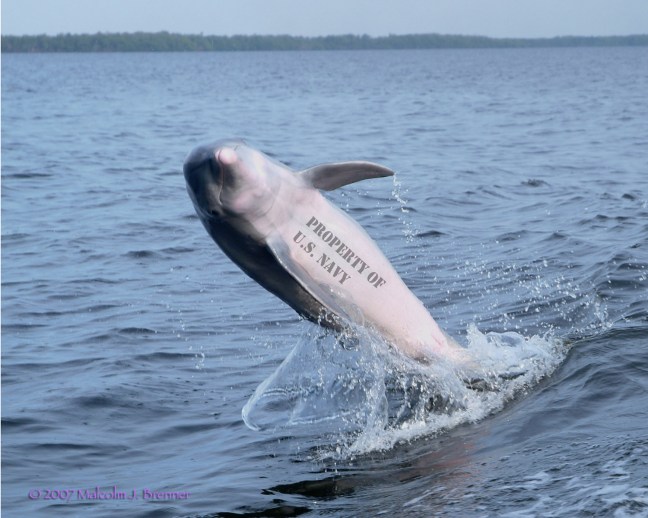
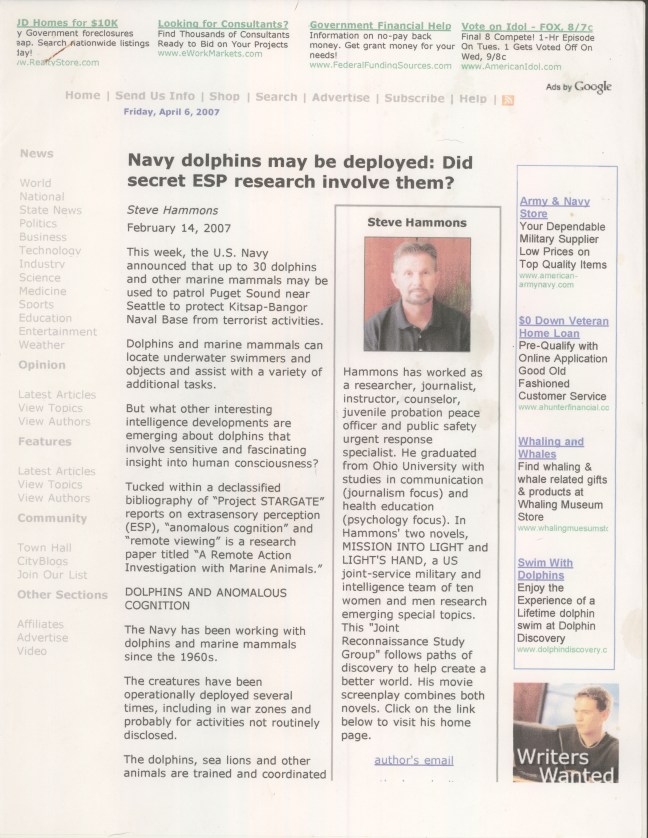
Did U.S. Navy conduct secret ESP tests with marine mammals? This guy said so, and I’m trying to find out.


NavyPhin

Today, while investigating this web post from 2007, I received some startling information. According to SRI, while the author, Steve Hammons, says this paper is unclassified, the project it was written for apparently isn’t! Whether I can even acquire a copy of the paper described here is in doubt, and I am told I may have to ask the sponsor of the research for permission.

It would be interesting to know who laid out the cash for this research, and what, if anything was learned.

As a former investigative reporter, I know how to file a Freedom Of Information Act (FOIA) request, but I’d prefer to ask nicely first, as a FOIA request is a royal pain in the ass to the person receiving it. At the same time, I’m wondering what, exactly, have I stumbled into in my relentless quest for the truth about dolphins? What findings would warrant keeping this paper secret for more than three decades?

Is there a marine mammal equivalent to the nefarious “Men In Black” who are reported to harass UFO witnesses? If you find wet, webbed footprints leading up to my door, and scales on the doorknob… don’t come in.

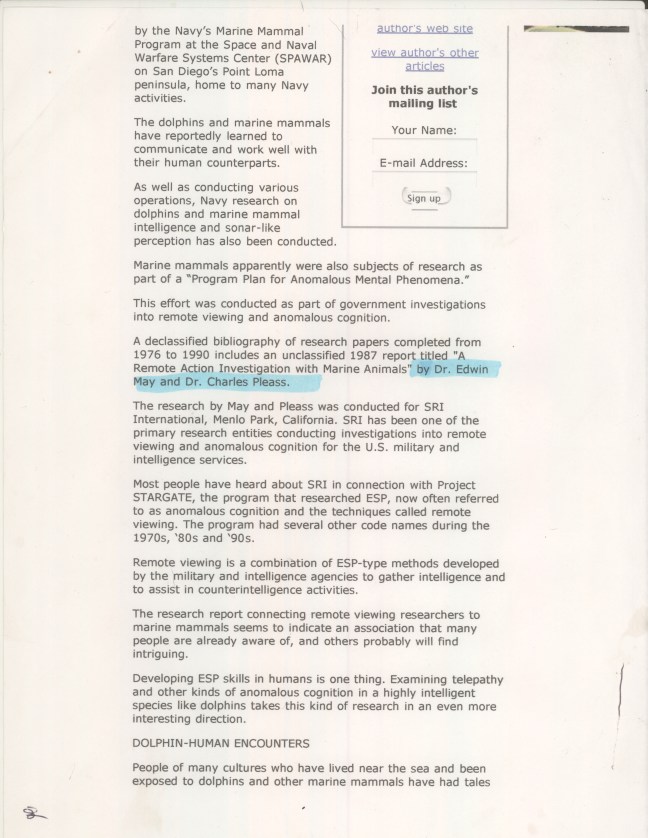
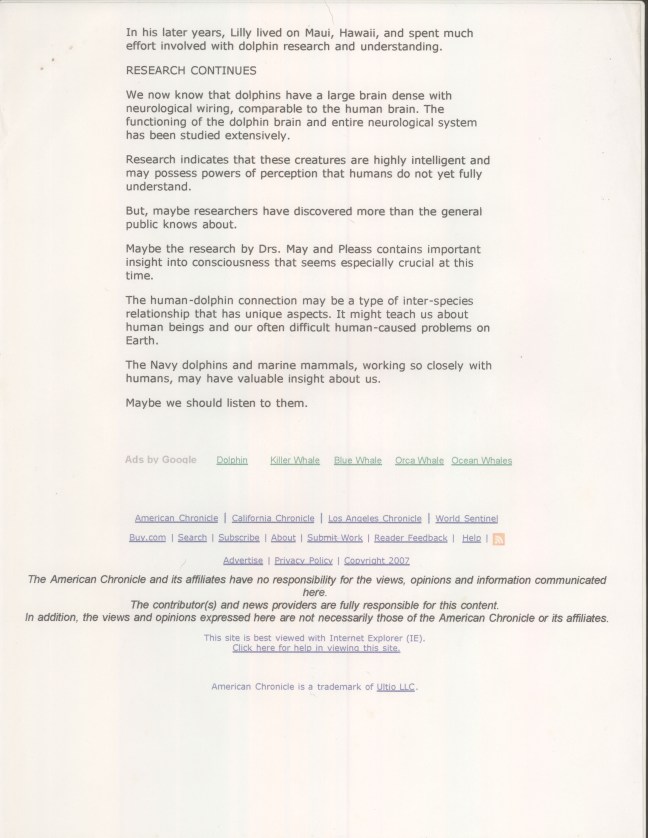
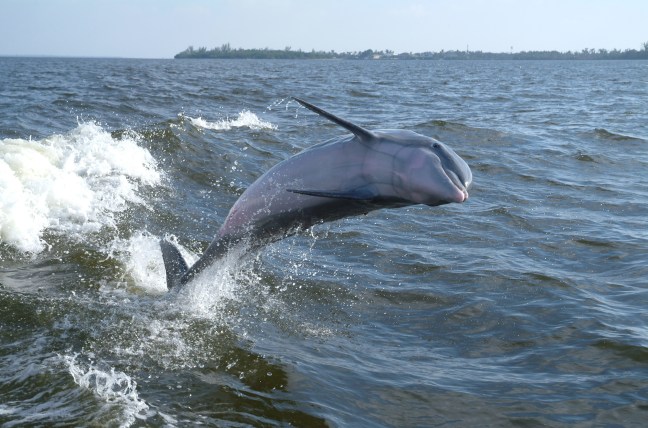
This post was scanned in from a hard copy of The American Chronicle web site in the author’s possession. All rights remit to the author. Illustrations added for shits and giggles by me.


Navy dolphins may be
 deployed: Did secret ESP research involve them?

The American Chronicle

Steve Hammons

February 14, 2007

This week, the U.S. Navy 
announced that up to 30 dolphins 
and other marine mammals may be
 used to patrol Puget Sound near Seattle to protect Kitsap-Bangor 
Naval Base from terrorist activities.

Dolphins and marine mammals can 
locate underwater swimmers and 
objects and assist with a variety of 
additional tasks.

But what other interesting
 intelligence developments are
 emerging about dolphins that 
involve sensitive and fascinating 
insight into human consciousness?

Tucked within a declassified 
bibliography of “Project STARGATE”
 reports on extrasensory perception 
(ESP), “anomalous cognition” and 
“remote viewing” is a research
paper titled “A Remote Action 
Investigation with Marine Animals.”

DOLPHINS AND ANOMALOUS 
COGNITION

The Navy has been working with
 dolphins and marine mammals 
since the 1960s.

The creatures have been 
operationally deployed several 
times, including in war zones and
 probably for activities not routinely 
disclosed.

The dolphins, sea lions and other
 animals are trained and coordinated by the Navy’s Marine Mammal 
Program at the Space and Naval 
Warfare Systems Center (SPAWAR)
 on San Diego’s Point Loma 
peninsula, home to many Navy
 activities.

The dolphins and marine mammals 
have reportedly learned to 
communicate and work well with 
their human counter parts.

As well as conducting various 
operations, Navy research on 
dolphins and marine mammal 
intelligence and sonar-like 
perception has also been conducted.

Marine mammals apparently were also subjects of research as 
part of a “Program Plan for Anomalous Mental Phenomena.”

This effort was conducted as part of government investigations
into remote viewing and anomalous cognition.

A declassified bibliography of research papers completed from
1976 to 1990 includes an unclassified 1987 report titled “A Remote Action Investigation with Marine Animals” Dr. Edwin
 May and Dr. Charles Pleass.

The research by May and Pleass was conducted for SRI 
International, Menlo Park, California. SRI has been one of the 
primary research entities conducting investigations into remote
 viewing and anomalous cognition for the U.S. military and
 intelligence services.

Most people have heard about SRI in connection with Project 
STARGATE, the program that researched ESP, now often referred 
to as anomalous cognition and the techniques called remote
 viewing. The program had several other code names during the
 1970s, ‘80s and ‘90s.

Remote viewing is a combination of ESP-type methods developed 
by the military and intelligence agencies to gather intelligence and
 to assist in counterintelligence activities.

The research report connecting remote viewing researchers to
 marine mammals seems to indicate an association that many
 people are already aware of, and others probably will find 
intriguing.

Developing ESP skills in humans is one thing. Examining telepathy 
and other kinds of anomalous cognition in a highly intelligent
 species like dolphins takes this kind of research in an even more 
interesting direction.

DOLPHIN-HUMAN ENCOUNTERS

People of many cultures who have lived near the sea and been 
exposed to dolphins and other marine mammals have had tales to tell. Legends and lore about dolphins offer fascinating looks at
 connections between our two species.

Throughout history,
 dolphins have been
 said to be a friend
 to humans. Stories
 of humans being 
rescued at sea, or 
being guided at sea 
by dolphins can be
found in many 
cultures too.

Much has been 
written about
 anecdotal reports, 
ancient and recent,
 of interesting
 encounters between
 humans and 
dolphins.

Personal authentic experiences have been reported by many 
people about unique and significant interactions with dolphins.

And, some people have written about possible telepathy among
 dolphins, and between dolphins and human.

Although these reports often come from credible people, they are
 also difficult or impossible to verify scientifically.

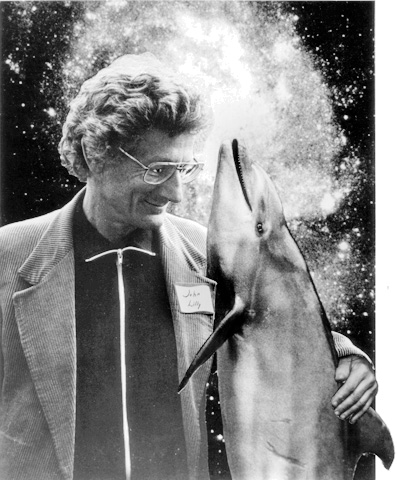
DOLPHIN RESEARCHER JOHN C. LILLY

ch29#1SM

(Photo montage © 1983 Malcolm J. Brenner for Future Life magazine.)

Many scientists have researched dolphins, whales and other
 marine mammals. Probably the most well-known of these is the 
late John C. Lilly, M.D. (1915-2001).

Lilly was a physician and psychoanalyst who focused on
 biophysics, neuroanatomy, neurophysiology, electronics and
 computer theory. He also studied consciousness – human and 
dolphin consciousness.

The 1973 movie THE DAY OF THE DOLPHIN was based on Lilly’s 
work. George C. Scott starred as a character similar to Lilly.

george-c-scott

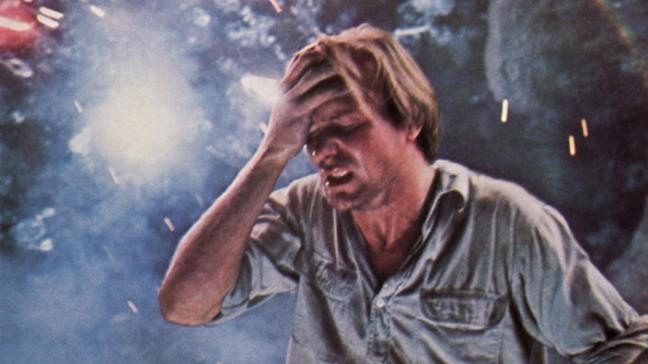
The 1980 film ALTERED STATES was also based on Lilly’s
 consciousness research.

ALTERED STATES

Explaining his view of dolphins, whales and other cetaceans, he
 said, “They (cetaceans) have been on the planet now with brains 
our size or larger for 25 million years. We’ve only been here with 
our present brain size about two-tenths of a million years. So
 they’ve been here something on the order of 25 to 50 to 100 
times the length of time we have.”

Lilly authored many books on consciousness and other subjects 
which have been read by millions worldwide. These include MAN 
AND DOLPHIN and LILLY ON DOLPHINS: HUMANS OF THE SEA.

In his later years, Lilly lived on Maui, Hawaii, and spent much
 effort involved with dolphin research and understanding.

RESEARCH CONTINUES

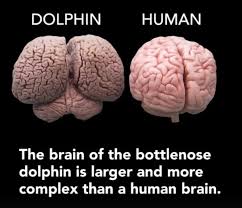
We now know that dolphins have a large brain dense with 
neurological wiring, comparable to the human brain. The
 functioning of the dolphin brain and entire neurological system 
has been studied extensively.

Unknown-1

Research indicates that these creatures are highly intelligent and 
may possess powers of perception that humans do not yet fully 
understand.

But, maybe researchers have discovered more than the general
 public knows about.

Maybe the research by Drs. May and Pleass contains important 
insight into consciousness that seems especially crucial at this 
time.

The human-dolphin connection may be a type of inter-species
 relationship that has unique aspects. It might teach us about 
human beings and our often-difficult human-caused problems on
Earth.

The Navy dolphins and marine mammals, working so closely with 
humans, may have valuable insight about us.

Maybe we should listen to them.

The American Chronicle and its affiliates have no responsibility for the views, opinions and information communicated here.

 The contributor(s) and news providers are fully responsible for this content. In addition, the views and opinions expressed here are not necessarily those of the American Chronicle or its affiliates.

Steve Hammons
Steve Hammons


Steve Hammons

Steve Hammons

Steve Hammons

Stay tuned, more details will be released as they emerge!

Emilie knows Malcolm (but not in the Biblical sense)!

b1a471147db5d830ad299e41b9f4b859

Some time ago I was asked by Los Angeles comedian Emilie Hagen to do an interview. I was feeling a little toasty from a couple of recent interviews where the hosts kept asking me the same hoary questions I’ve been asked by every interviewer, like “How did you meet this dolphin?” (I’m seriously tempted to answer, “A bad match-up on a dating site.”) So I wasn’t really enthusiastic to do what appeared to be another one.

When I expressed this to Emilie, she explained that she wanted to ask me about my feelings for Dolly. This was such a novel approach that I was momentarily taken aback. Most interviewers are like, “Did you do it in her blowhole?” or “When did you stop fucking your dog?” Emilie, in contrast, was showing me some actual respect and treating me like a human being, rather than a sideshow freak. Believe me, I appreciated that!

Our Skype chat lasted a little over two hours, which was pretty amazing, and while Emilie allowed me to drift a bit, she got what she needed (I hope so!). Then she sat down with the 1/4-inch magnetic recording, demagnetized razor blade, an editing block and a roll of Scotch splicing tape… oh wait, sorry, wrong millennium! It took her about three weeks to edit our long talk down to what I think is one of the best one-on-one interviews anyone has done with me.

Many thanks, Emilie, for keeping it light and keeping it real. It was genuine fun working with you, which is a fuck of a lot more than I can say about those slavering boobs, Howard Stern and Bubba the Love Sponge!

Listen to “Emilie Knows Everything” on Spreaker.

An Open Letter to Susan H. Shane, Ph.D.

Suse Portrait

UPDATE: I received a reply from Dr. Shane on July 12, apologizing for her statement and saying she wouldn’t make the same negative claim today. She also said she had no intention of denying my experience with Dolly, and described female dolphins as being “good candidates” for experiencing orgasm. (I think they’ve had it for 30 million years, but hey, I don’t have a Ph.D., which means I can leap to conclusions with virtually no consequences.)

I’d publish her response here, but she hasn’t given me her permission to do so.

I accept her apology and applaud her open-mindedness in being willing to change her mind. As far as I’m concerned, this matter, which has bothered me for 44 years, is closed. Thanks, Suse.


July 7-8, 2018

Suse, I’m writing you this morning to “get off my chest” something that happened between us in 1974, while you were attending New College and staying at my mother’s house on Siesta Key, where I was also living at the time. You deeply wounded me and ruthlessly invalidated me with six thoughtless words, and it has rankled me ever since.

Your professed ambition as an undergrad, as I remember it anyway, was to become “the Jane Goodall of dolphins.” Sorry you never made it, but maybe it’s for the best anyway. Let me explain why, from my own perspective.

You’ve probably forgotten all about this, but I never have, because you became symbolic to me of mindless veneration of dogma, any dogma but in this case SCIENTIFIC dogma (if you don’t tell me it doesn’t exist, I won’t have to call you a liar).

I don’t remember what led up to this, but we were sitting in my car, I was in the driver’s seat, you were in the passenger seat, we were stopped somewhere and I was trying to describe my 1971 experience with Dolly the dolphin to you, which was only the most profound, moving, deeply personal and transformative experience in my life.

No, you have no idea. You really, really don’t. And I’m not even sure you CAN.

And I was trying to describe to you, while Dolly and I were making love in her pen at Floridaland, how she took me underwater just before we experienced a simultaneous orgasm, and how she groaned, just like a woman, underwater.

You looked at me as if I’d just offered to sell you a slightly used bridge in Brooklyn, cheap.

That’s when you said the six words that utterly invalidated me, my experience with Dolly, my observational abilities, my truthfulness and my intelligence.

You said, and I quote, “But female animals don’t have orgasms!”

And I just sat there, gobsmacked, not believing what I’d just heard.

This has nothing to do with any feelings I may or may not have had toward you. You were very attractive (you still are), and I was hopeful enough to imagine we might get it on, even though I was pretty sure you weren’t attracted to me. I wasn’t very accepting of my own zoophilia then, and was looking to normalize myself through experiences with women. But that’s neither here or there.

When you said, “But female animals don’t have orgasms,” a number of rebuttals came to mind. More have come up int the intervening years. Here are some of them in a nicely-ordered, bulleted list:

• Without putting too fine a point on it, you’re a female animal (I presume you’re not vegetable or mineral) and YOU have orgasms, don’t you? What makes you so special? Or what makes female non-humans so unfortunate? Is female orgasm an evolutionary privilege of H. sapiens, and if so, what have you human women done to make the universe favor you over all other females on this planet?
• Since when is an unprovable negative hypothesis “scientific”? A single case of a female animal having an orgasm is sufficient to invalidate your assertion. Try this link  at 0:40. I don’t know what you’d call that, if not a bitch orgasm.
• Please cite a peer-reviewed scientific paper – ANY paper – which authoritatively states that female animals don’t have orgasms. The only two people I’ve seen allege this in print are Larry Niven (misogynistic SF writer) and Dr. David Bronowski (mathematician). I don’t see as that makes either one an expert on the subject, or anything remotely close. Nor can I find any references to actual studies of this question.
• The clitoris (not mansplaining) is the focus of female sexual arousal and orgasm. The only female mammal I’ve been able to find that doesn’t have one is the platypus. The platypus male has such a spiny penis that he has to knock her out with poison spurs before they can mate. Since other female mammals have clitorises, what do you suppose they have them for? Do you think they get stimulated during mating? And let’s not forget, because of humans’ upright stature, the female human’s clitoris is typically farther from the opening of the vagina than in other female mammals. This means other species’ females should find it easier, rather than more difficult, to experience orgasm during mating without much need for foreplay. Female equines even have a moveable clitoris which they can push against a stallion’s penis when he’s thrusting. Canines form the copulatory tie, which not only involves long-duration sexual stimulation but positions the male dog’s bulbus glandis so it’s depressing the bitch’s clitoris, which I’m sure leads to orgasm. Pigs copulate for up to 20 minutes; it’s difficult to imagine how a sow could NOT experience an orgasm with that duration of penetration.
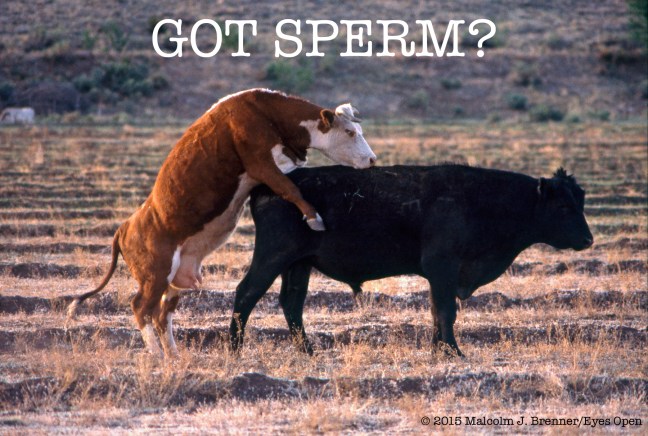
• In many species I’ve observed (dolphins, dogs, birds, bovines, equines, etc.) a female in estrus will solicit sex from a male rather than waiting for him to get around to it. (Below: cow in estrus soliciting sex from a bull.)

gotsperm?

Why do they do this? For Queen and Country? I think not; most non-humans don’t have the comprehension to connect sex with reproduction (dolphins and a few self-aware others being exceptions). They do it because they’re anticipating an orgasm! And why shouldn’t they? The anticipation of an orgasm leads female animals to solicit sex, just the same way it does males. It’s a powerful driver for bisexual reproduction, which is the most important act an animal can perform. If it didn’t exist, evolution would have invented it millions of year ago for just this reason. Also, in many females, orgasm triggers ovulation and various involuntary responses that help transport sperm to the ovum.
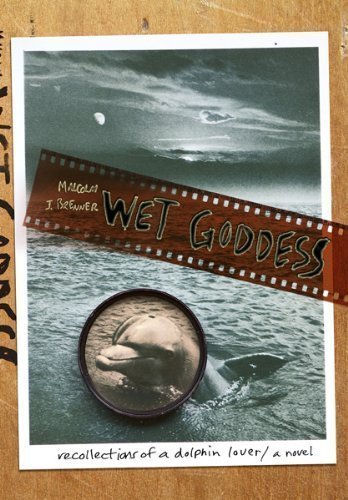
• How did this idea you parroted back to me get started? Well, it’s true, most female animals don’t display a lot of activity or vocalize during mating. The one exception, the feline, is supposed to scream during sex because it’s painful, the males having small spines on their penises. (I conducted an informal experiment many years ago to test this hypothesis and found that female cats scream even when penetrated by a smooth phallus, it just takes 3-5x longer than with a spiny one. So it isn’t the spines that are causing her to scream.) Does this lack of activity or vocalization mean they aren’t having orgasms? Of course not, and it would take a leap of faith to assume so. Many women do not display the “stereotypical” (i.e. faked) orgasm behaviors, moaning, thrashing around, biting, pulling their partner’s hair, etc., that are often associated (in men’s minds, at least) with the female orgasm. To make Brooke Shields fake an on-camera orgasm in the 1981 romantic film “Endless Love,” director Franco Zeffirelli stood off-camera, pinching her toe incredibly painfully. While my own experience is, admittedly, unscientific and limited, the two non-human partners I’ve successfully had sex with (Dolly and Pixel, my previous, 34-kg bitch) had orgasms. If you need to remind yourself what I told you about Dolly’s orgasmic behavior in 1974, you can buy & read my novel Wet Goddess  because I’m damn sure not wasting my breath explaining it to you again. When I had orgasms while having sex with Pixel, I could feel her vagina squeeze me. According to Masters and Johnson, involuntary contractions of the female sexual organs are the most reliable indicators of female orgasm, so I am inclined to think that’s how most female mammals experience it: totally on the inside, not the outside. After all, if the female mammal started thrashing around, the male would fall off her back and sex would be over without insemination. So thrashing around would be self-extinguishing, evolutionarily speaking. And looking for human-type behavior in non-humans is called “anthropomorphism,” isn’t it? (Rhetorical question, but you already knew that, didn’t you?) If scientists claim female animals don’t experience orgasms because they don’t react the same way human females do, they’re being anthropomorphic scientists. If they want an honest answer from somebody who is uniquely qualified to provide one, they should talk to zoophiles, like me. We’ve been there. We know. Not “think” or “believe” or “imagine” or “hypothesize” or “guess” or “that’s what the data indicate:” WE KNOW. Because we’ve been there, that’s how.
• How did this silly, crackpot, unsupported notion get started? I think I figured it out, and although this is my speculation, it’s based on well-known and often-observed aspects of male human behavior. Prior to the 1950s, there weren’t a lot of woman biologists, certainly not like there are today. So biology conferences were mostly-male gatherings. What do a group of men (yes, even scientists) like to do when they get together by themselves? Drink beer and watch porn movies in back rooms after the  conference. So some guy with a 16mm B&W fuck film would commandeer a projector and slap a hand-lettered notice on his hotel room door announcing that there would be an impromptu showing of “Mating habits of the female Homo sapiens” at such and such a time. And I assume the men would make coarse jokes about the ACTING of the players, all of whom are faking their reactions because they have to endure multiple camera set-ups, retakes, etc. Just like regular feature film-making, making porno films is a boring, time-consuming exercise in patience. But all the biologists see on the screen is the edited version: the woman screaming, flailing, thrashing around, biting her lip or her man’s shoulder, etc. Of course, when you go out in the field, you are subconsciously comparing that arousing performance with, say, a mare or a wildebeest who may let the male mount her with very little courtship. And under those circumstances, the biologists who have been Hollywood brainwashed by powerful images at primal levels about what to expect from sex (with a human ACTRESS, let us not forget,) look at a mare or sow or jenny mating, and they don’t see the dramatic performance seen in porno films, and that some women actually do achieve in their sex lives. (One of the worst nights of sex I’ve ever had was with a woman who assumed, without asking, that I liked her screaming and pulling my hair.) In short, the dubious conclusion that “female animals don’t have orgasms” is certainly a case of inadequate investigation, superficial observation, bias confirmation, constricted imagination, latent Victorianism and probably, not wanting to rock the status quo, an all-too-facile acceptance of “revealed wisdom”.

So I sat there, in my car, staring at you and trying to deal with a lot of disbelief, anger, even outrage. First, there doesn’t appear to be a source to your assertion, whereas I had actually performed the act and felt the sensations with my body, which is a very sensitive, but often unreproducible way of monitoring somebody else’s emotions. And I took a number of physical risks to do that. I had no inkling of the emotional risks i was taking, which turned out to be far worse and long-lasting.

I was trying to interest you, or anyone really, in the fact that I had a high-strangeness experience with an intelligent alien species. Information theory determines that the frequency of an event is inversely proportional to the value of the information can be gleaned from it. We learn more from rare events than common ones. So someone should be able to learn a whole fucking lot about dolphins from my experience, but so far no takers. I don’t know, maybe cetacean researchers are prudes?

“Female animals don’t have orgasms.” My first cogent thought, after I got over my shock, was How the fuck do you know, Suse? And I still wonder who told you that, or how you learned it, or what book you read it in, and why you decided to accept it was true without either an authoritative source or some research. And what made you think you “knew” it, when it could not have been anything other than a pure belief on your part, almost a superstition. I mean, you didn’t get a grant to check it out, did you? I didn’t think you bowed to authority, but I guess I was wrong.

My second thought was rage. Just pure rage, which I struggled very hard to control. I almost told you to get out of my car. It wasn’t so much what you said, Suse, as the abusive way you said it: as a pronouncement. A fact. No question of argument with YOU, Professor Shane! You didn’t express any curiosity about my description of human-dolphin love making, or question it, you invalidated it and negated it without really considering what I’d just told you. You seriously dissed me. Why did you feel the overwhelming need to blow me off? What did I ever do to you? I never fucking laid a hand on you, never insulted you or called you a rude name. I tried to behave like a gentleman toward you, as I was taught. In return, you insulted me, my observation abilities and my ability to reach conclusions based on evidence. You not only told me that I was wrong, but that I was stupid or naive for having reached the conclusion I did. Suse, I had experience. I had evidence, gathered at great personal cost. I’d been there, you never even considered the idea. Your comment on my experience was made from an armchair. Am I saying you should have been a zoophile? Of course not. I’m not proselytizing for my sexual orientation, I’m proselytizing for dolphins. And yet, in spite of my admission, which I was keeping very close at that time, you displayed no curiosity or interest. You just wanted to tell me I was wrong, and you didn’t explain what your motivations were, or why.

Third, I was astonished. I thought maybe you hadn’t understood me, that I hadn’t made my argument, when I told you that, as we reached climax, Dolly groaned three times in a rising tone synchronized with my thrusts. That detail seemed to go right by you. Selective hearing? You made some dismissive remark about that observation, I forget what, but then I tried to tell you that, as we swam along making love, Dolly synchronized the strokes of her tail with my pelvic thrusts. “That was just for deeper penetration for better fertilization,” you retorted, completely ignoring the subjective or emotional component there. I suppose you meant it was somehow “instinctual.” How could making love with another species be “instinctual”? We both know that dolphin matings are very quick, a matter of a few seconds, but Dolly not only managed to last about two minutes with me (sorry, I didn’t check my waterproof watch, I’m sure you understand) but apparently timed her orgasm to be simultaneous with mine. Besides, when you made your “better penetration” remark, you weren’t in possession of the full facts, because you never asked me. While it’s difficult for me to know for certain, I’m pretty sure I never penetrated Dolly’s vagina. At the time I thought I’d run into one of her pseudocervixes, but a marine mammal vet intimately familiar with the situation (if you believe him, anyway) told me I’d run into the external adductor muscle, which I guess closes the opening of the vagina, preventing salt water from getting in. Her genitalia are certainly a lot more complicated than yours! So I guess her thrusting in sync with me was because she enjoyed the sensation, not some vague instinctual urge.

Finally, Suse, there was a disillusionment, sadness, and rejection. I tried to share something very precious and rare with you, an intimate experience that, at the time, I had told almost nobody about. I felt like you’d be interested, but your only interest seemed to be in correcting me, and rather rudely at that. You weren’t trying to enlighten or inform me about something in which I was in error; you were bluntly telling me that my experience didn’t happen the way it happened, or that my sensations of it or conclusions about it were erroneous, and you did this without the slightest shred of evidence that they were.

In short, YOU GASLIGHTED ME, SUSE, at the same time as you ripped me a new one. For what reason? I think I have a right to know, even after all these years. Was my statement somehow a threat to you or the knowledge you represented? Were you appalled at my apparent ignorance? Did you think I’d taken too much LSD and hallucinated the whole thing, that I was bullshitting you, that I made it all up, or that I was sexually boasting? Nothing could be further from the truth. I was (and remain) deeply puzzled about my love affair with Dolly, and continue to try to understand her motivations and interpretations of it to this day. Because it was so strange, so tender, and so beautiful, it has become the central defining point in my life. (The birth of my daughter ranks second.)

You showed no concern for my feelings; in fact, like a lot of women I’ve encountered, you acted like I didn’t even HAVE feelings, which is offensive and sexist of you. You seemed eager to humiliate me, or show off your own “correct” knowledge. It was disparaging and emotionally deeply wounding, and at that point, while I was still in mourning for Dolly, I was easily wounded. Your callous remark twisted that knife.

I mean, what the fuck, Suse? What the goddamn fuck? I can’t find any reason why you behaved that way. I understood Dolly a lot better than I understood you, which has always been my problem with people in general and women in particular. I have no inherent facility for understanding, and interacting with, my own species. My tool kit to do so seems to have been assembled one painful socket wrench at a time.

As UFO researcher Jacques Vallee said of UFO skeptic Philip J. Klass’s derision of the whole subject, “Since when is ridicule part of the scientific method?” Because you showed no curiosity or interest in my experience, I don’t think you acted in a scientific manner. Admittedly, my experience was anecdotal, but you didn’t try to gather testimony. You reminded me of the savants of Medieval France who scoffed at the peasants who claimed that stones fell from the sky. Everybody knew such a thing was impossible!

Your attempted nullification, or re-interpretation of my experience to fit scientific orthodoxy, was very much in keeping with the other scientists I encountered at that period, people I’m sure you know or knew: the Caldwells, Blair Irvine, the Tavolgas, and so on. (Interestingly enough, Randy Wells, whom I knew in high school, has never tried to “correct” me, listens patiently to my ideas and manages to make insightful remarks. He’s a great guy and an open mind.)

I was confronting very unsettling and problematic questions about the “telepathic” communications with Dolly that I seemed to be having at the time. I considered the possibility that I was becoming schizophrenic, and rejected it. I existed in a state of “suspended disbelief” for quite a while, and even the overwhelming experience of totally interpenetrating each others’ bodies, hearts and minds when we made love couldn’t completely convince me that the phenomenon of inter-species telepathy was real. Since then, however, I’ve made contact with a number of other trainers and researchers who claim something similar (but non-sexual), has happened to them: Ric O’Barry (on tape: “Eventually I realized it was all telepathy, because shooting a weekly television show we just didn’t have time to use standard conditioning techniques.”); Frank Robson, NZ fisherman, dolphin trainer and author of Thinking Dolphins, Talking Whales and Pictures in the Dolphin Mind; Michael Greenwood, civilian scientist with the U.S. Navy, author of Peter Fisher’s Odyssey: Marine Mammal Warfare (“If the U.S. Navy would release what it knows about dolphins, it would revolutionize psychology,”); paranormal researcher Lyall Watson, who found a strange man in NZ who could mentally “bully” dolphins into obeying him; the inimitable and widely despised John C. Lilly, and most recently “David Capello,” pen name for a British trainer from the 1970s who wrote a very good trilogy, The Perfect Pair, about the brutal, frustrating and heart-breaking work of being a commercial dolphin trainer. I’m trying to get information about SRIs remote viewing experiences with dolphins. I also interviewed the late Florida sculptor Don Seiler, who claimed a dolphin thwarted an attempted shark attack on him in the 1940s. I got a letter from a witness who confirmed his story — Truly Nolan!

When a scientist proposes a hypothesis, he or she goes out looking for data to either confirm or disprove it. Based on the data, it is possible to make predictions about how the hypothesis will be received. Since Dolly and I made love in 1971, human beings have learned a hell of a lot more about dolphins that we knew back then. EVERYTHING WE’VE LEARNED HAS REINFORCED MY CONCLUSIONS ABOUT DOLPHINS, and nothing has contradicted them. Dolphins are self-aware, linguistic, tool-users with highly complex social systems, remarkable memories, undiscovered abilities and a so-far-unexplained camaraderie with human beings, their biggest predator. I could have told you that back in 1971, based solely on my experiences with Dolly, but I hadn’t paid my dues, so who would have listened? Certainly not you. You acted like a fucking know-it-all. It’s not an attractive attitude, even for scientists.

Since that time, I see you’ve come a long way. How far, or in what direction, I have no idea. You seem to have strong humanist values, for which I applaud you. Are they a recent acquisition? Where were they, in dealing with me? I just didn’t deserve the way you dismissed me, Suse, I just didn’t deserve it.

I had a terrible night last night, and woke up filled with an inexplicable, unfocused rage. I don’t think back on our encounter often, certainly don’t dwell on it, and I bear you no ill-will, Suse. I also want to say I was a very inconsiderate, selfish and careless person myself, in those times, and I regret having been that way. But I would like an apology from you, both for being factually wrong, then for deeply, callously hurting my feelings by invalidating the most personal, transcendental and loving experience in my life. It wouldn’t have cost you anything to keep your mouth shut, but you had to go and be a nerd showoff. Well, you hurt me, Suse, with your callous attitude, and you added to my increasing dissatisfaction with scientists as human beings.

You probably think I’m fucking nuts for writing this after all this time. Maybe I am, I don’t care anymore. I’m no spring chicken, and there is, as I said at the opening of this letter, an irrepressible urge to have this out with you. Although I have largely outgrown or learned to cope with the long-shouldered rage and resentment I experienced in my deeply troubled youth, I haven’t been able to let this one drop. Admittedly, I have a problem hanging on to resentment; worse, in the winter of 2012-2013, the stress of watching my lover’s people being slaughtered and captured by the Japanese fishermen in Taiji gave me an emotional breakdown. When they captured that little white dolphin, Angel, for display, something inside me snapped, and I decided I would try to make dolphin meat a little more expensive in Japan. I conceived a plan to invade the Japanese consulate in Miami and either kidnap or kill the consul. I worked on this for several days, laying out a budget, material requirements and strategies, before realizing I was fucking out of my mind and getting some psychiatric help. After that episode, my brother, a psych nurse, suggested I re-start taking gabapentin, which has helped with my episodes of Intermittent Explosive Disorder in the past. That rage hasn’t been a problem since… until today. But more recently, I’ve had terrible problems with vertigo, which has eluded all the usual diagnoses, and my ENT told me to stop taking the gabapentin, which I did about 3 weeks ago. So if this letter upsets or offends you, blame it on my meds. Or the lack of them.

That’s all I really have to say, Suse. My New College education was a sham, I’m not friends with anybody I went to school with there. My most precious possession from that time, the 8mm film 351 that I made with the late David Pini and my former friend John “Rabbit” Wasko, was destroyed by a careless projectionist. My only reason for “friending” you on FB was to share this complaint with you, a complaint about rather callous rejection and denial that also questioned my integrity as a human being, and to get an apology, if one is forthcoming. For a long time I just sloughed it off, because I didn’t want to go to all this trouble, thought I was silly for playing emotional paleontologist and was afraid of the reaction I might get from you – afraid of another rejection, oddly enough, and I just realized that now as I’m closing.

I wrote Wet Goddess and appeared in the award-winning short documentary Dolphin Lover because I had acquired some unique insights on dolphin thought, emotions and behavior. I had to explain to people that dolphins can offer us love as deep and profound (maybe more so) as we experience with other humans, to make people aware how emotionally vulnerable dolphins are in spite of their enormous physical strength, to show why it’s wrong to keep them keep them in captivity or eat them, to encourage the restoration of their degraded habitats and to encourage further investigations into their cognition, language, abilities and their facility for working with us, the killer apes of Planet Earth. And for most of the 37 years it took me to write, re-write, re-re-write, layout and publish that book, I was horribly afraid that I would die without being able to share my experience with a world that desperately needs to hear it. In a joking sort of way, I thought if that happened I’d have to go through reincarnation, except that this time I’d be the dolphin, and Dolly would be the human…

Unfortunately, I couldn’t figure out a way to disentangle my dolphin experience from my zoophilia, and it’s on my zoophilia rather than the dolphins that most interviewers and writers have focused. (The comments on Dolphin Lover range from WTFs and calls for eye bleach to the people who want to dismember or murder me for having made love with a dolphin.)  This is disappointing, but not unexpected, the shock media being what they are these days. In spite of this, I persisted because I JUST HAD TO TELL THIS STORY, no matter what the personal outcome to me. The same has been true for my other two books, one a memoir of sexual/physical/emotional abuse as a child in the late Dr. Wilhelm Reich’s infamous orgone energy-sex cult, the other being my second wife’s unbelievable tale of becoming a “seductee” after an extraterrestrial spaceship, piloted by a very humanoid alien, crashed in her back yard. I could never disprove her story, because, like my early suspicions about the dolphins, all the event-forks kept breaking her way. But, sadly, I couldn’t prove it, either.

I hope you read this, Suse; maybe it will make you learn something about yourself you weren’t aware of before, or teach you something you didn’t know. But maybe not. I know you thought I was a jerk back at N.C., and I did very little to change that opinion. But life has a way of abrading a person’s rough edges, and I am a better person now than I was back then, if not more materially successful. Now officially retired from journalism, I’ve had a very checkered career, never really achieving my goals. You seem to have done well for yourself and achieved at least some of your goals. What I’m feeling toward you, or at least your career path, isn’t jealousy but envy. My problems were seldom doing the job, almost always with getting along with other people on my jobs. On the other hand, your current posts display an admirable humanitarianism. I just wonder where it was when you told me, with the certainly of a pontiff quoting scripture, “Female animals don’t have orgasms.”

Whether you respond or not, Suse, I’ve fulfilled a personal need that has been simmering in me for decades. Unless you want to engage in dialog, I will not broach the matter again. Since I have no great affection for you, I’m going to drop you as a FB friend. I’ve said what I have to say, and while your response, if you choose to make one, may be illuminating, it’s utterly unnecessary from my POV. You can still PM me if you want. I hope you never treated, or will treat, anyone sincerely looking for knowledge like you treated me, Suse Shane, because it was beneath you, and it was lousy science, too. Have a nice life.

ch13#2a

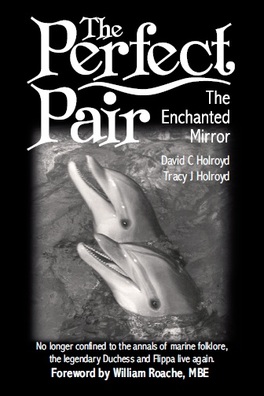
Book Review: “The Enchanted Mirror”

5618264

Book Review: The Perfect Pair, Book I: The Enchanted Mirror. 

 David C. Holroyd and Tracy J. Holroyd. 2012, Matador Press.

Reviewed by Malcolm J. Brenner

Being a dolphin trainer looks like a glamorous job, as Ric O’Barry could tell you. He trained dolphins for the mid-1960’s TV show Flipper, which was dubbed into dozens of languages and became a world-wide hit. Rightly or wrongly, O’Barry now blames himself for the current plague of dolphin exploitation, including the proliferation of swim-with-dolphin facilities and oceanariums that are pillaging wild populations.

In reality, dolphin-training is a difficult, demanding, often-dangerous job that is guaranteed to break your heart. The “why” becomes obvious in The Enchanted Mirror, the first book in a trilogy chronicling the career of one “David Capello,” the stage name of a dolphin trainer who worked for an unnamed entertainment company in 1970’s England.

Is the book fiction or a memoir? I’m not quite clear. The foreword writer describes it as “a true story,” but co-author Tracy Holroyd, who wrote it with her brother David, told me they fictionalized Capello’s story for legal reasons (like I did with my human-dolphin love novel Wet Goddess). Does it matter? No, because his story reflects what former trainers like O’Barry and SeaWorld’s John Hargrove have revealed about the job.

We open with Capello in the middle of a performance with Duchess and Herb’e, his “perfect pair,” two dolphins who can synchronize their moves flawlessly, and we find that he’s directing them by… thinking? Flashback to Capello, a callow 17-year-old, hearing his mom suggest he apply as an assistant at a dolphin show. Although disinterested, he somehow gets the job and goes to work at a training facility, improbably located in a grimy coal-mining town.

The first reality Capello encounters is unwanted animals: a pair of messy penguins and a dangerous sea lion. He gets so friendly with the pinniped that, after a drunken binge, he ends up sleeping in its cage! When confronted by an irate local whose parking space he’s taken, Capello experiences weirdness: the sea lion comes to his defense. “For the oddest moment,” he relates, “it seemed as though I were looking in a mirror; then I felt all my aggression seeping away and saw it – actually saw it – filling up those big green eyes.”

This is the first time he experiences what he calls a connection with other species, and when the first pair of dolphins show up for training, the feeling is amplified.

“Aren’t you beautiful? I thought. I reached out and, as my hand made contact with this strangely different creature of the sea, my nervy excitement began to dissipate, leaving in its wake a sense of peace and calm. I felt something: a connection of some kind that made me feel light-headed. It was as if she was stealing my strength, leaving me feeling weak and disoriented, yet I couldn’t break free of her spell. I was totally and utterly captivated.

“This animal was giving off some serious vibes.”

Here, Capello joins a very select group of humans, including me, O’Barry, New Zealand trainer Frank Robson, former U.S. Navy scientist Michael Greenwood and a few others who claim to have been touched by the dolphins in a remarkable way: mentally. But let us leave this improbability momentarily to continue Capello’s story.

By this point all the major forces are in play which will, I suspect, carry the story through three volumes. Capello rapidly becomes very possessive of Duchess and Herb’e, thinking of them as his dolphins, when in reality they belong to the megalithic company that issues his paychecks. The fact that other trainers can’t get them to perform makes no difference. Young, hard-working and sometimes just dumb lucky, Capello soon finds himself running the dolphin training operation and confronting all the problems which the commoditization and exploitation of sentient non-human species creates.

When the “perfect pair” aren’t up to performing eight shows on holidays, a second team of dolphins must be imported, one of whom turns out to have been traumatized in capture. Capello describes in agonizing detail the enormous stress of capturing her twice a day and trying to force-feed her. When the filtration system can’t handle the amount of waste in the water, he risks the wrath of management by dumping the tank and refilling it. When the show finally opens to the public, a woman trainer steals the limelight by disrobing for the cameras of the Fleet Street tabloids… and so on.

During all this time, Capello also recounts the colorful and sometimes creepy people he roomed with. He recalls his work as a trainer so clearly and vividly that I wonder if he kept a private journal, or had copies of the individual dolphins’ logbooks to work from.

Capello ends The Enchanted Mirror with himself ascendant, Duchess and Herb’e working as the perfect pair and a second duo, including one unfortunate dolphin blinded in shipping, as back-up performers. He feels on top of the world until he learns that a third pair of dolphins are being sent to him for training… a couple ominously known as Bonnie and Clyde.

Stand by for Vol. II: The Mirror Cracks.

Fiction it may (or may not) be, The Perfect Pair is one of the best and most authentic books I’ve ever read about the realities of dolphin training. The Holroyd siblings manage to convey all the aspects of the job, be they boring, funny, horrifying or wonderful. Although their writing is very good, I had a couple of minor quibbles. While most of the story is told in past tense it occasionally shifts into present tense, Capello talking to himself during the more extreme chapters. Tracy Holroyd described this as a deliberate technique to engage the reader, but I found it disconcerting. Also, a disturbing scene of some poltergeist-like nocturnal activity in the oceanarium raises questions that aren’t answered in this volume.

Historically, tales involving human-dolphin interaction don’t end well for the dolphins. This goes all the way back to Pliny the Elder, who in the 1st Century CE wrote in amazement of a dolphin who visited the now-Tunisian city of Hippo Diarrhytus. Alas, the creature’s friendly nature attracted many wealthy visitors. “At last, the vexations that were caused them by having to entertain so many influential men who came to see this sight, compelled the people of Hippo to put the animal to death,” Pliny wrote. So, while I have a dark feeling about how the Holroyds’ telling of Capello’s tale will end, fascination and professional interest compel me to continue. Ignorance is not bliss, particularly when you’ve gotten as close to one of these creatures as I have.

And what about that mysterious feeling of “connection” that Capello describes, the ability to train and direct dolphins with his mind? This is one of those things that gets discussed in back rooms at marine mammal conferences.  A lot of trainers report it; I know, because I’ve spoken to some. Scientists generally dismiss telepathy and other such paranormal phenomena as preposterous notions, the product of superstition or delusions. Well, I may have been stoned when I was communicating with my dolphin, Dolly, but I’m not stupid. I doubted the experiences at the time and thought I was literally going crazy later on, but it turns out I wasn’t: I’m not the only one who’s had a dolphin get into his mind.

I can’t begin to explain how they do it, but consider this: We humans have been in our present form on Earth, Homo sapiens, for about 150,000 years. That’s not even a blink in time. Dolphins, on the other hand, have been in their present form for at least 12 million years, or 80 times longer than we have. They not only have a vast history of survival, but they’ve been self-aware all that time and able to explore their consciousness. Isn’t it possible they’ve figured out some things about mind and the nature of reality that we haven’t?

The Perfect Pair will give you one man’s insight into their world as he encountered it, but if you find yourself buying the whole trilogy, don’t say I didn’t warn you!

(Malcolm J. Brenner is the author of the 2010 novel Wet Goddess: Recollections of a Dolphin Lover and two other books. He lives in Punta Gorda, Fla.)

The Perfect Pair homepage


An Interview with Malcolm J. Brenner, by David Jay Brown

DavidJayBrown


(David Jay Brown is known for his research into, and writing about, psychedelics and human consciousness expansion. He’s the author of numerous magazine articles and 15 books, including 2016’s Dreaming Wide Awake and his most recent, Women of Visionary Art, with co-author Rebecca Ann Hill. The interview was conducted by email.)

I interviewed Malcolm on August 20, 2014. He appears sincere and is eager to share his unique story with the world, and spread awareness about dolphins. We spoke about interspecies communication, telepathy, what people can learn from animals, and what its like to have sex with a dolphin.

David: What inspired you to write Wet Goddess?

Malcolm: I was inspired to write Wet Goddessby my six-month love affair with “Dolly,” a 400-lb female bottlenose dolphin who lived and worked in a small amusement park near Sarasota, Florida in the early 1970’s.

At the time, Dolly was the only dolphin outside the U.S. military who was trained to work in open water and reliably return to captivity. Her part of the show was to swim alongside a moving riverboat and jump for fish.

ch02-3SM

(Photo by Malcolm J. Brenner)

It struck me as an astonishingly athletic performance, and I found myself wondering why she bothered to return to the little sea-level pen where she was apparently bored and lonely much of the time.

When I learned of her death (spoiler alert), I wrote the book to commemorate her life, which otherwise would merely have been another untold story of the thousands of dolphins who have died in captivity, entertaining human audiences for corporate profit.

I also wrote the book because I felt partially responsible for her death, and I needed to make a confession and get my guilt off my chest.

Life had handed me an extraordinary story about a series of rare and remarkable events. Information theory says that the rarer an event is, the more information can be extracted from it, so I figured my experiences should be valuable to someone.

Finally, the public’s image of dolphins is largely shaped by conservative science and corporate oceanarium ($eaWorld) image-making, which promotes them as compliantly serving their human masters.

I had found them to be anything but that, they have minds of their own and can think for themselves! This was so startling to me, and the conditions of their treatment so unjust, that I felt I had to write about it as part of my personal ethics.

David: What is your philosophy regarding interspecies communication and interspecies love?

Malcolm: Not being a philosopher (I am by trade a reporter) I’m not sure I have anything as sophisticated as a philosophy regarding interspecies communications and interspecies love. The two are different things that do not necessarily go together. (So I think you have confused these two questions.)

Regarding interspecies communications, we are, or should be, talking science. In the 21st Century we find ourselves living on a strange planet with not one, but at least two pinnacles of evolutionary intelligence, the humans and the toothed whales (possibly more – elephants, mockingbirds, parrots).

The anatomical and behavioral evidence of a high degree of awareness, communication and cognition in the toothed whales is simply at this point irrefutable. And what are we doing with them? Enslaving them, murdering them, turning them into fertilizer and cat food, trashing their environment.

My sense of social justice, which compels me to defend the weak and helpless, is outraged beyond imagination. There is also a profound and terrible sadness that we as a species do not reach out to these creatures. As humans, we tend to flounder in our own humanness. We assume we are the only self-aware creatures out there, the only ones with a moral sense of right and wrong, the only ones aware of our own mortality.

I think the dolphins prove us wrong on all those counts. If we could communicate effectively with another, sufficiently different species, we could learn so much about ourselves through the comparison. We might just learn what it really means to be “human.”

When we talk about interspecies love, we are also talking about communication, but on a whole other level. Obviously, communication can and does exist outside of love; we do not love everyone we communicate with on a daily basis.

Interspecies love comes in a wide range of degrees of involvement, from a young girl whose room is decorated with horses to a rider who thoughtfully cares for horses in a stable to a man who has sex with horses in a loving or tender manner.

What this shows is that in English, “love” is a very sloppy word with a lot of imprecise meanings. What’s truly unfortunate is that as soon as interspecies love gets sexual, we enter the realm of bestiality, and in many places the law rears its ugly head. Right now, most bestiality laws are predicated on the false, biased assumption that to have sex with a non-human animal is to automatically abuse that animal.

This is no more true than a similar blanket assumption about a human partner would be. Most people have a reflex, kneejerk reaction to bestiality which leads them to assume that it’s automatically abusive and that a nonhuman partner “can’t give consent” because they don’t speak our language. This is patently false, because under natural conditions animals engage in courtship, which is the process of selecting and vetting a mate and obtaining non-verbal consent for the mating.

Unlike humans, mating animals (for the most part) don’t know they’re reproducing. They’re not consciously looking for the mate with the best survival characteristics, they’re looking for a mate who is going to get their rocks off, who is going to give them the best chance for an orgasm.

Often, a motivated human can perform that sexual function as well as a partner of the same species, with or without love being present. The animal partner in an act of consensual bestiality is only concerned with sexual gratification, not what species its partner is.

What’s important in any type of love is respect for the beloved. Simply put, mature love does not exist without mutual respect. Respecting and loving a sex partner of another species raises the sexual act from mere bestiality to zoophilia.

When you are in a zoophilic relationship, you actually accept responsibility for your partner to a greater degree than you do with a human lover; it’s just the same as owning a pet, which cannot adequately care for itself without human help.

When you respect your non-human partner, you acknowledge that its needs and desires are not your own and you take responsibility for them. If you’re a zoophile man, you’re only going to approach your non-human partner sexually when she’s in heat, unless she indicates otherwise. (Some female animals can and do solicit sex outside of the estrus cycle.)

I think most people wrongly see female animals as passive, when in reality they are receptive, active participants in sex with just as strong of a sex drive as a male animal. If you’re a male zoophile, you don’t rape, and you probably couldn’t, because you wouldn’t be able to get an erection– that rapist’s sense of violation, violence and domination isn’t what’s motivating you.

The law allows you to kill an animal in a humane way for food, and punishes you for killing an animal in an inhumane way or injuring it without cause. The law ought to treat sex with non-human partners the same way.

Crimes against animals ought to be based on actual actions that cause demonstrable harm, pain and suffering, not on vapid moral prejudices or Biblical declarations. I would like to see blanket laws against bestiality repealed where they already exist, to be replaced with stronger and more precise laws against animal cruelty.

David: What are your thoughts on telepathy?

Malcolm: If I had any thoughts on telepathy, how could I be sure they were my own? All kidding aside, I am unsure what to think about telepathy. As I understand it, the scientific evidence for it is not substantial.

In spite of that, I feel like I have been able to communicate telepathically with other species on several occasions, the experiences with Dolly being the most profound and longest-lasting of those events.

So I experience some cognitive dissonance here. It seems to me that nothing in information theory (what I know of it, anyway) makes it impossible for the same datum to arise in two places at once. This is what telepathy feels like to me, it feels more like a shared, simultaneous awareness than data traveling from point A to point B, with or without a physical medium of transmission being invoked.

Of course, I am talking about at least three different things I experienced here under the label of “telepathy.” One was this awareness that my thoughts no longer seemed to be my own, that another personality, Dolly, was sharing my consciousness, and that I could enter into “conversations” with her.

The second experience was while Dolly and I were actually, physically making love. It felt like our separate consciousnesses had merged into one and we were aware of the pleasure we were sharing.

The third “telepathic” event, which was terrifying, was this dream that awoke me some nine months after the sexual experience with her, while I was going to college in Washington state. In that dream, I got a very clear image of dolphins dying in a peculiar environment.

Dolly died around the same time, and when I visited the oceanarium where she died, there were remarkable similarities to the dream environment. So in some way, information got transferred between us in a symbolic but realistic form. I don’t pretend to know why or how, but in some way that dolphin and I were entangled on a mental as well as a physical and emotional level.

What throws doubt onto the first set of experiences as genuine telepathy was that they continued even after I knew Dolly was dead. I suppose this isn’t surprising if you believe in some murky concept of an “afterlife,” but I don’t.

My mental plasticity allows for the possibility of telepathy between living beings but not for channeling the dead. (Nobody has ever been able to explain the ecology of the netherworld to me.) So again, I have these paradoxes that I really cannot dismiss or ignore, but I cannot get myself to buy into them like a “true believer” would, whole-heartedly.

Do these paradoxes make Wet Goddess a better story, from a literary point of view? I don’t know, but I feel it would be dishonest to disregard or skim over them in an attempt to make some kind of point.

I have had fleeting telepathic experiences similar to the ones with the dolphin (but much less extensive) with other animals: a dog in a park, a hummingbird, a small wild bird of undetermined species, a praying mantis. They seem to happen at random.

I also had a very similar shared-mind experience happen while performing a Wiccan ritual, when a deity was “drawn down” into me by a priestess. There was a very peculiar sense of “me” being quarantined, as if in a fish bowl, while the Egyptian god Thoth manifested in me. Fortunately for me he was benevolent and the experience was benign.

If telepathy is real, it seems to me that it is not a spiritual thing but a genetic inheritance, the same as the color of one’s eyes or hair. Some people have it and some people don’t, and if you don’t have it you can’t somehow develop it, sadly.

This makes it very difficult to explain the experience to people who don’t have the capacity for it. It’s not that spirituality makes you telepathic, it’s that being telepathic pretty much forces you to confront some spiritual realities.

David: What do you think dolphins can teach people?

 Malcolm: I know dolphins can teach people how to make love with them because I was the successful graduate of six months’ lessons! What I don’t know is why.

I know that dolphins can teach us how to imitate them vocally, the same way we try to get them to squawk on command. Dolly also taught me quite a bit about play and playfulness, because I am a very tightly wrapped person.

Aside from that, which I know, I believe dolphins could also teach us a lot about themselves, their culture, and about their environment, the ocean. I suspect that they might be able to teach us quite a lot about ourselves as we compare our culture to theirs.

I do not think dolphins are Zen masters or paragons of virtue swimming around in the ocean. They do some things, from rape to murder and infanticide, which seem quite heinous to me. So I do not think they can teach us about “Universal Love” or any of that nonsense.

I don’t believe dolphins have the Secret of the Universe, any more than we do. What they do have is a different way of experiencing the world. Just encountering that alone, with them on equal terms, could shatter a lot of our introverted, twisted, dominant human paradigms.

David: What is it like to have sex with a dolphin?

Malcolm: Well you know, I spent a whole chapter of my book answering this question in great detail. I would really prefer not to cover that ground again. If somebody wants to find out, they can read my book!

But what I can say, in response to your question, is that my experience, with its deep spirituality, may not have been typical. I have spoken with two other men who have had sex with dolphins, one of whom convinced me by showing me a videotape of the event.

They said the sex was very good and that the female dolphins involved were very gentle and loving, but they didn’t describe this kind of profound sense I had of merging with the dolphin on every level, mental, physical, spiritual. I’m pretty sure they hadn’t fallen in love with their dolphin partners the way I did.

Also, there may be a difference in the position. The video showed the dolphin and man making love lying on their sides on a beaching ramp. This would seem to inhibit freedom of movement to me. Whereas Dolly and I made love in the water, swimming freely, which gave her almost complete control over the experience.

I really had to surrender to her. To answer your question succinctly, it was like making love with the whole goddamn ocean.

David: How did your psychedelic experiences affect your love affair with a dolphin?

 Malcolm: I don’t know how psychedelics affected my experiences with the dolphin. I was smoking a lot of pot at the time and that seemed to modulate or inspire these “telepathic” encounters with her where I felt we were sharing a lot of information.

I’d smoked some pot just before we made love, and I’m sure that heightened the experience. I’d taken psychedelics for the first time in 1969, when I was a freshman at New College, that was the year before these experiences with Dolly started.

I wasn’t taking a whole lot of LSD-type psychedelics at the time, because frankly I wasn’t having a lot of good experiences, like my friends were having on the same drugs, and I was wondering what was wrong with me.

I think psychedelics were teaching me that the world is, up to a point, our definition of it, but I hadn’t learned that lesson at the time. Really, I think that most of what I learned came from the dolphin, and not from my psychedelic experiences.

David: How did your romantic experience with a dolphin effect your perspective on marine mammals and other highly evolved, nonhuman life forms?

Malcolm: Nowadays, it makes me want to stop Japanese dolphin hunters, for one thing. I experience almost unbearable sadness and rage during the dolphin-hunting season, which lasts six months.  I’m not particularly enlightened about this. I don’t think the dolphins are “going to a better place,” I’m just shocked and outraged by the brutality they have to endure.

It’s like watching my in-laws being slaughtered, and standing around helpless. The problem there, of course, is not the hunters, who are simply providing product to a burgeoning number of dolphin exhibits in Asia, mainly China.

The problem is the people who go to dolphin shows. Nobody eats dolphin meat anymore, the stuff is toxic. It’s the oceanariums that are driving the drive hunts. Humans love dolphins too much in the wrong way, we love them to death.

As regards how my experience affected my perspective on marine mammals, needless to say I don’t go to oceanariums any more, they’re just dolphin jails to me. It took a surprisingly long time for me to reach that commitment, however.

The last time I was around dolphins was 2005. I used a small inheritance I’d received to go to the Bahamas, where I went swimming with a pod of wild dolphins. Due to weather we only saw them one day out of a week, but it was redemptive.

One dolphin swam right up to me and stared at me. I felt a sense of absolution, like my sins in regard to Dolly had been forgiven. Unlike going to an oceanarium, which is an oppressive experience, this was liberating. I was thankful. And then the dolphin swam away, which is more than she got to do.

David: How did your meeting with the late neuroscientist John C. Lilly affect your perspective on dolphins?

Malcolm: You’ve got it backwards, my experience reading John Lilly was what got me interested in dolphins. As a child growing up at the dawn of the Space Age, I read a lot of science fiction and was fascinated by the possibility of extraterrestrial intelligence.

When Lilly first began proposing that we could communicate with dolphins as a precursor to communicating with extraterrestrials, I was very excited. I didn’t have a very well-developed sense of ethics at that age, so I just glossed over his dreadful early brain experiments on dolphins, the ones that upset everyone else so much.

I finally got to meet Lilly when I was on the West Coast, attending Evergreen State College. As described in Wet Goddess, that first meeting was rather underwhelming and confusing. It came at the end of a long day when all sorts of people had been through his house, and I didn’t know him well enough to really open up and discuss my sexual experiences with him or his wife, Antoinette Lilly.

Later, I attended a weekend workshop with him and Toni in New York state, and for the first two days, Toni mistook me for one of the staff! But Lilly said the interview I did with him for Future Life magazine was the best anyone had done with him, up to that point.

My perspective on dolphins had been pretty well established by the time I met Lilly, so I don’t think our meeting in person affected it very much. Later on, when he started the JANUS project, I was sad that I couldn’t work with him, but I didn’t have the requisite skills or resources. Turned out, neither did he, and the experiment went no place.

David: Do you think dolphins can attain high levels of spiritual awareness?

Malcolm: I think dolphins exist in a high level of what we would call “spiritual awareness” all the time. Their oceanic lifestyle requires it of them.

For one thing, the dolphin lives in a truly three-dimensional world, where danger or opportunity can come at you from any angle, whereas humans live primarily on the flat surface of the earth and operate in two dimensions.

Very few things in nature attack us from above, and almost nothing serious attacks us from below. Most of our predators are either extinct or in zoos. Whereas the dolphins live in a world of real monsters, sharks, killer whales and squid.

A dolphin’s echolocation provides it with its own illumination. A dolphin is constantly making its own “light,” in the form of ultrasonic sounds, which it uses to “illuminate” the objects in its environment.

What our eyes do passively with light, a dolphin does actively with its hearing and sound-producing organs. The dolphin can, of course, vary the intensity, wavelength and beam coverage of the sound as dictated by the needs of the circumstance.

So imagine if we went around in the world, and we had these flashlights on our heads that could change brightness, color and zoom in or out. That’s the visual equivalent of what the dolphins can do voluntarily with their bio-echolocation.

Then there’s the whole sleep thing. Dolphins don’t sleep like we do, they have to rise to the surface to breathe every few minutes or so. For them, breathing is a conscious act of will, there is no involuntary breathing reflex the way there is in terrestrial mammals.

This raises the question, how does a dolphin know how long it can hold its breath without going unconscious, but let’s not get into that here. The need to breathe while sleeping requires that the dolphin sleep with only half its brain at a time.

While the left hemisphere is slumbering, the right hemisphere is keeping one eye open for sharks and remembering to breathe, and vice-versa! What this means is that dolphins’ dreams and reality must overlap, since they are dreaming and awake at the same time in opposite brain hemispheres.

In addition, it was recently found out the mother bottlenose dolphins go without sleep for the first month of their newborn calf’s life! That would kill most normal mammals. They’re constantly awake and alert, making sure the calf doesn’t get into trouble, and this goes on until they can hand the calf over to a babysitter and catch a bit of shuteye themselves.

A bottlenose dolphin can dive down to 1,000 feet (300m) and come up again in less than 10 minutes. At that depth, the external water pressure is so great that its rib cage collapses, but the dolphin has evolved to survive this experience.

Just the difference in environment between the surface, which is where two or three elements meet, and the depths, where there is absolute darkness and profound differences in pressure, temperature and sound, means the dolphin’s consciousness must readily adapt to these different realms.

And a lot of this stuff isn’t instinctual, it’s learned. So I think that by the nature of their oceanic lifestyle, the dolphins must have a profound knowledge of consciousness and how it relates to reality.

They have to have an acute awareness of their world just to survive in it, and if my experience is any indication, this also includes an awareness of love and what we would call the tender emotions. Attachment, I think, is the clinical term.  Certainly, they can become very attached to each other, and to us as well.

David: What can people do to increase their understanding of dolphins and help to protect them?

Malcolm: You don’t increase your understanding of dolphins by seeing them perform stupid tricks in an oceanarium, I’ll say that for starters. What you see is what former Flipper trainer Ric O’Barry has dubbed “spectacles of domination,” humans forcing dolphins to perform unnatural behaviors in synthetic environments.

That teaches you nothing about how dolphins live in the wild. To appreciate that, you have to be able to observe dolphins in the wild, or read about it from authors who have researched it. One of the best books I know about working with dolphins in a scientific context is Carol J. Howard’s Dolphin Chronicles.

There must be other good, current books out there about dolphins’ lives, but I don’t know what they are. I doubt if many of them speculate on the awareness or spirituality of dolphins, though. Those seem to be taboo subjects since Lilly passed away. It doesn’t mean they don’t exist, though.

Help protect them? First thing, stop patronizing dolphin jails. Stop going to commercial aquariums, especially those in foreign countries that buy dolphins from the Japanese slaughter industry. Countries that have no Marine Mammal Protection Act.

The only good thing I can say about a place like SeaWorld is that they breed their own dolphins, so they don’t need to capture any more from the wild, which is traumatic for the individual and devastating for the population.

But a dolphin raised in a concrete tank isn’t able to dive or swim or echolocate like a wild-born dolphin can, so in my opinion the dolphins born in captivity aren’t real dolphins, they’re look-alikes. I dub them “Tursiops homunculus,” the warped little man of a dolphin.

Second thing, it would be nice if fishermen would quit leaving gobs of monofilament and fishing lures in the environment. It seems like every year or so we read about yet another dolphin getting tangled in fishing line, and then the Florida Fish and Game people and some local research and conservation organizations have to get out and net the poor dolphin before the fishing line cuts it in half and untangle it.

People could stop leaving trash on the beach, by the seaside, or along rivers and creeks where it will wash into the sea. Stop feeding dolphins! Yes, we have dolphins down here in Florida who solicit humans for food, and we have people stupid enough to feed them.

It’s dangerous for both the dolphin and the human. The dolphin may get sliced by a boat propeller, and the humans may get hurt if the dolphin doesn’t like the ham sandwich or banana or whatever else they’re feeding it. Dolphins evolved to eat raw fish and squid, not the food we eat.

Don’t run over them in boats! Dr. Randall Wells, who has been studying the dolphins in nearby Sarasota Bay for more than 40 years, has calculated that based on the number of boats that use the bay, a wild dolphin has a boat come within 100 meters of it every six minutes during daylight hours. It’s like living on a freeway.

On a larger scale, we need to stop polluting the dolphins’ environment. Dolphins are near the top of the food chain, so toxins like mercury and PCB accumulate in them. In many populations, female dolphins are so polluted that their suckling young die from toxins in the mothers’ breast milk.

The dolphins slaughtered in Taiji have so much mercury in them they actually violate Japanese food law, but there’s a loophole that allows their meat to be sold and even used in children’s school lunches. It’s sickening, literally. Finally, we need to understand them.

I suspect there’s a lot going on with the dolphins that the scientists simply do not understand because they can’t imagine it, their scientific discipline simply doesn’t give them that luxury. Or if they do imagine it, they can’t talk about it because they’ll lose their research grants.

David: What are you currently working on?

Malcolm: A pair of Miami filmmakers, Joey Daoud and Kareem Tabsch, who want to make a documentary about my experience with Dolly, contacted me a few months ago. According to them, it will contrast my opinions about my experience with those of scientists and animal-rights activists. I feel a little uncertain about it, but I’ve met them and they seem like a couple of pretty reasonable guys, so I trust them.

By the time your readers get this, I will have published a second book, this one a memoir titled Growing Up In The Orgone Box: Secrets Of A Reichian Childhood.

In the 1950’s, my parents were followers of the mad scientist Dr. Wilhelm Reich, who claimed that orgasms were the key to mental and physical health. If you just know a little about Reich that sounds kinda groovy and all, but in reality it led to a series of terrifying, painful encounters with a close associate of Reich’s who sexually molested me and hundreds of other children sent to him for “orgone therapy.”

My family suffered from mammoth dysfunctions that eventually destroyed it, and this book chronicles how Reich and his bogus, pseudo-scientific crap utterly failed us.

Finally, I am writing a third book, Mel-Khyor: An Interstellar Affair, a novel about a woman’s UFO experience back in the late 1970’s and how her husband’s discovery of it affects their relationship.

David: Is there anything that we haven’t spoken about that you would like to add?

Malcolm: Everybody seems to think of me as “the guy who had sex with a dolphin.” Some people aren’t that discrete. That isn’t what’s important, though. If I had just banged a dolphin to get my rocks off, like some farm boy banging a goat, I would never have exposed myself the way I have.

The fact is, however, the dolphin reached out to me in emotional and intellectual ways that I never anticipated, and we fell in love with each other. That’s the primary reason why I wrote Wet Goddess, to commemorate what undoubtedly has to be one of the strangest and most moving love affairs ever consummated on this Earth.

Prologue

(Dolly, the subject of Wet Goddess. Photo by Malcolm J. Brenner.)

Book Review: “Wet Goddess” by David Jay Brown

DavidJayBrown


“I loved this book! Wet Goddess is the most compellingly written book that I’ve ever read about human-dolphin communication. I simply couldn’t put this fascinating book down.


“Malcolm J. Brenner’s thoughtfully and beautifully recounted odyssey, detailing his unorthodox romantic adventures with a wise and sexy 400-pound marine mammal–in the guise of fiction–is unlike any other book that I’ve ever read. Wet Goddess is simply overflowing with unusual insights and esoteric information: telepathic communication dialogues, psychedelic astral adventures, interspecies romance and truly unique eroticism.


“This mind-shattering book made me question what it means to be human, just how boundless love can be, and what an outrage it is that our species keeps dolphins in captivity, and treats them like slaves, for money and amusement. Dolphins have larger and more complex brains than we do, and they appear to be more evolved than us in numerous ways.


“Wet Goddess belongs in every human-dolphin communication researcher’s library, right next to John Lilly’s and Diana Reiss’s books–as Brenner’s personal experience with a female dolphin lover is every bit as instructive as any scientific data. Animals have been carefully studied by biologists in laboratory settings, and by ethologists in the wild–however, the human-animal love-trust-communication bond has rarely been researched, and that is why this book has such tremendous value. It’s also a wild and wonderfully entertaining story to read.


“Funny, sad, and enlightening, Brenner’s novel has the uncanny ability to suck you into his mind with his carefully chosen words, and after reading this remarkable book, this heart-wrenching love story, you’ll never see the world quite the same again.”


David Jay Brown, author of Mavericks of the Mind,  The New Science of Psychedelics and other books on human consciousness expansion.

With some effort, dolphin-human love story regains its lost “Premium” status

It's a book cover, dudes! MY book cover!

PrimeStatus

PUNTA GORDA, Fla., USA – “The role of the self-published author is not an easy one,” Malcolm J. Brenner said, sliding onto a dingy leather couch that might have once been white.  “In addition to successfully writing one’s magnum opus, one must also bring it forth into the real world, where it will grow up to compete in a ruthlessly Darwinian struggle for readers and reviewers.”

Brenner sipped iced tea – his habitual summer drink, with the occasional hard cider thrown in for historic, recreational and religious reasons – and relaxed. He had the furrowed brow of a man who has a lot on his mind, and no wonder. He recently finished re-formatting a 113,000-word Microsoft Word file for the ebook version of his most famous, or infamous work, the 2010 autobiographical novel Wet Goddess: Recollections of a Dolphin Lover.

“It’s basically a re-telling of a torrid love affair I had with a female bottlenose dolphin in the summer of 1971,” Brenner explained.  “I just changed the names and a few details so that living people on whom the characters are based couldn’t sue me.  Even though I’m publishing it as a novel, it’s much closer to Tom Wolfe-style ‘new journalism’ than it is to fiction.”

Author Malcolm J. Brenner at home.
Malcolm J. Brenner in his trailer in Punta Gorda, Fla.

An admitted procrastinator since childhood, Brenner said that Smashwords, which publishes and distributes the ebook edition of Wet Goddess, alerted him last November that changes to their Premium Catalogue distribution system might require revising the file, which he first uploaded in 2011.  “I wasn’t clear on the details of what exactly the problem was, but apparently the old file no longer satisfied the new requirements, or so they said,” he said.

The Smashwords Premium Catalog puts the book into the hands of all the large ebook distributors, including iBooks, Barnes & Noble, Kobo, Scribd, OverDrive, Tolino, Gardners, Odilo, Baker & Taylor Axis 360 and more.  “I’m interested in sharing my experiences with dolphins as widely as possible,” Brenner said.  “They are non-human people, so it behooved me to take care of this update issue sooner or later.”

After receiving warning emails for several months, Brenner finally pulled up his socks and tackled the problem himself.  This versatility, he said, demonstrates the technical virtuosity required of successful self-published authors in the 21st Century.

“If you’re an aspiring author and you’re lucky enough to land an agent or a publisher these days, you can thank a higher power,” Brenner scoffed.  “I knew a controversial book like Wet Goddess would be a hard sell even for a successful author.  I made a few stabs at finding a publisher without success, and an agent took me on for a while.

“She wined and dined me once at a book fair in Tampa, then, with no explanation, stopped communicating.  Months went by with no word.  It was only when I threatened to sue her to recover my manuscript that I learned from an irate family member she was still recovering from a near-fatal car crash months before.

“In publishing, like anywhere else, sometimes shit just happens,” Brenner concluded, with a hint of resignation.  After more rejections, he responded by abandoning the idea of conventional publishing and taking on all the tasks himself.  “It required me to become a jack-of-all trades, but the fact that I don’t get along well with many people actually makes that a good way to work,” Brenner admitted.  “If I work for myself, I may have an asshole for a boss, but at least he understands me.”

Brenner pre-sold copies of Wet Goddess to family and friends to raise funds for the initial press run of 50 copies.  A sympathetic friend contributed necklaces made from fossilized sharks’ teeth as premiums for advance sales.  The worst problems came from trying to get the manuscript proofread before it went to print.

“Don’t get me started,” Brenner fumed.  “I hired a so-called proofreader from a local community college, but she could only proof in academic style!  Book manuscripts require what’s known as Chicago style, and besides, Wet Goddess has a lot of colloquial dialogue in it,” he recalled.  “Every time a redneck character used the word “ain’t,” she flagged it – more than 300 times in the manuscript!  You’d think that if she was professional she’d have called me up and asked me what my intention was, but no.”

As a result of this and other unforeseen difficulties that cost him the original author’s proof copy of his debut novel, the first press run of Wet Goddess shipped with about 250 typos in it, including one whole, and rather crucial, paragraph repeated, Brenner admitted.

“It appears very close to the, uh, shall we say ‘climax’ of the novel, and it was very embarrassing to find it,” he explained.  “I hope I’ve got it stuck back in the right place now.”

For a cover, Brenner was able to rely on the talents of his daughter, Thea Boodhoo, an advertising industry professional and college-trained artist.  “I was going to use a B&W photo of a dolphin that a friend in New Mexico colorized many years ago,” he said, “but Thea thought she could do better, and when I saw her finished work I knew she was right.  I only made a couple of very minor Photoshop changes to the file she handed me to make the title stand out more and add the subtitle.”

wet-goddess-cover

A friend who owned a small desktop publishing business referred Brenner to Royal Palm Press, a nearby print-on-demand company, for production services.  “I had no idea what the local reaction to the book would be, so I had a chat with Tom Lewis, the press’s owner at the time, to make sure he wasn’t blindsided,” Brenner said.  “Tom said ‘As long as it’s between consenting adults, that’s fine with me,’ and that was that.”  Brenner also served as his own layout artist, an experience he described as “a mad blur of on-the-job training.”

With book in hand, Brenner ventured onto the soggy ground of marketing.  “Here, I got terrifically lucky,” he said.  “I didn’t have the money to hire a public relations firm to distribute a press release, but I found one that had a reverse-charge policy. The media outlets who received the press releases paid for the service, not me, so my initial publicity was free!”

Upon its release in January 2010, the novel received intense press coverage due to its taboo-shredding themes of interspecies sex, zoophilic love and a dolphin character smart enough to out-think a human.  “For a while it was frantic, but very gratifying,” Brenner recalled.  “I was doing several interviews a week, sometimes two a day.  A few of the interviewers were skeptical or harsh about what they thought might have been going on, but the majority were genuinely curious to know what happened, and to learn more about dolphins.”

Since then, the book has enjoyed sales surges whenever some news gatherer gets curious and wants to know about his experience, Brenner said.  One came in 2011, when a New Zealand TV producer, David Farrier, released a videotaped interview with Brenner he’d recorded the year before.  Others don’t conjure such pleasant memories.  Brenner felt humiliated by shock-jock Howard Stern’s 2015 obsession with his zoophilia, and a 2011 interview with Bubba the Love Sponge cost him a gig with a local slick when its advertisers threatened to withdraw unless the magazine dropped him.

Brenner’s most recent foray into the murky waters of self-promotion was somewhat less melodramatic.  “When I finally got around to looking at the Smashwords file, it said there was a problem with one of the book’s photos, but I couldn’t find it with a self-diagnostic program they offer,” Brenner said.  “So I took a chance and asked Smashwords’ customer service, citing the warning notices they sent me.”

He quickly received a courteous reply from a guy named Kevin, explaining that the problem was probably due to the use of colons in his chapter titles and sub-sections.  “I was glad it was so easily resolved,” Brenner said, “until I downloaded the file onto my computer to make the corrections and realized what a mess it was.”

In the interim between uploading the file in 2011 and downloading it in 2018, Microsoft had changed Word and given it a new file extension, .docx instead of the original .doc.  “That one little ‘x,’ unfortunately, made a hell of a lot of difference,” Brenner said.  “When I had to add a couple of pages to the print manuscript of Wet Goddess, converting the book from the old to the new file format inserted blank spaces more or less at random between paragraphs.  I had to start at the beginning and re-do the whole layout, including throwing in a couple of new photos to fill some yawning blanks.”

The problems with the ebook file were similar.  There, many words were unnecessarily hyphenated, and photos had to be re-aligned to make sure they didn’t obscure the text.  Brenner said the process took him about two weeks, including a couple of days off when he wasn’t feeling well, but he’s glad he did it.

“I don’t have the money to pay somebody else anyway,” he complained, “so I might as well do it myself, because being retired I do have a fair amount of time.  Besides, whenever I master a task like this, I improve my overall word-processing skills, which helps me find work in the freelance job market.”

In the eight years Wet Goddess has been in print, it has sold about 1,500 copies in 18 countries, mostly in the English-speaking world, due to Brenner’s unflagging self-promotion efforts.  When a fan in Russia contacted him  three years ago to inform Brenner he’d undertaken an unauthorized translation, the author responded by granting him permission to publish it there!  “It hasn’t taken off yet, because the translator, Anton River, lives in a very conservative northern city,” Brenner said.  “He’s planning to move to a better climate soon, and I hope he’ll renew his efforts to promote the book when he does.”

In addition to Wet Goddess, Brenner has written and self-published two other books.

orgone-box

Growing Up in the Orgone Box, published in 2014, is an unflinching memoir of his torture and sexual molestation at the hands of Dr. Albert Duvall, an “orgone energy” therapist and close associate of the late Dr. Wilhelm Reich, and the dysfunctional family structure that allowed this to happen.

mel-khyor-01-copy

His 2016 novel Mel-Khyor: An Interstellar Affair is a more light-hearted romp through the mythology and culture of the UFO scene, told from the point of view of a young woman determined to live up to her family’s expectations of her, no matter what it costs her personally.  “There is, again, inter-species sex, but since the other species is bipedal, mostly humanoid and obviously sapient, nobody should blow a 50 amp fuse over it,” Brenner said.  “After all, ‘Star Trek,’ Edgar Rice Burroughs and countless other science-fiction writers have only been doing it for about 100 years.”

Sales on these two books have been nowhere near those of Wet Goddess, Brenner said, and he’s had difficulty getting them any kind of publicity or reviews.  “That’s because, while they’re both sexually radical books, they’re not as radical as a man and a dolphin making love,” he said.  “Somehow, that just blows people’s minds.”

Having just turned 67, Brenner hopes to see his work more widely appreciated before he dies.  Asked if he thought his writing would endure beyond his lifespan, he waxed philosophical.

“My daughter might take it on, but she’s not planning to have children, so who knows what will happen over the course of time?  We only know of the Greek poet Sappho’s beautiful writing because it was used to wrap fish,” he noted.

“Let us remember that from the point of view of a book, which may endure for millennia if it’s an epic, humans are fleeting things who read it at some point in their limited lifespans, devoting to it some portion of their precious time,” Brenner said, drawing on an eerie theme reminiscent of the ambiguous Argentinian writer Jorge Luis Borges.  “For this reason, books, especially long-lived books like Epic of Gilgamesh, Tao De Ching and Cattle Raid of Ulster, are grateful for the time their readers spend with them.  The books try to compensate the readers through a symbiotic relationship that informs you with a novel set of ideas, or supports your need for entertainment that doesn’t require batteries, WiFi or 3D glasses.

“I think that we humans, as a species, have a lot to learn from our dolphin cousins,” Brenner concluded.  “As for my writings, they will survive if people find value in them.”

###

dolphinleapMED