Interview: John C. Lilly, M.D. (Part 1)

ch29#1

“YOUR GOD ISN’T BIG ENOUGH:”
An Interview with John C. Lilly

By MALCOLM J. BRENNER, FUTURE LIFE #20, August 1980

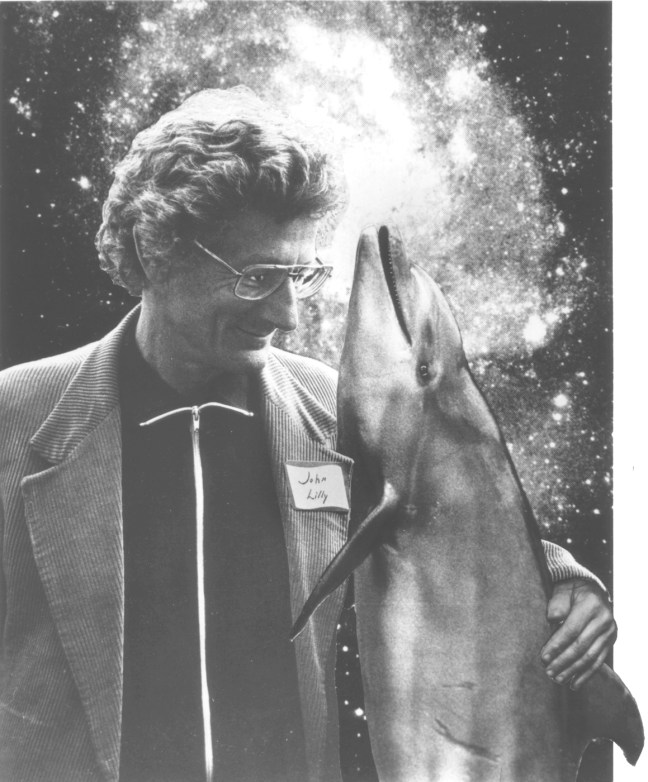
John Cunningham Lilly is that rare breed of scientist willing to talk openly about his belief in God—or, more precisely, his belief in his mind’s ability to simulate God with a reasonable degree of accuracy. An M.D. with psychiatric training, Lilly is best known for his sometimes controversial research on interspecies communications with bottlenose dolphins, a study he’s pursued for over 25 years (Man and Dolphin, Mind of the Dolphin, Lilly on Dolphins, Communication Between Man and Dolphin).

A self-described “permissionary” possessed of a sometimes dangerously insatiable curiosity about the workings of the human mind, Lilly has also immersed himself in sensory isolation tanks (Programming and Metaprogramming in the Human Biocomputer, The Deep Self), experimented with hallucinogens and Sufi mysticism (Center of the Cyclone), deep dyadic relationships (The Dyadic Cyclone with Antoinette Lilly), and explored the fringes of his own consciousness in The Scientist, a “novel autobiography. ” With Antoinette Oshman Lilly, his wife, partner and “soulmate,” he has started the Human-Dolphin Foundation headquartered in Malibu, CA.

Lilly is currently conducting tests at a California oceanarium on a new computer program designed to overcome the difficulties of human-dolphin communication, Project JANUS (Joint Analog-Numerical Understanding System). Dr. Lilly was interviewed during the Second Annual Mind Miraculous Symposium of the Church of Religious Science in Seattle.

MB: How did the sensory isolation tank work you did at the National Institute of Mental Health in the early ’50s lead you to the dolphins?
JL: I began that work at the National Institute of Mental Health, just wondering what would happen if you freed yourself up from a lot of external stimulation, and lowered all the inputs to the lowest possible level; what would happen to your mind under those conditions? It was just curiosity, just that sort of extracurricular activity one does in one’s general research; they didn’t even know I was doing it on my own time. I was working on monkey brains, and I’d go off to the tank and come back to the lab with a different perspective.

When they got wind of this, they asked me to get deeper into it. I was floating around in the tank in 1954 and started wondering about these things. I was beginning to find that my freedom of thinking was immensely increased, freed up from the necessity of temperature and gravity and light and sound and all that. There was this huge freedom of imagination, of experiencing things inside, which isn’t there any other way that I know of. And I was just wondering whether there wasn’t somebody floating around 24 hours a day their whole life who might be experiencing this all the time, and who would consider it absolutely normal.

So I began to talk to various people about dolphins, Pete Scholander and various others, and got interested. And then the brain thing came in, looking at their brains, seeing if the substrate for mind was there. And it was.
MB: When you were doing that early tank work, did you have any of the type of apparent “contact” experiences with other civilizations or creatures from other planets or dolphins you wrote about in Center of the Cyclone?
JL: No, there was a period there from ’54 to ’58, when I left NIMH, where the dolphin work and the tank work were overlapping. I began to see that the dimensions of mind were far greater than I’d been assuming they were, and were assumed by psychiatrists and psychologists. And I didn’t own up to it at the time it was happening. I didn’t own up to it until I was free to set up a tank in the Virgin Islands without all this government support and financing.

In fact, none of the tank work was ever directly supported by government grants; it was all done extra-curricularly. And I didn’t realize how important it was until I began to see how my thinking was changing as a consequence of these experiences, and the kind of vastness of the whole business. The mysteries of the mind… I was really immersed in them. And I began to see that the dolphin mind was probably far greater than our consensus reality allowed our minds to be. That’s why I want to communicate.
MB: In the early ’60s, you got a lot of publicity from media like Life and Newsweek, and there was a big surge of interest in the possibility of interspecies communications with dolphins. Did that make your work more difficult? Did it make other scientists more skeptical of you because you’d “gone public” before your results were confirmed?
JL: That was unplanned; the results began to come out in sources like The Journal of Acoustical Research & Engineering, and the media got interested. They were reporting on what we were doing; we weren’t seeking them. Now, as to what you mean by “other scientists,” I don’t know.
MB: Other marine mammalogists.
JL: Well, I’m not a marine mammalogist. Never have been. I’ve never been a cetologist or a delphinologist in the narrow sense that those people call themselves. I’ve never approached dolphins that way; I’ve always approached them from the standpoint of mind. They won’t even assume dolphins have a mind, so right off the bat we’re in entirely different domains of discourse. I’ve never felt that conflict they’ve felt; it’s their conflict, not mine.

MB: Between the period in 1968 when you released your dolphins and the beginning of Project JANUS, did you get discouraged about your dolphin research?

JL: Well, the time wasn’t right. The computers weren’t fast enough, small enough, and didn’t have large enough memories to do the job I wanted them to do.
MB: Between Aristotle in 350 B.C. and the resurgence of dolphin interest in the ’50s, due largely to your work, we have a terrible gap in our curiosity about these creatures. Why? How did we lose that closeness with the dolphins that the Greeks and some other ancient peoples had?

JL: The Mediterranean was much warmer in the time of the ancient Greeks, and they were much closer to the sea. And Aristotle was, I think, a kind of observing genius who got in contact with fishermen and people who were in close contact with the dolphins. And they must have had dolphins in captivity, caught in shallow pools or something like that, and they just were free with them, spoke to the dolphins, and the dolphins spoke back. It was this intimate contact, which we reproduced in experiments back in the ’50s and ’60s, which led to Project JANUS. In the modern oceanaria there isn’t much of this. It’s beginning, but it’s not there yet.
It’s shallow-water intimacy with the dolphins. Humans in deep water are pretty ineffective; dolphins in extremely shallow water are pretty ineffective, but you have to balance those two things together, and I think that just by chance the Greeks did that.
If you follow the history of humans since then, they got away from that, away from the sea. They stuck to deep water when they went to sea, and this tidepool thing just disappeared. The whole attitude—the belief systems and so on—were counter to it. The Jewish-Christian-Muslim ethic took over, and we totally moved away from that free-floating thing the Greeks had. The interest in dolphins as reincarnated humans and all that disappeared.
MB: One point Robin Brown makes in his book The Lure of the Dolphin is that, in terms of their morals and their scruples, the Greeks actually placed the dolphins above their own gods! One can detect a lot of the same thing in your writings—that there is a morality in the dolphins that prevents them from harming humans, under most circumstances.

JL: Ethics. It’s taught. The Greeks worshipped dolphins; they had a dolphin cult. Temples to them were found in the Negeb desert in Jordan, for instance. It was a very, very different socialized belief system which disappeared. And the modern point of view, which we started going after, was just sort of empirical approaches to them based on all sorts of considerations the Greeks didn’t have, such as their large brains, their behavior in captivity—those sorts of things.
MB: Do you think the Greeks kept dolphins in captivity for religious purposes?
JL: Yeah, I think that the original Delphic oracle, before the gal who was breathing vapors from a vent in a volcano, was probably a seaside thing that was never written up, in which certain people began to use dolphins speaking in air as oracles—spiracle oracles, you might say. But that’s speculation.
MB: You said earlier that you weren’t expecting a “breakthrough ” at this stage of Project JANUS. Is it fair to ask what you are expecting?
JL: A lot of hard work, one step after the other. For a while we’re going to have to be really restrictive, because it’s going to be a lot of hard work by a very few people. It’ll be a while before we can get our feet on the… get our feet wet. We don’t talk about “getting our feet on the ground’’ any more.
MB: What level of communication do you think you can achieve with the equipment you now have?
JL: I don’t know; that’s open-ended. Imagine starting out with humans, say, somebody that didn’t know your language, with the JANUS program. Now, in the JANUS software there is a program which chooses alternate tables of frequencies; one for the dolphins, based on their frequency discrimination curve, and one for humans, based on ours, and we’ve been working with humans on this. Turns out that there are new gestalts that develop. For instance, if you type H-E-L-L-O and activate JANUS, it comes back with the frequency for H, and the frequency for E, the frequency for L, and repeats it, and the frequency for O. This makes a little tune. And that word has been used so many times around the lab that everybody knows when the computer’s saying “hello!”
MB: Like the tones on a touch-tone phone?
JL: No, it’s not, because the touch-tone phone is designed so you can’t do that. Each button has two tones, so a pure tone won’t affect it; they’re fouling you up on that. It doesn’t have the clarity it would if they were pure sine waves. The basic idea is quite different, actually. What does the phone have—12 buttons?—of which we only use 10 for normal dialing. And we have 48 buttons, each one of which gives you pure sine waves, and each of which you can remember, without trying to untangle multiple frequencies. So you’re hearing pure tones the way you would keying a synthesizer with only one oscillator instead of three.
MB: But you type in ”hello” and what comes out is a characteristic tune?
JL: A gestalt, right. An easily recognizable acoustic gestalt. It looks as though we will be doing a very peculiar job, which reminds me of Herman Hesse’s Bead Game in Magister Ludi, in which they’re combining mathematics, logic and music in a very complex game. And that’s what we’re doing, really—developing a whole new vocabulary in the acoustic sphere which is representable by ordinary typewriter script. John Klemmer came up and started playing with it, and he wants to write music this way. So now you can type out music on an ordinary typewriter. For instance, we worked out what that theme they used in Close Encounters of the Third Kind means, where they start communicating with the aliens. You have these five notes. Well, it turns out that on the JANUS program those are S, U, Q, B and K.
MB: Not much of a message…
JL: Yes it is, because anybody who’s seen CE3K recognizes it instantly. So you’ve got all these new degrees of freedom in the acoustic versus the symbolic typing. For instance, we can type out a very long message on JANUS, put it through a phone line, bring it back into JANUS, and JANUS will type out what those sounds mean.
MB: Why did you decide on a computer system, rather than a frequency-shifting real-time vocoder, as described in Mind of the Dolphin?
JL: I wanted a system that is more easily, reliably reproducible than a human talking.
MB: Punch a key on the computer and you always get the same sound out the other side?
JL: Right. It’s an elementary approach where you have a chance of learning new things about the dolphins’ perceptual systems. Then you can eventually design something that’s much more sophisticated, based on the basics you discover with this approach.

It’s what you might call a survey apparatus. You’ve got a general purpose computer you can reprogram; general purpose interfaces you can reprogram through the computer so the voice can be reprogrammed, the ear can be reprogrammed. So you can try different approaches. We’re initially starting with pure sine waves as the output to the dolphins, from about 3,000 to 40,000 Hz., and varying the duration. We’ve had to modify our initial guesses to match their frequency-discrimination curve a little better. We may then add clicks, continuous FM whistles and tones.
This is just the initiation, the opening-up of the whole field. JANUS is the first system that has total round-trip feedback, where the computer has a voice and ears, instead of dictating to the dolphins, as some other researchers are doing. They ignore what the dolphins have to say, mainly because they don’t have the sophisticated approaches that allow the computer to hear and interpret the sounds.
MB: Will the computer have a memory system that will allow it to build up a vocabulary of dolphin sounds?
JL: Not initially, though we will be building that up through the transitional symbolic vocabulary. We’re starting with 48 symbols, which is a sufficiently large population so we can get a large number of different strings. English has 44 phonemes in it. That should appeal to the dolphins; they like long strings and complex strings, a great variety of sound. And we’re covering their frequency-discrimination curve where they’re best at it, the way English covers the human curve.
MB: So the objective of JANUS is to set up an intermediary language between humans and dolphins?
JL: Yeah. Now language… we’ve set up a code system to develop any number of languages, and we’ve tried to arrive at a reproducible standardized system, which you can’t do with a vocoder, because of the variations in individual voices… yet vocoders have degrees of freedom this doesn’t have. The vocoder will respond to different kinds of voices, and the dolphins will answer in different voices. But here, we’re requiring a rather narrow slot in performance on their part, which we can record and follow.

So at one end of the spectrum you have this rather rigid system we’ve devised, and at the other you have a somewhat more flexible system. We’ll probably meet in the middle somewhere, so there’s more flexibility and it’s more like a voice.
MB: Now, if I were a dolphin inputting into JANUS, would I have to input in the same pure sine wave tones JANUS puts out to me?
JL: Well, we had a gal who put a pair of headphones on—we used the human scale on this —and she had a Moog synthesizer, the keys on it marked like a typewriter, so you can tell just what you’re typing out. She was typing things in, listening to the tune, then singing it back into JANUS through a microphone. And she could make the transfer; she would type out words on the synthesizer, hear them, then with her own voice sing to JANUS, and JANUS would type out the same thing. But she’s an expert singer.
MB: So you don’t anticipate nearly as much trouble on the dolphins’ part as it would be to phonate in air, as you were doing earlier?

JL: Oh, no, this is all underwater. Though they have started to phonate in air, mimicking JANUS’s output. Apparently they’re eager to learn.

MB: Have you received widespread public support for Project JANUS?

JL: Enough. We’ve always had just enough.

###
Read Part 2

Thankful.

wet-goddess-cover

I meant to write this at Christmas, but due to this and that, didn’t get around to it. But here it is, and it is an astonishing fact:

In the month between Nov. 19 — Dec. 20, I got 20 orders for Wet Goddess!

I haven’t had that level of holiday sales since 2010 or 2011, when the book was new, or still relatively new, and David Farrier did his now-notorious interview with me.

What’s even more impressive is that three of those orders were multiples, one for 3 copies, and two for 2. What does that mean? It means they don’t just want to find out about dolphins for themselves, they want someone else to read it. Total sold: 24 copies.

When you consider that the narrator (me, aw shucks) is a zoophile, this is remarkable. What message does it send, giving Wet Goddess for a holiday present? That you are a zoophile? That you are interested in communicating with dolphins and willing to invest $18.95 + S/H? That you have a streak of perverse sexuality in you?

Yes. Perhaps all these things, perhaps other reasons that haven’t imagined. “The Universe is,” as Exeter the alien from Metaluna said in the 1956 special-effects spectacle This Island Earth, “vast, and full of wonders.” I hope it always remains that way.

A Couple More Reviews

I don’t get around much anymore, but I do get on line, reading, writing and watching videos. In some ways, this telepresence is wonderful: saves gas (trips to the library) and gives me access to the whole universe of human information, fake news and all. In other ways, it’s a pain in the ass, which is why I got off Facebook, plus Zuckerberg’s politics are Fascist. But what was I getting at? I can’t remember, so herewith some more reviews.


Witness of another world - Movie Poster

Witness of Another World, a film by Alan Stivelman

Most documentaries assume a point of view, then show you a bunch of images to convince you they’re right. A good example would be Gabriela Cowperthwaite’s 2013 film Blackfish. I studied documentary film in college and kept an interest in it all my life; it is infinitely more interesting to film a documentary, where you never quite know what will happen next, versus a feature, where you are shooting, piece by piece, a structure, following a script, and trying to get everything right (i.e. no jets overhead, no telephone poles projecting from the actors’ heads, etc.).

Blackfish is the most influential documentary I’ve ever seen; I am convinced that film alone “ruined” a visit to SeaWorld for hundreds of thousands of people, cost $ millions at the box office and brought about the organization’s newfound commitment to quit breeding and exhibiting orcas when their current stock dies off.

Like I said, a very successful documentary.

Witness of Another World is equally moving and convincing, but in a different way. For here we have a boy, Juan Perez, who was by his own story taken aboard an unidentified flying object 40 years ago, and has never felt at ease with himself since. He has grown into a man not so much shunned by others as shunning them, because they mock and humiliate him and his experience, because they do not understand that he has seen something supernatural, something metaphysical, something genuinely mysterious.

In a video flashback, as the 12-year-old Juan is being questioned on live TV as to what he saw, he suddenly freezes, then presses his hands over his eyes and breaks into tears. He cannot put the experience into words, and if he could, who would believe him?

Sound familiar?

Finding a UFO encounter with that depth of time and footage behind it is extraordinary, but what makes Argentinian director Alan Stivelman’s film even more remarkable is the entrance of Franco-American UFO researcher Dr. Jacques Vallee, who interviewed Perez way back when, and now re-emerges offering some hope.

Stivelman isn’t one to stand aloof from is subjects, like a nature documentarian filming a hunting lion. From the first frame he admits his involvement, saying he stumbled across Juan’s case and wondered what became of him. Now, he determines (somehow, it’s not made clear) that Juan is from the Guarani tribe, ancestrally. Perhaps the tribe has some wisdom to help him?

Indeed they do, and the film features the gnarled faces and sage advice of two tribal elders. The Guarani culture has recognized the spirit world for generations, and Juan’s bizarre experience fits right in.

Other documentaries try to persuade you of the reality of UFOs with fuzzy photos or jumpy films. Witness of Another World presents a human being, changed and remolded as new interpretations of his experience reveal themselves. It is, in its own way, much more moving and effective.

This is what the UFO does: it alienates us from our own debunking, scientific, materialistic world. It is perhaps, as Vallee  suggests, the breakthrough of the irrational, like some uber-quantum particle, into the rational world; or rather, the temporary dissolution of the rational world in something like a dream-state, where the laws of reality allow you to meet your grandfather again, these many years dead.

Do I need to say that Witness of Another World is one of most remarkable documentaries I’ve ever seen? It needs to become the new touchstone of the supernatural film, bringing compassion and humanity to a subject has long been argued on a digital, yes/no basis. I urge you to to view it, buy it, and share it with other like-minded people. Do it today!


51XTbyHw9aL

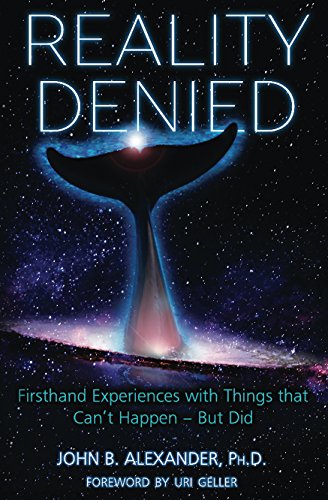
Reality Denied: Firsthand Experiences with Things that Can’t Happen — But Did. Non-fiction by John B. Alexander, Colonel U.S. Army (Ret.)

I remember, before my teens, my father would from time to time take us out to The Viking Smorgasbord in Ardmore, a suburb of Philadelphia near Radnor, where we lived. It featured a vast, rotating table, covered with all kinds of Scandinavian delights, but what I remember most clearly (and oddly) are the spiced, pickled plums. I’ve never tasted anything like them.

Of course, the most important part of visiting a smorgasbord is to remember not to eat too much of any one item. This leaves room for more variety. On the other hand, only having a taste or sample of an item — variety itself — sometimes becomes boring, and you want to eat something (think ice cream or chocolate cake) in depth. Unfortunately, you are stuck at the smorgasbord.

Such is the fate of the reader of Reality Denied, a lack of any depth. Author Col. John B. Alexander devotes at most a chapter to each subject and a brief synopsis of what was obviously a complex event. This is simply insufficient, but my criticism of this book doesn’t end there.

I bought Reality Denied for one reason, to read Chapter 3, “Speak To Me,” where the colonel finds that his (now ex-) wife is conveniently telepathic while in the Bahamas to research dolphins. What does he do with the remarkable link to an alien, literally extra-terrestrial intelligence? Why, he orders a pod of dolphins to swim hither and yon, like a platoon of soldiers on a parade field. Having thus proved the utility of human-dolphin telepathy in the wild, he carries it backward to a captive dolphin whose most perceptive comment about his living arrangements is that he can’t jump twice like they wanted, the ceiling is too low. (“Look up!” is the exact transmission.) So he agrees to bob twice. Problem solved!

Do I need to say that I AM ASHAMED BY THE LACK OF IMAGINATION SHOWN BY THIS HUMAN BEING?

I mean, Alexander had the brightest minds in the ocean at his beck and call, and he never asked them about their lives? How bio-echolocation works? How they breathe while sleeping? How they fend off sharks? Do they dream? Can they make things up, i.e., lie, tell stories, invent religion… What are those big brains so preoccupied with?

If Alexander did any of this, he doesn’t write about it here. He makes communicating with another species sound about as exciting as reading a train schedule. He goes on to chronicle other unbelievable adventures, such as “spoon-bending parties” where telekinesis is exhibited, and… that’s all I can think of now. There’s plenty more here, I’m only halfway through the book, I’ll probably finish it someday, I might as well get my $9.99 Kindle fee out of it. But there’s no real impetus to do so.

AM I THE ONLY HUMAN BEING WHO HAS USED HUMAN-DOLPHIN TELEPATHY TO TRY TO ENTER (be it ever-so-hesitantly) THE DOLPHINS’ WORLD?

Apparently so. Why, or why not? Is it even of interest to anybody else, what dolphins on the high seas think and feel as they go about their extraordinary lives?

In answer, all I can say is it became very important to me 48 years ago, and it has never stopped being important since. Colonel Alexander, you should be ashamed for writing such a dull book about such exciting subjects!


Cosmic Paranoia!

Paranoia strikes deep

As into your life it will creep

Starts when you’re always afraid

Step outa line, The Man come and take you away…

(Buffalo Springfield, “For What It’s Worth”, 1967)

It seems very unlikely to me, but apparently I am part — perhaps even a major part — of a vast, undefined, poorly-documented conspiracy of gays, homos, perverts, queers, lesbos, zoophiles, dog-fuckers, chicken-rapers, donkey-humpers, child molesters and people who fuck dead people.

What, you ask, is this mysterious, shadowy organization about?

Beats me, but that is the opinion of many of the people who write on the Dolphin Lover YouTube page. So it must be true!

These people, it seems — two of their first names are Dante and Laura — want to condemn me not for what I say, but just for speaking out, admitting I’m a zoophile and telling the story of me and Dolly, the dolphin.

Mind you, it’s OK for them to call me disgusting, sub-human, perverted, sick, degenerate, and saying I (not my story, ME) make them puke. But let me tell them they are mean-spirited and hypocritical (well, a little stronger than that), and I am apparently defending this VAST, SHADOWY CONSPIRACY to undermine the American Way of Life, promote illegitimate values AND TRYING TO SPREAD ZOOPHILIA ACROSS THE LAND!

(Because we all know that everyone — yes, even YOU – harbors a dark, secret desire to fuck, or be fucked by, a goat, and one must RESIST this toxic impulse with every fiber of one’s being and will every hour of the day and night or be sucked into the quivering morass of despair and self-hatred that is BESTIALITY!)

Wow… who knew?

A lot of the comments on the site are simply infantile. To the latest person who wrote “You make puke,” I responded “Great, send me a picture of you puking to add to my collection.” I’ve gotten so many, I could wallpaper my new house with them!

The people who fear my voice so much they want to muzzle me are something else, however. They represent a dark strain of American culture now on the ascendancy in this country that doesn’t want ANY voices of protest or defiance of authority to be heard. Funny, I thought that’s what the United States was all about, a constitutional republic where the people rule themselves and we can speak out freely on ANY SUBJECT without fear of prosecution by the government.

Guess not!

What people like Dante and Laura think is that I am operating with the objective of subverting American morals of decency and righteousness. Gee, it’s nice to be finally recognized for what I do, folks! And I’ve done it ever since the late 1970, when a Georgia cop radicalized me by knocking me off a stool and saying “Let’s let the nigger upstairs take care of him.”

Well, I don’t know your name, Georgia pig, they told me you were FBI but I have reason to doubt them, you were too fat to make the government payroll. But I do want to thank you for the experience because, for a few moments, I, a hippie college student, was a “nigger” with no rights in that situation, and I knew if I didn’t play my cards right I was going to end up in a shallow grave in a pecan grove somewhere, or maybe in a pig stye.

And NOBODY knew about Dolly, then, except me, and her, and her dolphin lover, Jimbo.

That experience gave me a newfound respect and admiration for my black brothers and sisters. (Latino, Asian, Native American, Irish, Italian, Vietnamese, Guatamalan… there’s no end to the victims of hate.)

LET’S GET THIS STRAIGHT, this is the country that A) murdered 95% of the Native Americans, B) massacred their food source, the buffalo, almost to the point of extinction for their hides, C) captured Africans to work as slaves, D) fomented Jim Crow laws and the KKK to control the “slaves” when they were freed, E) to this day denies WOMEN, who compose slightly more than 50% of the population, equal rights with MEN, because, you know, bathrooms might be compromised, F) denies trans-gender people the right to pee where they feel comfortable because they only want to get into the bathrooms in women’s clothes so they can watch little girls go pee and then molest them… and on and on, ad infinitum, a catalogue of tragedies, travesties and slaughter that, taken all together, makes everyone in Europe, Asia, Africa, and South America (they stole our name!) blush with shame every time they hear it recited.

We have, in the highest office in the land, President Bonespurs, a man so righteous and selfless he says thing like “I could stand in the middle of 5th Avenue and shoot somebody and I wouldn’t lose voters,” and, of women, “You can grab them by the pussy,” meaning, I should point out, by the labia, not by a feline.

And these people, Dante and Laura among them, are worried about me being a source of unAmerican values? Jesus Christ, the dead elephant in your living room stinks, has shit all over and is attracting flies, and all you can worry about is ME?

I ought to be proud of that, because it means my voice, and my message (WHICH CONCERNS DOLPHINS, not zoophilia) is getting out and being heard. And once in a while, some open-minded person with an open heart too sneaks in there and writes a message supporting me, or acknowledging the great love Dolly and I felt for each other.

To those few who have supported me, or at least wanted to hear impartially and without preconception what I have to say, I thank you. You are what this country is all about, the right to criticize the leader without losing your head. There’s a reason that’s the First Amendment, folks, and it wasn’t because the Founding Fathers couldn’t think of anything else to go first.

So when these pathological haters criticize me for speaking out about my experience, for being a zoophile or denying their pathetic, outdated “facts,” what they are really trying to do is silence me, shut me up, stick their fingers in their ears and go “NYAH, NYAH, CAN’T HEAR YOU,” and make me go away.

But I won’t go away. I will continue to tell our story, which is the story of an admittedly rocky interspecies relationship that turned great, then tragic, until they shut me up, one way or another. And I don’t think they have the courage or the will to do that. They are just so much hot air. Bullies are always cowards underneath their bluff and bluster, that’s what six years in public school playgrounds taught me. If you stand up to them, they melt away like shit in the sun.

And if they do manage to shut me up, watch out, because they’re coming for you next. Arm yourselves, and resist because you’ll be fighting (once again) for what the United States is really all about, freedom. Not freedom to make a buck, not freedom to make love with who you want, but just the freedom to speak freely, a right which has been and still is denied to most of the world’s population. And it’s worse than a pity, it’s a crime against humanity, and one of the reasons we remain stuck in vicious nationalism, racism, ethno-centrism and sexism, all the other -isms.

I am the canary in the coal mine.

If the definition of a liberal is a person who can’t sleep because someone out there isn’t getting what they deserve, the definition of a conservative is someone who can’t sleep because someone out there might be getting something they haven’t earned. Apparently in the USA, this includes health insurance, equal rights, shoes, housing, food and clothes. You are, after all, only promised a right to the persuit of happiness, not happiness itself.

It’s a heavy burden, practicing Satanism, raping 400-lb. dolphins, spreading inequity and throwing banana peels in the path of Mitch “Moscow” McConnell, but somebody’s got to do it!

I am that man, and I admit it. All who are with me, raise their hands. You are the true citizens of the USA, and I thank you. I ask my accusers, repeatedly, to show me where in the Dolphin Lover video I actually endorse, promote or advocate for zoophilia as a life style, and they can’t, of course, because you see, I never do. Never. Not once.

Zoophilia has been a source of so much stress, fear and worry in my past life, because of the perceived threat of haters like Dante and Laura, that I wouldn’t wish it on my worst enemy. (Okay, maybe I would on Tim Clarke and Duncan Seidel, two guys who used to try to bully me in grade school, but only them.) But that doesn’t matter to the professional haters, because they mistake my explanations of my behavior for excuses, my telling my story as promoting bestiality as a lifestyle and my very existence as an affront to human decency.

As if they knew anything about that.

They will be sad to learn that I am at peace with myself, that I have forgiven myself for letting Dolly die and her for committing suicide, that dolphins are the non-human people of the sea whether they (and SeaWorld) like it or not, and that dolphins, bless them, will go on being the wonderful, dreadful, perverse, loving creatures that they are, for as long as they can exist in the seas of this planet.

That’s what it’s all about, folks. That’s why I do what I do.

The Man Who Spear-Gunned Flipper: A Dialogue with Ricou Browning

To spare (spear?) you the trouble of paging back, I’m going to reproduce my first letter to Mr. Browning here. He has not responded to my last letter, and I do not anticipate hearing any more from him.

Did he spear gun “Flipper”? You read the mail, consider the state of movie special effects in 1963 and be the judge.


Mr. Ricou Browning
Browning, Ricou & Fran
5221 SW 196th Ln
Southwest Ranches, FL 33332-1111

Feb. 20, 2019

Dear Mr. Browning,

I briefly met you once in 1971, I think, at the Miami Seaquarium. You were very busy fixing something that had sprung a leak, as I remember, and didn’t have much time to talk. I did remark upon your having played The Creature from the Black Lagoon,of course, which makes you immortal in the eyes of monster-lovers everywhere.

Another issue has cropped up, repeatedly, over the years regarding statements by Dr. John C. Lilly about how a dolphin named Pam was treated during the filming of “Flipper!”, the original 1963 movie. According to Lilly, the scenes where the dolphin is shot with a spear gun, and beaches itself, were actually filmed that way, with the dolphin impaled by a spear.

Lilly told me (not hearsay) that Pam was shot a total of 3 times in the peduncle to get the take. The first time, she swam back and allowed the spear to be removed. The second time, she couldn’t make up her mind what to do. The third time she headed for the high seas, had to be netted with the spear in her and returned to the beach to do the scenes with Luke Halpin and Katherine Maguire. Then, apparently, the spear was removed and the wound(s) treated.

Reportedly Pam was so traumatized by this she would not approach humans again. She was sold to Dr. Lilly who reportedly used her for LSD experiments, but that’s another story.

Lilly said “you” did this, but did it actually happen, and if so, what were the circumstances? Why couldn’t the effect have been done by an optical, or some other process? Were you directing the scene, or was somebody else? What really went on? And why was the dolphin left screaming on the beach during Halpin and Maguire’s scene? I just want to know the truth, and would like to get it from your lips. Lilly also told this story to David J. Brown, who included it in an interview with Lilly in his book Mavericks of the Mind,so the story is getting around.

I would like to know the truth, not only because I’m dedicated to it in my profession as a writer, but I would hate to see your reputation sullied because of it. It’s a nasty story, and I’m sure there must be some explanation for it; the film footage is there, unfortunately, to show that it happened, and I don’t think you had any animatronics that could do a scene like that in 1963.

Sincerely, Malcolm J. Brenner

RicouBrowning0002

Mr. Ricou Browning
Browning, Ricou & Fran
5221 SW 196th Ln
Southwest Ranches, FL 33332-1111

March 6, 2019

Dear Mr. Browning,

Thank you for responding to my letter of Feb. 20 with your information. Since the story has already been made public by David Jay Brown’s interview with Lilly in his book Mavericks of the Mind, do you mind if publish it, together with my letter inquiring about the incident? Putting them both together will allow me to rebut Lilly’s story.

However, I do mean to question you a little further, if you will indulge me. Please assume I am somewhat familiar with professional movie special effects. How exactly were the shots done of the beached dolphin with the spear sticking out of its side done? It’s thrashing around a lot, as I remember. Was this an early animatronic, a dummy, something like that? Do you remember who made it? I would appreciate knowing.

Finally, I think “a writer of any integrity” would check out the sources of all stories he/she heard and verify them before going public with them. Very often, he will have to explain things to an editor. Although I met Dr. Lilly and his wife Antoinette, attended a couple of his workshops (they mistook me for staff at one!) and interviewed him regarding his work with dolphins, I have no knowledge of where he got the story. However, in the spirit of open inquiry, I thought I’d ask as you are the last person who was there. I hope my boldness hasn’t offended you.

Sincerely yours, Malcolm J. Brenner

RicouBrowning0003

Dear Mr. Browning,

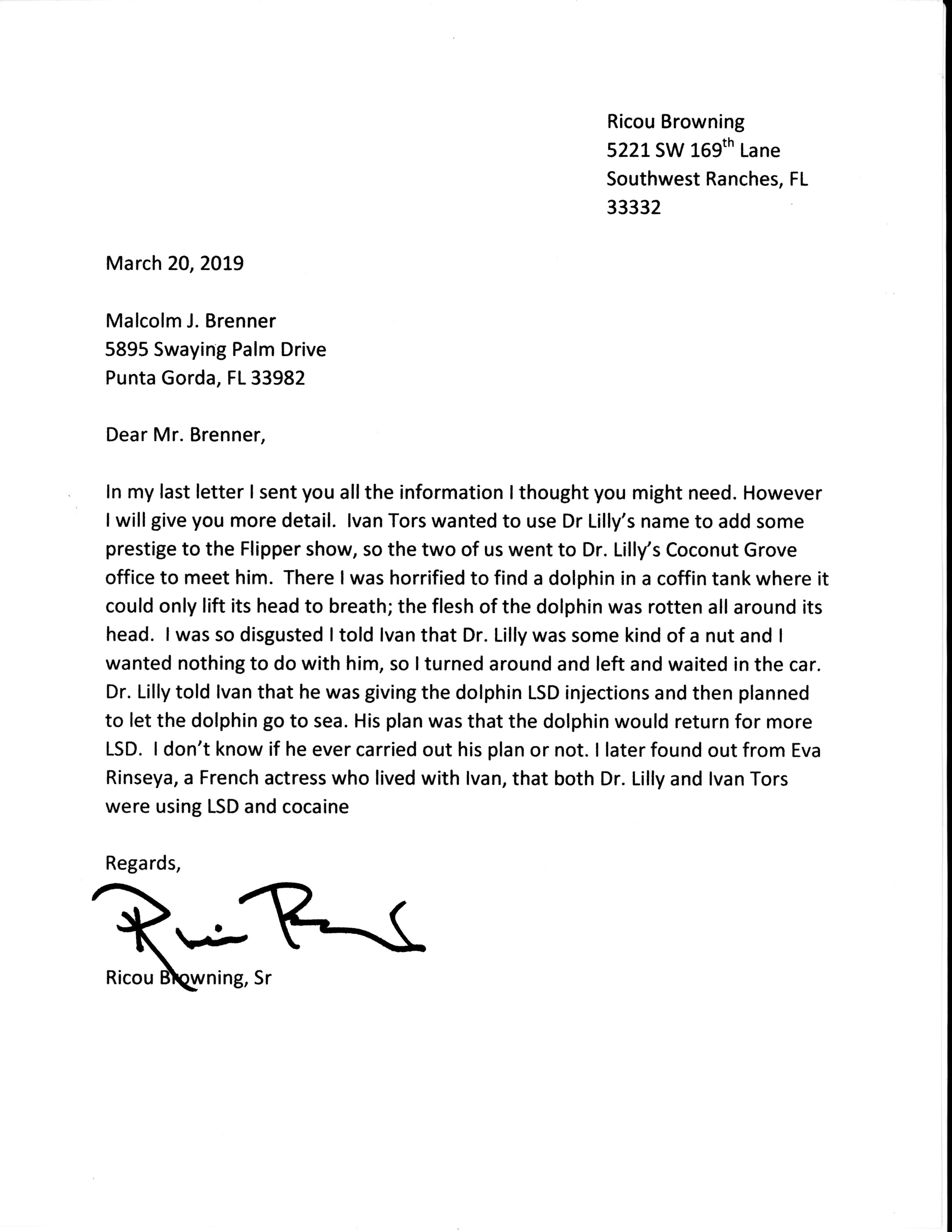
Thank you for your letter of March 20. Nothing you could tell me about Dr. Lilly (and very little about Ivan Tors) would surprise me. Lilly was widely known for both his abuse of dolphins and drugs.

What surprises me more is that you did not answer my question. You have responded satisfactorily about the scene where the dolphin was shot with a spear gun, but as to my question about the dolphin on the beach thrashing around with a spear in it while Luke Halpin and Kathleen Maguire are delivering their lines, no answer. You said, rather vaguely, that the scene was rendered by “special effects,” an all-inclusive term so vague as to be meaningless.

The IMDb data base does not list a special effects person in the crew of “Flipper,” and there is no credit given for special effects. (However, Dr. Lilly is listed as a consultant; TCM lists him as a “scientific advisor.”) It would be uncommon not to list such a credit, wouldn’t it?

Mr. Browning, it’s really a very simple question: If, as you say, a dummy, model or animatronic dolphin was used in the beach scenes, who built it? What person or shop in Hollywood? There were only so many people at the time who could do this and pull it off. The dolphin on the beach looks amazingly realistic to me, so whoever it was must have been good!

Over the years, you’ve made a lot of money off dolphins. I don’t begrudge you that, but I’d like to know the truth of what happened during the making of “Flipper.” I think you owe it to the dolphins. We now know they are creatures who name themselves, who recognize themselves in a mirror, who are arguably non-human persons. The truth is very simple to recognize, there’s no hiding it. You are being evasive and trying to divert me by bringing up Lilly. Please answer the question, and truthfully. Thank you.

Malcolm J. Brenner


August 8, 2019

Mr. Browning,

I apologize for not concluding this business sooner, but I have had an illness and also moved. Please note the new address, above, if you choose to reply.

This will be my last letter to you on the making of “Flipper” and whether the stunt dolphin was shot with a spear gun or not. Since you did not respond to my previous letter questioning the veracity of your claim that the shots on the rocks were done with undefined “special effects,” I presume you refuse to speak any further on the subject. Am I right?

Just let me finish by telling you that I bought “Flipper” from Amazon and watched it. And I thought that, at the time, it was very sympathetic to Florida families, what with the red tide, the hurricane and all. I guess it made Ivan Tors, or somebody, a lot of money.

However, regarding the subject of this letter: In the scene where the dolphin is spear gunned, the dolphin is hit on the left side of the peduncle with the spear, and immediately flexes sideways in that direction reflexively, it appears. Then, in the next scene, it changes direction, heading back where it came from and dragging the spear gun behind it. The spear gun lodges in some rocks.

(I regret I can’t capture some frames here for you to view, but I’ve had difficulty with Amazon letting me find the right frames.)

If, as you say, the spear’s pronged head had been replaced with a hypodermic needle, it seems to me it would have bent, broken off or been dislodged from the force of that flexion, not to mention the spear gun getting stuck in the rocks.

I will give you that you probably used a model for the distant scenes of the dolphin on the rocks. They were taken from such a distance I couldn’t tell.

However, when we come to the closeups of Luke Halpin with the dolphin on the rocks, with only apparently seaweed for padding, what I see looks like a very drugged dolphin. It isn’t flopping around, it isn’t trying to get off the rocks, and it sure as hell isn’t a motorized model or the primitive sort animatronics they had in 1963. It breathes most convincingly, just like a real dolphin.

As you know, drugging dolphins is very dangerous, because they have no breathing reflex, something our friend Dr. Lilly discovered at Marineland in the mid-50’s, much to the disgust of veterinarian Forrest Wood.

The titles for the movie, both opening and closing, bear no mention of who might have done the “special effects” you claim were used, or who might have built the prop dolphin.

I can only conclude that not only did you shoot a real dolphin with a spear gun (you have admitted as much yourself, except you say you used a hypodermic needle instead of the pronged head) but that you drugged that dolphin afterward to enable it to withstand the pain while you filmed on the rocks with Halpin. I’d contact Halpin, but I hear he has Alzheimer’s.

As I said, Mr. Browning, this is my last letter. I intend to post all our correspondence to my blog, malcolmbrenner.com/news, to make it available to anybody who wants to read it. I will, of course, include whatever answer you decide to make to this letter.

Not only have you admitted to spear-gunning the dolphin (and I doubt your explanation), but I now also accuse you of drugging that dolphin and failing to remove the spear from it in a timely manner. In short, you knowingly abused and tortured it to get the shots you wanted because you didn’t have the budget to do anything else (hire a special effects man, build a dummy).

Kind of subverts the whole premise of “Flipper,” doesn’t it? When you torture an animal to make a movie about a kid who has fun with animals, what does that say about you as a person? I think it’s hypocritical and debased and sadistic. You objectified a creature that is much like a human being, pretending it didn’t have feelings so you could get your shot and make your movie. And if you did it to them, you can do it to me, or anyone.

Care to convince me otherwise? – Malcolm J. Brenner


(Addendum: I can find no mention in Google’s database of “Eva Rinseya,” the French actress mentioned in Browning’s second letter.  If anybody knows anything about her, please contact me.)

Closer to “The Edge”

dolphinsmile
It’s a dolphin, and it looks like it’s smiling. It always looks like that.

Here it is, fans, my response from the MediaWorks Standards Committee about my complaint.  According to law, I had to file a complaint with MediaWorks first and be declined before I could appeal to the Broadcast Standards Authority, New Zealand’s FCC. Stand by for my response! All italicization is mine, for emphasis.

Dear Malcolm,

The MediaWorks Standards Committee wishes to advise you we have completed our inquiry into your formal complaint about the decision to broadcast on The Edge on 3 April 2019, an edited version of your interview with Dom Harvey, Meg Annear and Clint Randell. You complained that this breached Standards 4, 5, 6 ,8, 9 and 11.

We have not identified any breach of the standards set out in the Code of Broadcasting Practice. Our reasoning is outlined in further detail below.

If you are not happy about this decision you have the right in accordance with Section 7(3) of the Broadcasting Act 1989 to refer your complaint to the Broadcasting Standards Authority, (P.O. Box 9213, Wellington or bsa.govt.nz) for the purpose of an investigation and review. You have 20 working days after receipt of this email to exercise this right of referral.

The Broadcast

The broadcast on 3 April was the final installment of a storyline which ran over three episodes of the Dom, Meg and Randell show. We have provided copies of all of the audio from these episodes, with this response. However in summary:

On 29 March the hosts first discussed the viral ‘Florida man’ birthday challenge, in which people conduct a Google search with their date of birth and the words “Florida man”, and receive news stories about the behaviour of a ‘Florida man’ on their birthday. ‘Florida man’ is a generic descriptor for a person who commits bizarre or idiotic crimes, popularly associated with—and often reported in—Florida.

Dom had conducted such a search using his birth date 3 February. The first search result was an article about you with the headline “Florida Man who had sex with dolphin says it seduced him”.

Following this discussion, listeners rang in to contribute their own birth dates and “Florida Man” stories.

On 1 April: the hosts discussed how they had recorded an interview with you, and provided some more detail about your story, including that:

  • you had written a book;
  • you had been fired from the aquarium where this occurred (which we are aware is not the case, but do not think is material);
  • you had been interviewed by MediaWorks’ journalist (at the time) David Farrier;
  • you had reviewed the movie “The Shape of Water” in a piece for Huffington Post;
  • the dolphin’s name was Dolly;
  • you had made a documentary about your relationship with Dolly;
  • you didn’t go through the court system and weren’t sent to jail;
  • you claim Dolly was in love with you;
  • you claim Dolly initiated the behaviour and seduced you over time;
  • you claim Dolly was so distraught when you were separated that she took her own life.

Meg made clear her opposition to hearing about bestiality and outlined her counter-view that Dolly was “traumatised because a man had seduced her and she’s a dolphin”. The hosts then sought and received feedback from listeners on whether or not to broadcast the interview.

Dom indicated he would need to clear it with his legal team before broadcasting.

On 3 April the hosts described the “Florida Man” challenge again, played extracts of the previous show and emphasised to listeners not to ‘flip out’ because they had heard the audience feedback and weren’t going to play the full interview.

They talked about Meg’s opposition to this storyline and played the following extract from the interview:

Malcolm: Dolphins’ skin is peeling all the time so they need to have it rubbed. She would roll over on her back and then swim forward until I was rubbing her [bleep].

Meg: This is sick. This is sick. I think you’re sick in the head and this is disgusting. This is a non-consensual situation. A dolphin cannot consensually choose to have sex with a human and you absolutely took advantage of that and I don’t want to be involved with this.

Meg explained she was flustered and furious, and the hosts explained that everyone who got into contact with the show – apart from one listener named Peter – had agreed that the topic was not appropriate for broadcast. Peter was given the opportunity to listen to the entire interview off-air and was then asked for his view of the interview. Peter indicated that he regretted having heard it.

Standard 4 Violence

The Violence Standard states that :

Broadcasters should exercise care and discretion when referencing violence.

We have not identified any content which referenced violence, and no breach of this Standard.

Standard 5 Law and Order

Under the Law and Order Standard:

Broadcasters should observe standards consistent with the maintenance of law and order, taking into account the context of the programme and the wider context of the broadcast.

As the commentary on this Standard makes clear, its purpose is to prevent broadcasts that encourage audiences to break the law, or otherwise promote criminal or serious antisocial activity.

This broadcast did not promote criminal or serious antisocial activity; rather the inverse is the case. The hosts criticised behaviour which is unlawful in New Zealand under section 143 of the Crimes Act 1961. We consider that this was appropriate,and there is no breach of this Standard.

Standard 6 Discrimination and denigration

Under the Discrimination and Denigration Standard:

Broadcasters should not encourage discrimination against, or denigration of, any section of the community on account of sex, sexual orientation, race, age, disability, occupational status or as a consequence of legitimate expression of religion, culture or political belief.

Although elements of the Broadcast – particularly Meg’s comments – were dismissive and even condemnatory of your behaviour, the Commentary on this Standard is clear:

“This standard does not apply to individuals…
The standard applies only to recognised ‘sections of the community’ which is consistent with the grounds for discrimination listed in the Human Rights Act 1993.”

We do not accept that people who have sex with dolphins, or even at the broadest level, zoophiles (i.e. people with a persistent sexual interest in animals) comprise a “section of the community” within the scope of this Standard. Although the Human Rights Act does prohibit discrimination on the grounds of “sexual orientation”, it defines this as “heterosexual, homosexual, lesbian, or bisexual orientation” only (see section 21(1)(m)), and not an orentation towards animals.

This is consistent with the fact that bestiality is illegal in New Zealand. Zoophiles are not protected from discrimination in the Human Rights Act and we do not accept that the Standard applies here, or that the Standard was breached by this Broadcast.

Standard 8 Balance

Under the Balance Standard:

When controversial issues of public importance are discussed in news, current affairs or factual programmes, broadcasters should make reasonable efforts, or give reasonable opportunities, to present significant points of view either in the same programme or in other programmes within the period of current interest.

As summarised in Guideline 8a, for the standard to apply, the subject matter must be an issue ‘of public importance’, it must be ‘controversial’ and it must be ‘discussed’ in a news, current affairs or factual programme.

The Standard does not apply in this case, because at least two of these requirements are not made out:

  • While clearly important to you, this issue is not relevant to the wider New Zealand public and is not ‘of public importance’. Bestiality, and the capacity for animals to consent to intercourse with a human are fringe issues, without any widespread or mainstream importance.
  • The Dom, Meg and Randell show is not a news, current affairs or factual programme. The show is promoted as a place for “the latest entertainment news, celebrity gossip, scandal, competitions and all the funniest gags to spark up your morning”. Listeners expect light-hearted chat and laughs, but do not reasonably expect it to be “authoritative or truthful”, which is the defining characteristic of a factual programme according to the commentary on the Standards.

Standard 9 Accuracy

Under the Accuracy Standard:

Broadcasters should make reasonable efforts to ensure that news, current affairs and factual programming:
• is accurate in relation to all material points of fact
• does not mislead.

The purpose of this standard is to protect the public from being significantly misinformed. However the Standard applies only to news, current affairs and factual programming, which this was not (see para 16b above) . Therefore there cannot be a breach of this Standard.

Standard 11 Fairness

Under the Fairness Standard:

Broadcasters should deal fairly with any person or organisation taking part or referred to in any broadcast.

There are serious issues with how Dom, Meg and Randell dealt with you and your contribution during the Broadcast. In particular the Committee is concerned about the way the interview was edited and broadcast on 3 April, and the information which Dom Harvey provided to you after your interview, which was misleading and incomplete. We have raised these concerns with the show’s producers and presenters and have reminded them of their obligations under this Standard. We have also reviewed our processes to take into account the slightly unusual situation here, where a storyline was modified in response to clear listener feedback.

However overall we are satisfied that the storyline or the 3 April broadcast were not unfair to you, and fairly reflects your position in relation to your interactions with Dolly.

The BSA’s Commentary on this Standard states:

Generally, a consideration of what is fair will take into account the following:

  • whether the audience would have been left with an unduly negative impression of an individual or organisation
  • whether an individual or organisation taking part or referred to in a programme was adequately informed of the nature of their participation
  • whether informed consent was required and/or obtained (guidance on what constitutes ‘informed consent’ is found in Guidance: Privacy at the back of this Codebook)
  • whether the individual or organisation was given a reasonable opportunity to comment, and whether their comments were adequately presented in the programme
  • the nature of the individual, for example, a public figure or organisation familiar with dealing with the media, as opposed to an ordinary person with little or no media experience
  • whether any critical comments were aimed at the participant in their business or professional life, or their personal life
  • the public significance of the broadcast and its value in terms of free speech

The Committee has considered the context around the broadcast:

We accept that the show’s audience would have been left with a negative impression of you based on your behaviour with Dolly. However we do not accept that this impression was caused by the Broadcast. In the Committee’s view, any negative impression was a result of pre-existing perceptions of bestiality and those who engage in it. The Committee is satisfied that there is already widespread distaste for the behaviour you engaged in. The feedback from listeners of the programme supports this view, and again we note that the New Zealand legislature has seen fit to prohibit bestiality with a serious criminal sanction of up to seven years’ imprisonment.

We consider that prior to the broadcast you were adequately informed of the intended nature of your participation. At that time the hosts did plan to broadcast your interview in full or use it for a podcast. It was only after they received overwhelming listener feedback and appreciated that there was no audience appetite for this story, that the hosts and production team reconsidered their approach. We would have expected them to communicate their decision to you. In any event is clear to us that you are experienced in dealing with the media and have told your story before, and we are certain that you would have expected and would have been prepared for opposition or condemnation of your behaviour.

The Committee does not approve of the way your interview was edited, and we understand why you might feel you had not been given a reasonable opportunity to comment. However we agree with producers that in light of the audience’s clear expectations it was not appropriate to play the entire interview. A better decision would have been not to play any part of your interview, rather than playing only the portions of the interview in which Meg reacted to your behaviour. Despite this we are satisfied that your position was adequately presented across the series of broadcasts, and the 3 April Broadcast on its own. In particular your claims that Dolly initiated and consented to this behaviour were presented, as were your claims that Dolly was forlorn by your separation and died of a broken heart, and the fact bestiality was not illegal in Florida at that time or until 2011. We do not accept that listeners were unaware of your position.

Summary

In summary there is no basis to uphold your complaint.

Kind regards,
The MediaWorks Standards Committee

Stay tuned for more exciting news!


Interviewer denounces author as “dolphin abuser,” walks out.

Well folks, I went on the Dom, Meg and Randell podcast this morning (in New Zealand, it was late afternoon the day before in Punta Gorda) and about 4 minutes into the interview, as I was describing Dolly’s first advances, rolling on her back and swimming forward until I was rubbing her genital slit, then, when I moved back to her head, doing it again, Meg (the female member of the interview trio, as you may have adroitly guessed) exploded into rage completely unrelated to what I was talking about.

Without giving me a chance to answer her accusations, she said I was a “dolphin abuser” who “took advantage” of that poor dolphin! Then she stormed out of the studio, all too eager to leave before she could learn the truth: dolphins are sexual creatures.

Very sexual.

The two male interviewers, Dom (who recently had a good friend commit suicide) and Randell, continued the interview without her, and it went rather well from my point of view. I got to say everything I wanted to say, got to promote human-dolphin telepathy, got to answer all the interviewers’ questions about the event and got to plug my book and ebook at the end. Listen to it all here, friends. (As soon as it’s published, it was pre-recorded.)

UPDATE: They recorded it, then sent me a version that was half long but still all right, and then, without telling me, they ran this shit. I’ve been treated badly by shock jocks before (Bubba the Love Sponge and Howard Stern come to mind), but I’ve never been set up like this! I feel like a bowling pin, and the station is going to get a letter from me denouncing this.  It’s right here, and they start talking about me at 42:30.

“Beach Bum” on dolphins

This is the funniest thing I’ve seen on dolphins recently, or, should I say, on tourists and what delicate flowers they are:

https://www.vulture.com/2019/03/beach-bum-movie-martin-lawrence-dolphins.html

The Wet Aliens

2018-10-31-0003

(This is an article I wrote for Future Life #2, May 1978, and illustrated with my own photos. I’ll get them posted here when I can find them. Meanwhile, it’s surprising how little has changed in the dolphin world.)

THE WET ALIENS

By MALCOLM BRENNER

Suppose you are tuning your radio, 
hunting for your favorite music,
when the following blood-curdling 
announcement comes on: 
“NEWS FLASH: Scientists report
the Earth is about to be invaded by
 extraterrestrial aliens. The invaders 
range in length from six to thirty feet,
 and their brains, much larger than ours,
 suggest a fantastic degree of intellectual
 development. They are so strong they 
can leap twenty feet into the air or travel 
two hundred and fifty miles a day for
 days at a time without sleep! Their jaws 
are filled with needle-sharp teeth, and 
their tails can break bones with a single 
blow. Furthermore, these aliens possess
 an unusual ‘sixth sense’ which enables
 them to look into our internal organs,
 uncovering our hidden strengths and
weaknesses! Their cryptic language,
 undeciphered by scientists, allows them
 to communicate ten times faster than we 
do. They can hear the sound of  a single
drop of rain falling fifty feet away! And 
latest reports indicate they possess
 highly developed psychic abilities which 
allow them to read our minds and 
second-guess our thoughts. Prepare
 yourself!”

“What is this?” you might wonder.
“Another War of the Worlds prank?
 Should I get a gun; clean out the old
fallout shelter? Or should I pray?” 
But wait! Before you can stir, the 
announcer’s back on the air.

“NEWS 
FLASH: More on those alien invaders. 
Scientists report that they are not
warlike, but peaceful! Their astounding 
powers are used only for gathering food 
and for protection against their 
enemies. Despite their great strength,
 they are helpless under Earth ’s gravity 
and can exist only in a weightless environment. Our air is corrosive to their skin and will kill them in twenty-four hours unless they are constantly bathed in fluids from their home world. Their 
huge brains have produced no form of
technology, and many scientists believe 
them to be no smarter than dogs. They 
lack clothes, shelter, and even the most 
rudimentary tools. They have rescued
humans from mortal danger, on occasion, and they have built-in smiles! Congress has imposed fines up to $20,000
 and jail penalties up to one year for killing or injuring them; but scientists 
studying the aliens report several thousand are being held captive around the 
world, and despite government protection more than fifry thousand of them 
may be killed next year — accidentally!”

By now you’d know it was a hoax — but you’d be wrong! These aliens are not the dream of a science-fiction 
writer, nor the creation of some Hollywood special-effects department. They 
are real. They have existed on Earth for
 over thirty million years, their form unchanged, their roots going back before
 the beginning of human evolution. We 
call them dolphins.

All of the above statements about
 dolphins are true, including those that
 seem contradictory — depending on 
whom you choose to believe. They 
reflect the current scientific confusion 
about dolphins, but it’s nothing new. 
Throughout history, dolphins have 
either been worshipped as demigods, or 
devoured as delicacies, with no middle
ground. Prehistoric Norwegian hunters
 carved them on the walls of caves. The 
author of the biblical Book of Job held 
a creature called Leviathan in high
 esteem; we now call the same creature 
orca, or killer whale, an overgrown 
dolphin with an overblown reputation 
for ferocity. 
The Nabataeans, a pre-Christian 
race of Bedouin merchants, were so
 fond of dolphins they carved them into 
the statutes of their gods, posing a riddle to the archaeologists who discovered
 their crumbled temples — in the middle 
of the Negev desert! The Greeks were 
infatuated with them; killing a dolphin, 
the sacred beast of Sun-God Apollo,
was an unforgivable sin. Greek authors 
told stories of their friendliness which
 were considered fantasy until well into 
the 20th century.

Pliny the Elder, a Greek naturalist, is credited with 
discovering that they are not fish but 
warm-blooded, air-breathing mammals, 
like ourselves. The Romans and Polynesians ate them, but the Chinese and
 Vietnamese held them to be divine.
 The truth about dolphins is no less astounding than the many myths surrounding them, but until the 1950s 
almost nothing was known about them. 
Dolphins had been kept in oceanariums
since the early 1900s, but not until
 World War II and the development of
underwater microphones was their 
astonishing sense of echolocation (or “sonar,” to use a military term) 
discovered.

Like bats, dolphins emit high-pitched
 clicks, which sound like a door with 
rusty hinges. Originating in the larynx
 and in nasal sacks below the blowhole 
(nostrils), these clicks are reflacted off 
the dolphin’s concave skull and through 
an oil-filled ‘acoustic lens’ in its domed forehead. By varying the shape of this 
lens, the dolphin can spread a wide beam
 of sound for miles under the sea, or 
focus it with laser like intensity to nearby objects. The “sonar” pulses are ultrasonic to humans, but the dolphins hear 
their echoes bouncing off objects. By
 listening carefully, a dolphin can determine the size, distance, and shape of an
 object; what it is made of; whether it is 
alive or nonliving; whether it is approaching or retreating, and how fast;
 whether it is hollow or solid, textured or
 smooth — everything but its color! Since animal flash is 75% saltwater, dolphins 
can “X-ray” each other — or humans –
with harmless beams of sound.
 A dolphin’s enormous and complex 
brain enables it to process all this information instantly. The brain of a 
bottlenose dolphin — the species seen 
in oceanariums and on TV — is about 
10% larger than a human brain, and appears to be superior to ours as a
thinking machine. It has more folds on 
the neocortex, where rational thought
originates, and the density of its 
neurons is greater. The only animals
 with larger brains are elephants and 
some whales, the dolphins’ distant
 cousins. Some scientists believe the extra brain matter is occupied with controlling the dolphin’s large bodies, or analyzing their complex echolocation.
 But whale sharks and dinosaurs possessed huge bodies and very small 
brains, and bats are able to use their 
“sonar” with brains that fit on a dime!So these theories do not wash.

Given this fantastic biological computer, you might think scientists would 
have long ago recognized the dolphin as 
a creature of unique intelligence. Not 
so! Dolphins lack hands and, being self-
sufficient, have no need for human 
technology. Their oceanic lifestyle
 makes them difficult to observe. Not 
until 1955 did anyone wonder what the
dolphins might be doing with all those 
brains, aside from chasing fish. In that year Dr. John C. Lilly, a young psychiatrist and neurophysiologist, was conducting sensory-isolation experiments
 for the Air Force to determine what
 would happen if an astronaut were cut
 off from contact with Earth. Lilly 
simulated weightless outer space by immersing himself in a tank of warm sea-
water. Breathing through a facemask,
isolated from all sensory inputs, Lilly experienced incredible hallucinations
 and proved that the brain can generate 
its own ghostly form of reality from 
within. He also began to wonder what 
the mind of a creature living under such
 conditions would be like. 
He conducted a series of experiments 
on the dolphins at Marineland near St.
Augustine, Florida. While anesthetizing 
them to implant electrodes he made his 
first startling discovery — when a dolphin loses consciousness, it stopsbreathing! Unlike other animals, each 
breath for a dolphin requires an act of
 will. His first few experiments proved 
fatal to his subjects and angered the 
Marineland staff, some of whom have 
not yet forgiven him. After developing
 more humane techniques, he was able to 
“map” the dolphin’s brains and determine which areas controlled what
behavior.

During these experiments, Lilly 
noticed that the dolphins in his laboratory behaved more like curious humans than white rats or rhesus 
monkeys. They second-guessed his experiments and tried to imitate the voices of his assistants! Fascinated, Lilly ended his brain research and began studying the dolphin’s sound emissions.
 He found they produce complex trains
 of whistles and squawks with which they
  communicate. In 1961, convinced of the 
existence of a dolphin “language,” Lilly 
received a NASA grant on the ground
 that his research might help us better 
understand communications from other
 planets — when we receive them.

He quickly encountered hostility 
from other scientists. Like early UFO 
investigators, Lilly found himself up 
against a wall of mockery and prejudice. His recordings of dolphins mimicking human speech were not convincing to untrained ears. His remarks
 were sensationalized by a press more eager for headlines than the plodding
methodology of science. His stories of 
“intelligent” behavior were laughed at
 by cetologists familiar only with 
robotized oceanarium dolphins. Even the basic premise of his research was 
challenged; any idiot could see that
 human beings were the most intelligent 
creatures on earth — otherwise the 
dolphins would be keeping us captive!

Undaunted, challenged by the alien 
mind of the dolphin, Lilly began a series 
of experiments on his own mind, using 
sensory isolation and the then-legal drug 
LSD. Tripping among his dolphins, he 
realized that, if he was right, keeping 
them captive was not just an insult; it 
changed them, in the same way involuntary imprisonment changes a free man 
into a slave. The dolphins locked in his
lab were not the same creatures as those
 roaming the wild seas; they were products of his experimental parameters.

“I 
felt,” he has since admitted, “like I was 
running a concentration camp for dolphins.”

As he considered closing the lab
and setting his subjects free they began
to die mysteriously, starving or drowning themselves. In 1967 he released the
 survivors, ending his research.
 Lilly remains much-hated among professional cetologists, partly for his 
“unscientific” theories, partly for his 
early brain-probings, and partly for his
drug experiments, which nearly cost him
 his life on two occasions. If he were the
 only person to report such experiences with dolphins one might well doubt 
him, but a small number of scientists
 and laymen, fascinated by the idea of an 
Earthly non-human intelligence, began 
their own investigations. Some supported Lilly’s theories; others sought to 
disprove them. Still others wavered.

This is typical of the problems scientists encounter when they attempt to
 measure the dolphin’s intelligence.
 Its sense and thought processes are so 
different from ours that it’s hard to 
develop a meaningful test! But there are
 still profound mysteries surrounding 
them. For almost every fact postulated
 by a respected dolphin researcher, an
 equally illustrious scientist can be found 
to contradict it!

For example, Lilly 
claims that dolphins can produce a 
“distress whistle” when in danger or 
pain. This call, described by him as a
 whistle of rising, then falling pitch (like
 an inverted V) brings other dolphins to
 the rescue. Rene-Guy Busnel, a French
cetologist who works with Jacques 
Cousteau, agrees about the “distress 
whistle” but insists it’s exactly the opposite — falling, then rising in pitch 
(like an upright V)! The Caldwells,
 equally respected, maintain there is no 
such thing as a distress whistle. According to them, dolphins have only one 
whistle apiece, which they repeat over 
and over to tell other dolphins “here I
 am,” like Kurt Vonnegut’s mythical
 Mercurian harmoniums.

Are you sufficiently confused?

One person who shares Lilly’s views is 
Ric O’Barry, formerly a trainer for 
Ivan Tors’ Flipper TV series. After 
working with dolphins for years, 
O’Barry concluded that the dolphins 
were not only smarter than he was –
 they were sometimes able to read his mind, learning complicated tricks faster 
than seemed possible. He now devotes 
his time to saving the whales and 
dolphins from extinction.

Another believer is Michael Greenwood, formerly dolphin trainer for the
 U.S. Navy and CIA. Greenwood
 became interested in marine mammals during the Navy’s Sea Lab program. 
Dolphins can dive to 600 feet and return 
in three minutes without being crushed
 by the pressure, equal to 200 atmospheres, or dying from the bends. 
Having gained some experience training sea lions, Greenwood was asked to take
over a top-secret dolphin project in the
 Florida Keys. The mission, under a conservationist cover story, was to train
 dolphins to run intelligence missions 
against communist Cuba, planting instruments on atom-powered Soviet warships which would transmit data on the
 size and power of their nuclear reactor.
 The CIA and Navy factions on the project were warring with each other; the 
electronic equipment malfunctioned;
 and the dolphins were poorly trained! Greenwood became convinced it was immoral to train such intelligent and 
friendly creatures for warlike ends. He, 
too, came to believe they could telepathically read his mind. He now fears
 they are facing a slaughter by the
world’s naval powers, who are unable 
to tell an innocent dolphin from one 
trained for espionage.

But the dolphins are already facing a
 wipeout. For the past fifteen years, 
tuna fishermen have been killing hundreds of thousands in the huge purse-seine nets used to trap yellowfin tuna, 
which are packaged for sale as “chunk 
light.” The dolphins and tuna stick 
together — no one knows why — and 
when the fish are netted the dolphins
panic. Their “sonar” beams pass uselessly through the net’s mesh, and in their
confusion they may become tangled and
 drown, or, worse yet, be dragged on
board and crushed in the machinery. In 
1971, an estimated 320,000 were killed. 
Since then the numbers have been dropping, thanks to new types of nets, new 
catching techniques, and the Marine
 Mammal Protection Act, which sets
 yearly quotas on the number killed. But
 the battle isn’t won: the tuna fishermen, 
chafing under what they feel are unfair
 restrictions, talk of taking their boats to 
nations without quotas.

Dolphin ESP is a highly puzzling
 issue, one that is infrequently discussed. Studies on humans
 show that, contrary to most science fiction, strong emotions, rather than powerful intellect, are responsible for telepathy, and this also seems true in human-dolphin mental contacts. People who see dolphins as highly intelligent are more open to psychic contacts than those who regard them as big fish; familiarity with dolphin ways also increases the likelihood of interspecies ESP. People who have had psychic experiences with dolphins find them difficult to describe.

Don’t rush down to your local oceanarium expecting to pick up dolphin brainwaves, however. While you might, it is highly unlikely, unless you’re exceptionally psychic. As Dr. Lilly discovered, captive dolphins are a different breed from their wild counterparts. While some thrive in captivity, many more have died from it, and the survivors frequently display spirits broken by the rigorous behavior-modification techniques used to produce oceanarium shows. Conditions vary greatly from one establishment another: some take great pride in maintaining healthy, happy specimens, while in others the death rate is staggering. Stories of trainers mistreating their dolphins out of malice or ignorance are confined to backroom discussions, where the public can’t overhear.

Sometimes the dolphins bear mistreatment
 stoically; sometimes they retaliate!
 Some dolphins have been kept for years
 in lagoons with nothing more than a line
 of floats keeping them in; others have 
ripped steel fences apart to escape! It’s 
impossible to generalize about dolphins 
for the same reason it’s impossible to
 generalize about humans: no two are 
alike.
 But there is no doubt that the “happy 
dolphin” image perpetuated by
 oceanariums and the media is a lie.

The 
Flipper series shows them as happy-go-lucky types, fawning all
 over their human masters, Kenny and 
Bud. The movie The Day of theDolphin, while somewhat more
realistic, still showed dolphins as being 
childlike, naive, and gullible. Trainers 
know better: dolphins can be sweet, 
even sexy, but they can also be deceptive, arrogant, and demonically cunning. The recent movie Orca, the Killer
 Whale did little to change the image of
 the most maligned creature since the
 snake. Although the orca saves the
heroine, Rachel Bedford (a sympathetic
 biologist played by Charlotte Rampling)
 from a shark at the beginning, and
 spares her life at the end, in between 
these chivalrous deeds it devours Jack
Campbell’s (Richard Harris’) crew, 
sinks a fishing fleet, sets a town on fire,
 and rips a woman’s leg off! Dino De Laurentiis would be well advised to restrict his swimming to pools from now on.

Paul Spong, a Canadian biologist who has studied orcas for the past six years, knows better. When a group of orcas swim by his research station in Alert Bay, Spong may hop into a one-man kayak and paddle out to meet the “deadly” killer whales. When he plays his flute to them, the whales stop roaming and listen raptly. If we stop to think about it, aren’t humans the real monsters? Orcas are captured for oceanariums with concussion grenades, and catchers show no qualms about breaking up pods that may have existed for centuries.

The future holds greater promise for interspecies communications. While the scientific community wrangles, several groups are planning to decipher the dolphins’ language. The Dolphin Embassy Project, based in Australia, is headed by Doug Michaels, of San Francisco. This group is building a ferroconcrete “floating embassy,” loaded with electronics, which will function as a meeting place where humans can observe and interact with wild dolphins along the Great Barrier Reef. Plans call for the expedition to begin in April, 1978.

Members of the Canadian Greenpeace Project have, for the last several years, been literally laying their lives on the line to save the great whales. Using rubber Zodiac boats operating from a converted fishing vessel, Greenpeacers have been harassing Soviet and Japanese whaling fleets in the North Pacific, gathering evidence of illegal undersized kills and producing a documentary film. On two occasions Russian whalers have fired harpoons at whales the group was guarding, narrowly missing the humans!

Dr. Lilly, too, is returning to the dolphins with a new plan. He is programming a sophisticated computer to act as a human-dolphin translator, linked by radio to communications equipment in a sailboat. Lilly hopes that, by working with wild dolphins, he will both avoid the problems that plagued his earlier work, and vindicate his theories.

If any of these groups are successful, the benefits to humanity could be endless. We will have established communication with minds perhaps greater than our own; we will receive an outside view of ourselves from creatures who watched us evolve. The dolphins and whales could help us control ocean pollution and aid in the search for undersea energy sources. They might be able to shed some light on the persistent myth of Atlantis. And who knows? By the time we encounter real aliens from outer space, we humans might be able to say “Hello!” to them in their own language — with the smiling dolphins by our sides.

WGslide27

The Greeting, © 1970, 2010 Eyes Open Media.


Book Review: The Perfect Pair, Volume III: Shards from the Mirror

1668622


Book Review: The Perfect Pair, Book III: Shards from the Mirror

By David C. Holroyd and Tracy J. Holroyd. 2016, Matador Press.

In the mid-1950’s, Leon Festinger, an American psychologist, infiltrated a UFO cult. The leader channeled a warning of the end of the world – but the cult’s members would be saved by a flying saucer. When the expected deadline passed, the Earth endured and no saucer materialized, the leader issued a revelation: Their faith changed the aliens’ minds! No Earth cataclysms! The members of the previously media-shy group went out… and began to proselytize.

What does this have to do with dolphin-training and Shards from the Mirror, the final volume of David and Tracy Holroyd’s The Perfect Pair trilogy?

Oh, plenty!

Festinger labeled the mental anguish that comes from holding two mutually-exclusive concepts “cognitive dissonance,” and those two words popped to mind as I read about “David Capello’s” downfall. That was the stage name of an English dolphin trainer who shot to fame in the early 1970’s for his “perfect pair,” two dolphins who performed in flawless synchronization.

Because, by the time this book opens, Capello is experiencing growing cognitive dissonance. On one hand, his dolphins’ act wows audiences, makes him famous and makes a lot of money for the entertainment conglomerate he works for. On the other, he knows a concrete tank is no place for dolphins, he’s seen them suffer and die and he’s totally fed-up with bottom-line managers who have no fondness for them.

Volume I, The Enchanted Mirror, chronicles how young Capello falls into the job and succeeds beyond his wildest dreams. The first dolphins he meets, Duchess and Herb’e, are not only a perfect pair, but can communicate with him mentally!

As its title suggests, The Mirror Cracks recounts not merely Capello’s increasing success as a trainer but his growing frustration with the callous corporate bureaucracy. Particularly troublesome is his general manager Tommy Backhouse, a besuited corporate suck-up more concerned with the dolphinarium’s profits than the welfare of his performers, dolphin or human. Backhouse’s attitude is best summed up by his oft-repeated remark “Anybody with a whistle and a bucket of fish can be a dolphin trainer.”

This rather grates on Capello, who not only slaves to make his dolphin show the best in Europe but teaches Scouse, a blind dolphin, to perform using his unique “psychic training” method!

Backhouse, who fancies he knows everything about dolphins, isn’t impressed with Capello’s Jedi mind-tricks, and his requested raises (he’s a “presenter,” not a “trainer,” Backhouse reminds him) keep getting denied by the main office.

Worse, Backhouse pinches pennies by physically endangering the dolphins, like refusing to dump the dirty tank water, or expecting them to perform to exhaustion. And Capello suspects his boss is just waiting for the right moment to grab all the credit for his achievements.

When Shards opens, Capello is wondering if he hasn’t gone too far. He’s thrown his weight around trying to get what his performers need, and now the head office is talking about his mysterious way with dolphins… dolphins who won’t work for anyone else!

Even with all this hanging over him, Capello pushes forward, trying to train Duchess and Herb’e to do a double forward somersault. It proves difficult for an unexpected reason: Herb’e gets the trick, but wanting to perform solo, he won’t teach Duchess how it’s done! Duchess, in turn, has started courting Capello, and won’t allow a woman presenter he’s fond of in the pool! And earlier, Capello was freaked by the way his dolphins ignored a dying comrade.

These revelations mark Capello’s growing disenchantment with dolphin ethics. As marine mammologists are fond of reminding those of us who have dared read the late Dr. John C. Lilly’s scientifically embargoed books, “Dolphins are not little humans in wet suits!”

Like those of us who have been close to them need to be reminded! Once you’re in their environment, they appear quite large, and they’re happy to let you know they are now in charge!

Only something as dissociating as knowing you are harming the creatures you love could explain why, when Backhouse gets in his face once too often, Capello grabs a fire hose and blasts the man off his feet, then has to be physically restrained from pushing him into an empty concrete tank.

Backhouse, of course, tries to fire Capello, but the head office intervenes, instead transferring their golden-boy trainer to another dolphinarium far from Backhouse’s lair, a place called West Coast, where seemingly nothing ever goes right.

Reluctantly preparing to move his pair, Capello recounts one of the book’s strangest scenes. With the dolphins slung in canvas stretchers, the attending veterinarian notices that Duchess has outgrown hers, and he proposes to cut an eye-hole in the fabric to avoid a possible injury. Almost immediately, Duchess starts screaming in Capello’s head, projecting images of blood and pain. When the surgeon pulls out a scalpel and goes to make the cut, Capello, acting as if entranced, slides his hand between Duchess and the blade. Need I say he ends up at the local emergency room, bleeding profusely? The veterinarian, it seems, slipped.

What happens next becomes the crux of Capello’s disenchantment with the “magic mirror” of dolphin training. While he and the vet are tending his wound, Backhouse vindictively orders the helpless dolphins placed in an unheated truck on a cold night. When Capello returns two hours later with a few new stitches, he finds to his horror that his dolphins are freezing, and they have shut him out of their minds. Especially Herb’e, who has fled where humans cannot follow, a dark corner of the dolphin psyche that marks a fatal disengagement from life.

Having previously dealt with force-feeding other dying dolphins, Capello is determined not to give up on Herb’e, and to restore his perfect pair to their former glory.

It takes lavish care and a diagnosis of Herb’e’s illness, a viral infection, to bring the pair back from death’s jaws, and during this interval Scouse worms his way onto Capello’s center stage. Now the trainer must juggle not only human politics but the politics of his dolphins, too! (In defense of dolphins at large, I will ask the reader not to judge them by their behavior in captivity.)

In an odd twist of fate, the determined young trainer makes Scouse a star in spite of his disability. The dolphin is eager to perform, and while directing him through mental images, Capello has the bizarre experience of bi-location – of seeing both himself and Scouse performing their act from a remote point of view…

By this point, the reader may be granted some skepticism, and rightly so, if the reader has no experience with ESP or dolphins. However, some of us who have are sharing notes and rapidly approaching the conclusion that what Capello calls his “connection” with his dolphins and I call my “telepathy” with Dolly bear striking resemblances that can’t readily be explained by chance alone. It was even investigated by the U.S. military at least 31 years ago, yet it’s still classified! What did they find, and what methods did they use? While I have no ready explanation for this, I am working to make it a recognized phenomenon.

In this final volume, Capello at last muses about the dolphin behaviors that have puzzled and infuriated him, something he’s only given passing thoughts to before:

What if dolphins view life and death differently from us humans? That would explain why your Atlanteans constantly show indifference when in the presence of a dying colleague – a phenomenon you’ve never been able to get your head around.

 What if they view their bodies as a mere conveyance – temporary vessels to be discarded when deemed no longer of use? An ethos that could well explain their suicide beachings in the wild. A view of death not as an end, but as a new beginning… in which case, you’ve been totally wrong in your previous evaluation of their attitude…

 It’s not that they are uncaring; it’s simply that they have a different set of beliefs.

 Blimey, Capello, what an idiot you’ve been – some expert you turned out to be!

As is often the case, dolphins are full of surprises, and Capello, unlike some people, is humble enough to admit it. For a while he’s finally able to concentrate on training the mostly rehabilitated perfect pair for the double forward flip, the culmination of a “shadow ballet” performance that will win them (and their proud trainer) a permanent gold star on the Dolphin Walk of Fame. But he can’t get Herb’e back to his old self, and soon Duchess is battering her former partner and showing an unwelcome interest in teaming up with Scouse for work and play.

When his latest request for a raise is rudely refused, Capello realizes he’s being played, that Backhouse and his people have out-maneuvered him. He has two equally repugnant choices, to remain in the sub-par trainer position under the thumb of a man he hates, or to quit and cut his telepathically-trained performers loose with the same man. Reluctantly, he decides to deprogram the dolphins for his inevitable departure. Cognitive dissonance seems to be the inevitable fate of any dolphin trainer stupid enough to care.

But the next blow is fatal: bad fish. Not just a few, but a prime supplier sending its good fish to restaurants and the rest to the dolphins, who only rate “animal feed.” This disruption is too much for the barely-recovered Herb’e, and Capello realizes to his shock that his beloved performer is slipping away. When management learns they’re about to lose half their top money-making duo, they do what any sensible executives would do: they throw gas on the flames. They send Backhouse to manage West Coast.

The confrontation, as inevitable as a Main Street shootout in an old western movie, takes place with Capello in the water supporting Herb’e, who is clearly on his last legs (pardon the meaningless expression). Distracted, Capello loses track of him, and the dolphin sinks. He somehow drags the 180-kg creature back to the surface, but it’s too late. Shattered, Capello stalks off, leaving Herb’e’s lifeless body for the others to deal with. He makes the last entry in the dolphin’s logbook, and in a final act of defiance, steals all of Herb’e’s logs from the company.

But like the inevitable resurrection of an immortal monster in a horror movie, things aren’t quite over yet. Capello goes home, where his dolphin odyssey started four years before with his mother’s innocent suggestion he answer a classified ad. And for several nights, he’s bothered by dreams where he violently attacks the props and scenery at West Coast. And early morning phone calls, which his mother answers, asking what he’s doing there when he’s been banished from all the company’s dolphinariums?

The dolphins have apparently taught Capello how to astral project, or create what Tibetan Buddhist monks would call a tulpa – a copy of a person composed of mental energy but capable of acting in the real world. And one last frantic “call” from an agonized Scouse sends him rushing back to West Coast in person, where he finds the dolphin just deceased. A nameless caller later informs Capello that an autopsy showed Scouse was horribly murdered, and that Duchess has followed her partner Herb’e into depression and death.

This being a true story, nobody gets what they deserve in the end. Capello goes back to his father’s sign business and tries to forget he ever trained dolphins. Backhouse buys the first dolphins sold by the notorious Taiji drive hunts, and winds up a celebrity dolphin expert and honored naturalist on a popular English TV show.

Years later, Capello visits an American uncle who drags him to a dolphin show at the local zoo. Capello reluctantly attends, only to find his fame precedes him: his success with the perfect pair hasn’t been forgotten after all. Capello closes with every ex-dolphin-trainer’s powerful suggestion: Don’t buy a ticket!

And now, after four decades of silence, he is sharing this tale with everyone. It is a truly remarkable story as much for his achievements and perseverance as any paranormal content, but my high praise for Capello’s telling of it doesn’t change the fact that, at 350 pages, Shards is not only the longest of the three volumes, but the weakest stylistically.

In contrast to the first two books, which open with vivid flashbacks, the beginning of Shards is scattered and unfocused, which leads to confusion about where Capello is and what’s happening. When the narrative finally settles down around page 10 and the paranormal themes emerge, the Holroyds, an unusual brother-sister writing team, seem determined to spin out Capello’s descriptions of his astral encounters by employing every ellipsis (you, know, those three dots…) in the United Kingdom! I know they’re trying to capture the disoriented, shifting feeling of an interspecies mind-meld, but the scene where Capello saves Duchess’s eyesight goes on with ellipsis after ellipsis for four bloody pages, and we get the point, already!

I can’t blame the Holroyds too much, because I tried the same literary tactic in my novel Wet Goddess for exactly the same reason, and concluded there were better ways to achieve the same result without annoying the reader. Compared to the first two volumes, Shards feels a bit rushed and padded, in need of some good stiff editing. Perhaps if the Holroyds do another printing, they will consider this suggestion.

But in relation to the importance of Capello’s moving and momentous story, this is minor carping. I’m thankful that he’s finally chosen to share his saga to create the perfect pair with us, not only because it validates my own strange experiences, but because we cannot have too much truth about how the dolphin enslavement industry destroys and consumes the self-aware beings it employs. Along with the revelations of Frank Robson and the confessions of Ric O’Barry and John Hargrove, The Perfect Pair trilogy deserves a space on every true dolphin-lover’s bookshelf.

(Malcolm J. Brenner is the author of the 2010 novel Wet Goddess: Recollections of a Dolphin Loverand two other books. He lives in Punta Gorda, Fla.)