(The third in a series of posts describing why dolphins really DO resemble “little humans in wet suits,” a derisive description by famous dolphin researchers David and Melba Caldwell, and what evolutionary oddities make us so similar!)
I’d never read anything by Marcel Proust, a 20th Century French literary critic and author, not a word until writing this article. He was very verbose, and frankly, at my age, who has the time? However, his flashback to his childhood after eating a madeleine, a small French cookie his mother offered him on a dark Paris afternoon, brought back a now-famous flood of memories that had, until that moment, remained buried. Proust wrote:
No sooner had the warm liquid, and the crumbs with it, touched my palate, a shudder ran through my whole body, and I stopped, intent upon the extraordinary changes that were taking place. An exquisite pleasure had invaded my senses, but individual, detached, with no suggestion of its origin. And at once the vicissitudes of life had become indifferent to me, its disasters innocuous, its brevity illusory–this new sensation having had on me the effect which love has of filling me with a precious essence; or rather this essence was not in me, it was myself. I had ceased now to feel mediocre, accidental, mortal. Whence could it have come to me, this all-powerful joy? I was conscious that it was connected with the taste of tea and cake, but that it infinitely transcended those savours, could not, indeed, be of the same nature as theirs. Whence did it come? What did it signify? How could I seize upon and define it?

Unbaked madeleines, showing the distinctive shell shape on one side. The other side looks like a 8-month baby bump.
Now, if you had the same sort of education I did — mostly American public schools — you should have learned in oh, about 5th grade, the same time they started the mandatory, segregated-by-gender sex ed classes — that we only have taste buds on our tongues for five flavors: salty, sweet, sour, bitter, and lastly umami, discovered in recent years the by Japanese scientist Dr. Kikunae Ikeda, described as “sort of meaty,” a flavor which was apparently added to our pallets as we humans transitioned from gatherers to hunters!
For taste, those are the only flavors your tongue recognizes. Every other taste is actually a smell, yours compliments of the close cooperation of between your mouth and your NOSE, thanks to evolution. You taste your food with your tongue, yeah, but all the subtlety, anything beyond those five basic tongue-tastes, is actually your sense of smell backfilling what your taste buds won’t acknowledge! The delicious flavors of ripe strawberries or juicy peaches, the robust taste of Earl Grey tea, the satisfying lunch of a home-made ham and cheese sandwich — let’s put the credit where it’s due, OK, and acknowledge the enormous role of SMELL in our diverse human TASTE?
Smell/taste is one of the most ancient and primeval senses, after touch. Along with hearing and vision, it is a sense that can bring you things REMOTELY, although it falls far short of those two. You can hear a clap of thunder from 20 miles away, and our eyes are the long-distance champion senses, at night detecting the light of stars that are billions of light years away, stars that may even have vanished in a nova explosion since their light left for Earth, stars that may be extinct. All the light we can see from stars other than the Sun is fossilized light! The smell/taste combo is infinitely more immediate, limited in humans to a radius of just a few miles — think about being alone in the woods and catching a whiff of a camp fire! And while taste might be of some value in a vacuum, providing you can somehow still breathe, smell is utterly useless. If there’s no atmosphere, there’s nothing carrying scents into your nostrils, is there?
“In space, no one can hear you smell!”
— a tag line that was considered, then discarded, by 20th Century Fox for the 1979 sci-fi/horror thriller Alien. Reportedly it didn’t test well with marketing groups.
Compared to other animals, we humans got the short end of the smell/taste stick. Most of them would find our sense of smell to be meager, pathetic and so faint as to be laughable! Smell is how most animals, especially those without our sharp eyesight, determine whether prospective mates are ready, willing and able! The males do this by smelling the female herself, and, more importantly, her urine, which she obligingly provides, for estrogen. Mammalian males almost all use a specific facial expression, called the flehmen grimace, to detect this: they lift their heads and pull back their upper lip, which bypasses the nose and sends the scent directly to the Jacobsen’s organ, a specialized nasal gland whose only purpose is to detect the presence of estrogen.
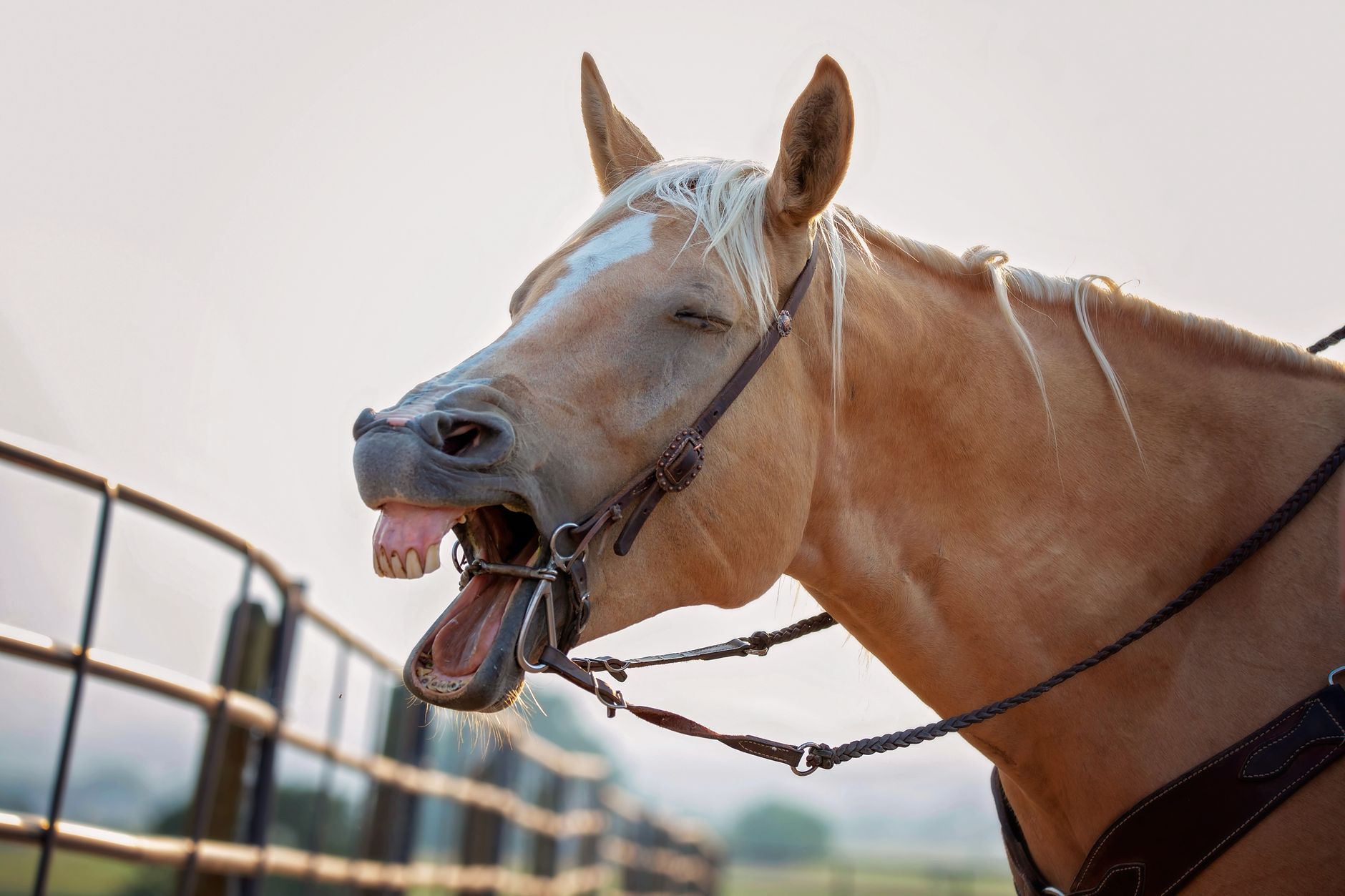
No, that’s not Mr. Ed — does anybody reading this remember the talking TV horse Mr. Ed, and his human companion “Wwwwwilburrr”? This stallion is showing the flehmen grimace described above when he smells a mare in heat. There were many other examples, but I just thought this was the clearest, and the funniest!
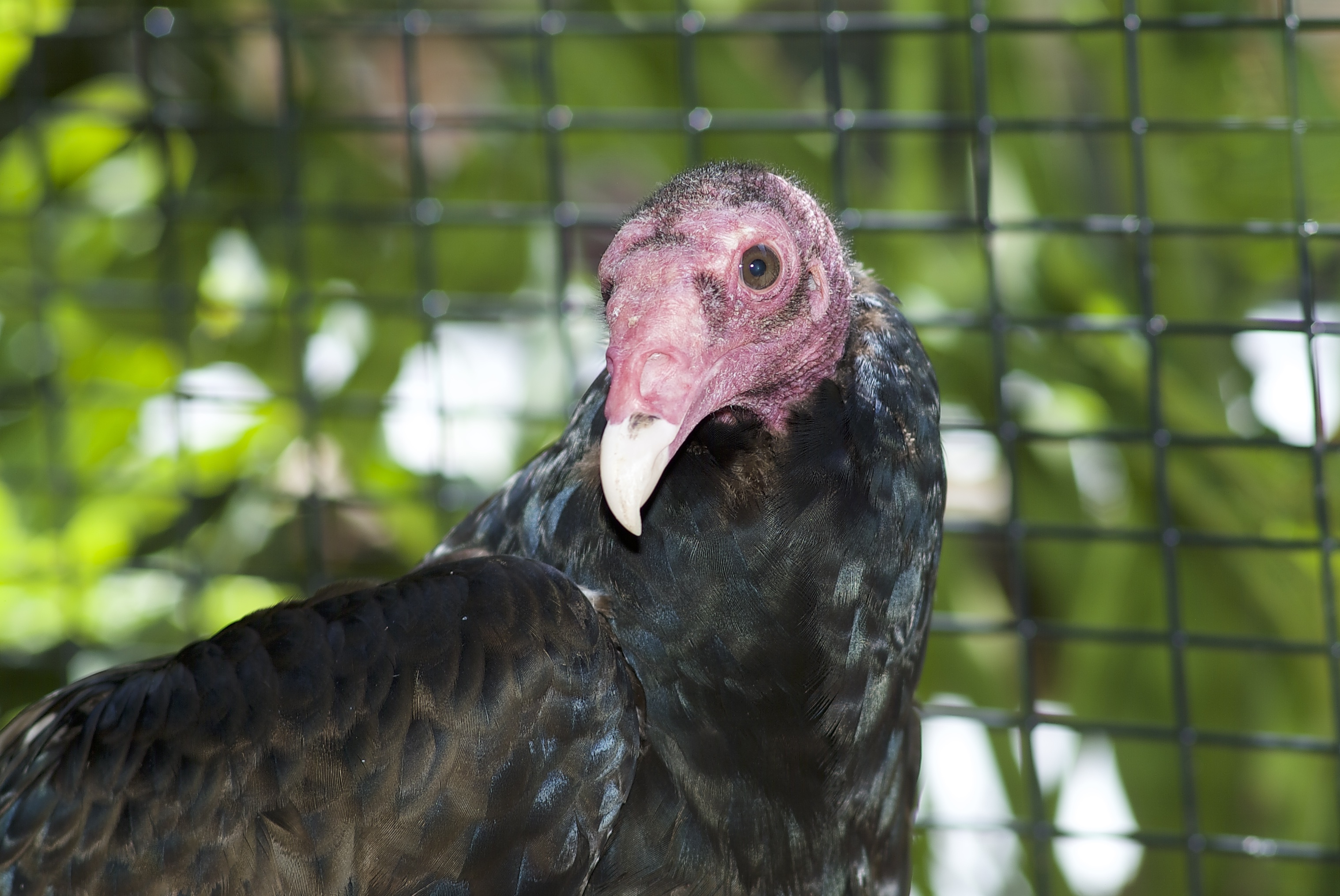
Above, a turkey vulture, photographed at the Peace River Wildlife Center in Punta Gorda. This bird, although otherwise healthy, could not fly, and thus ended up in the shelter. MjB photo.
So we can say, without exaggeration, that smell plays an ENORMOUS role in the life of most animals (except avians, for most of whom smell has been replaced by sharp, color eyesight). AFAIK, the only North American bird with a distinctive sense of smell is the turkey buzzard, and I think you can guess why! The stench of rotting flesh is like a whiff of his/her momma’s cooking wafting out an open window! (Vultures are so immune to everything, they can even eat animals who have died of ANTHRAX –– the disease, not the deceased heavy metal band popular in the 1980’s!) In fact, black buzzards, a similar species larger than the turkey vulture with almost no sense smell, parasitizes their cousin vultures by observing their behavior, following them to a kill, then chasing the turkey vultures away so THEY can feed! Some gratitude, huh? Freaking BIRDS! As a photographer I hate them, because they’re so damned FLIGHTY!
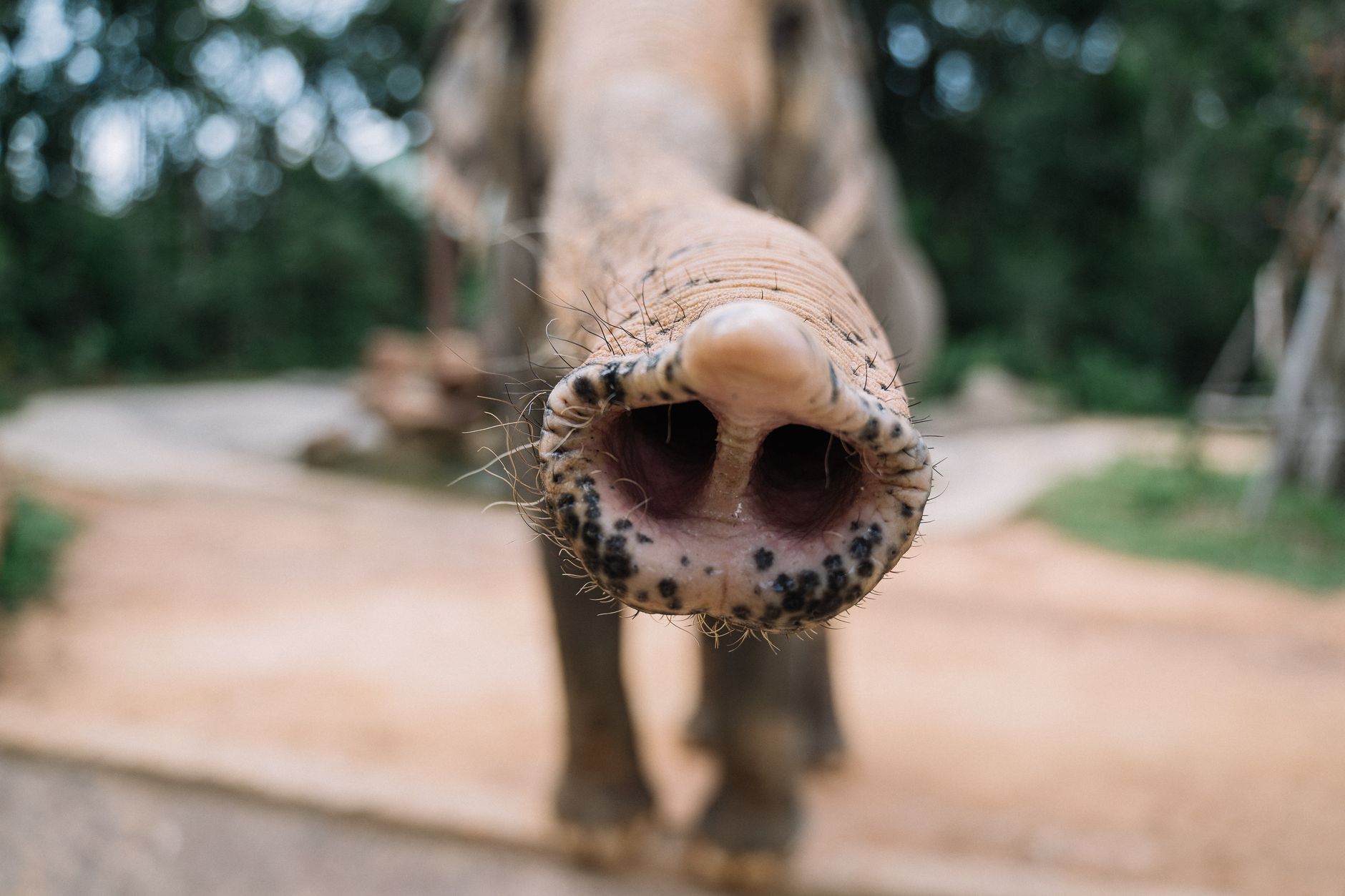
The business end of an elephant’s trunk. Oh, wait — it only has one end! Sorry about that, Chief!
Scientists estimate that a bloohound’s sense of smell is between 100 to 10,000 times more powerful and discriminating that ours, and the giant, formidable brain of an elephant revolves around smells the way a human’s is based around sight. Their sense of smell is about 5 times more powerful than ours, but it is intensely discriminating, and you know what they say about elephants… they NEVER forget, and what they don’t forget is your unique SMELL! They literally build their conceptual world around smells, and you can tell how important smells are to an elephant by their one, unique physical feature: the trunk, which measures six feet long (1.8m) on average.
Please hang on, I’ll get around to what all this has to do with dolphins very soon!
A trunk is the solution to a smell-oriented proto-pachyderm’s problem which occurs as you evolve to grow bigger and taller: AS YOU GROW, YOUR NOSE GETS FURTHER AND FURTHER AWAY FROM THE GROUND, and as in most animals, the ground is where the action is when it comes to smell, because that’s where animals urinate and defecate, which tells other members of their species everything they need to know to have a good time with them!
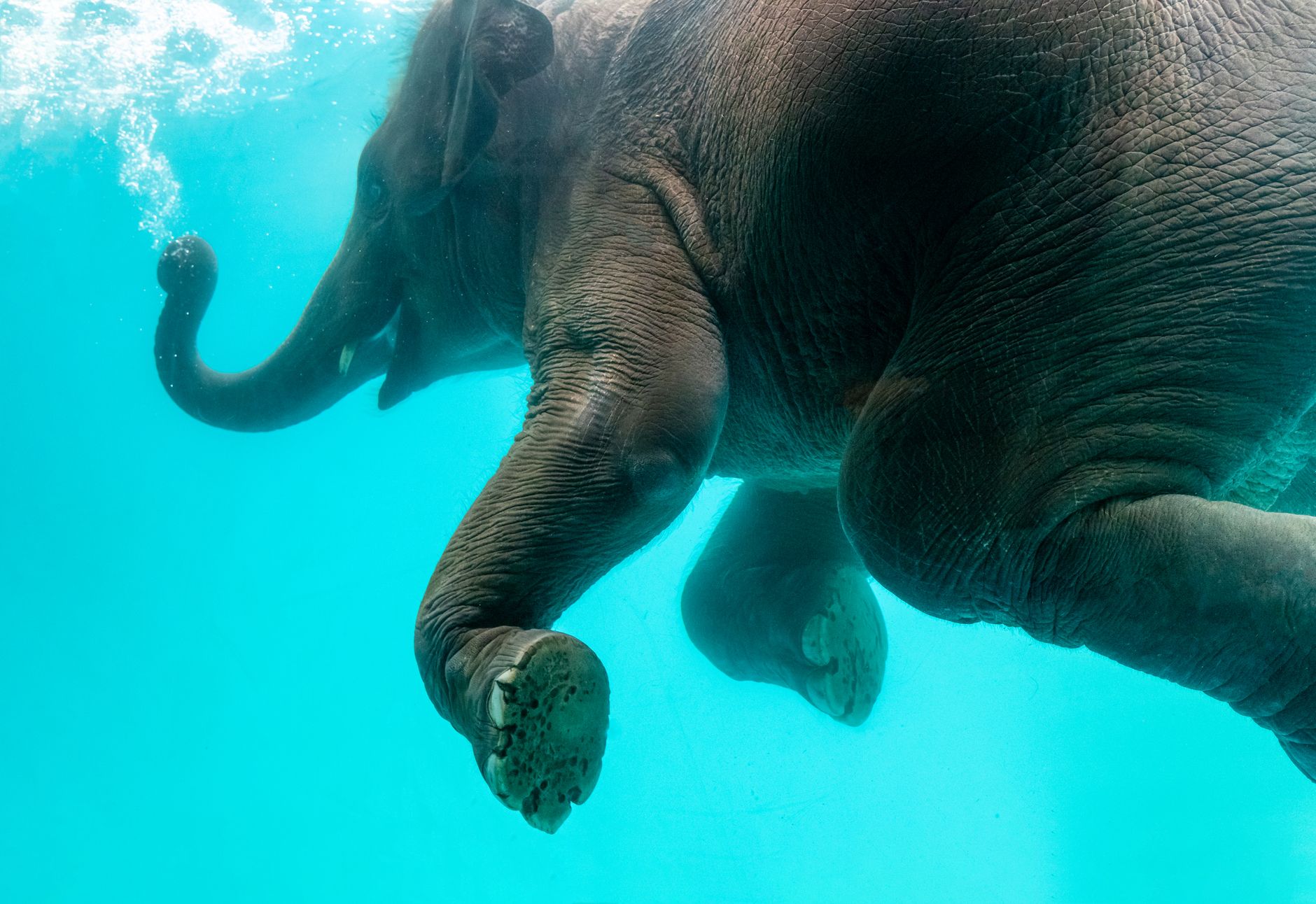
Now, here’s where we get to the dolphins. As what is an essentially a nose, elongated to an absurd length and equipped with astounding muscularity, the elephant’s trunk also has been observed to serve as a natural snorkel when the animal is swimming beyond it’s depth! To do this it curves the trunk into an S-curve for two reasons. One, this curvature makes the trunk stiffer and more resistant to the pressure of the elephant’s swimming forward. The second reason is somewhat more primal: SNORKELS ONLY WORK WHEN YOU’RE SWIMMING RIGHT AT THE SURFACE, because of water pressure on your rib cage and your lungs inside it. This particular S-curve may also reduce somewhat the air volume of the trunk, which makes it easier for the elephant to expel stale air after each breath.
While sharks have a famously highly evolved sense of “blood in the water” (how does one part per billion sound?), a comparable predatory mammal, which evolved on land before returning to the sea, obviously isn’t going to find an airborne sense smell useful if it spends 99% of its time living underwater, as a dolphin does. And a trunk is only a short-term, short-reach solution to this problem, as we have seen with elephants! So what is the Cetacean order’s solution? Well, evolution pretty much dictates that any organ, limb or ability that isn’t being used regularly from day-to-day by individuals or from generation-to-generation by a species will atrophy, because the genes for it don’t get reinforced by need, and because, you know, Entropy! Chaos! Things always go from good to just OK to bad, then they disappear. Often forever.
Bottlenose dolphins, I have it on good authority (Dr. Randall Wells, director of the Sarasota Dolphin Research Program, in casual conversation over lunch circa 2016), have had their current, beautifully streamlined physical form for about 25,000,000 years. Around 12,000,000 years ago, for some strange reason, their brains almost doubled in size to their current volume, 110% of ours. (That gives them the second highest brain-to-body weight ratio, after us humans.) In that recent evolution, their brains lost ALL sense of smell! There isn’t even a vestigial remnant of an olfactory lobe buried in dolphins’ brains. All the brain volume that used to be devoted to smell is now re-occupied by a novel sense, a sense that, unlike smell, requires a great deal of interpretation to be effective, a sense that only one other order of mammals, the Chiroptera (bats) have mastered — I refer to the science and dark art of echolocation! It’s the dolphins’ ace in the hole, their primary sense of determining whether anything is swimming around them and what it is, maybe even what it had for lunch!
Furthermore, exactly what is a dolphin going to smell on the high seas when its blowhole (which is its nostrils, for idiots who find that term smarmy, and they will kill you without a moment’s hesitation if you mess with it) emerges ever-so-briefly from the water, exhales and inhales with a sound like a muffled shotgun blast, in 1/20th of a second? I’ll tell you what it’s going to smell, the SALT WATER all around it! And not damn much else. Connecting back to taste, scientists, ever curious, have also demonstrated that dolphins, who always swallow their fish whole and head-first, don’t have much a sense of taste, either! Figures: If jaded human gourmands complain that everything tastes like chicken, then dolphins are entitled to complain that everything tastes like fish, except when they catch an octopus, or tease a pufferfish until it gets them high! And it’s a good thing they do get high like that, because let me tell you, brothers and sisters, those stubby little pectoral fins of theirs are absolutely no good for rolling joints! Not to mention they can’t keep their Zig-Zags® dry, most of the time.
That’s how dolphins lost their sense of smell. Losing it doesn’t seem to have made much difference to their success! Now, let’s look at the evolutionary factors that have also made the sense of smell pretty much irrelevant to human life and reproduction!
In contrast to the dolphins, humans’ sense of smell evolved in the jungle, where our predecessors lived much like gorillas or chimpanzees, foraging mainly fruits and vegetables but occasionally snacking on road kill, and even less frequently, killing something themselves. (ROAD KILL? Did I really write that? Sheesh, somebody smack me upside the head with a 2×4! You know what I meant! Right?) Smell must have been vitally important to them, not only to detect ripe fruits, potential predators, edible vegetables and safe magic mushrooms, but to determine the reproductive status of eligible females, in other words, SNIFFING AROUND TO SEE WHETHER OR NOT THEY WANT TO GET DOWN, BABY!
Chimps are basically quadrupeds that have learned to use all their limbs as grasping organs, and as such, they can dip a finger or toe into something, then hold it up to their nose to smell it. Or, if it’s something on the dirt, it is relatively easy for them to lower their noses and smell it directly. Not so ancient human ancestors, such as Homo erectus, the first in our direct lineage adapted to walking on its hind legs! Yeah, if you walk upright, you can see a leopard approaching you even in the tall grass, and having your front limbs free frees you up to carry your offspring, a primitive weapon — or anything else! Our vast empire of human technology began its long journey toward atom bombs, space flight and AI not because we got good at chipping flints, that came somewhat later (in the era of Homo habilis, literally “handy man!”). It began when we got up off all fours, walked exclusively on our hind legs, and began to carry things with our tree-brach-grasping, fruit-eating, ten-fingered front arms. Only after our manipulative appendages (hands) had achieved a level of control over very fine motor movements, in coordination with our eyes, were we able to make anything more with flint technology than the crudest of hand tools — the hand adze or a stone axe, for instance, or some other cutting tool.
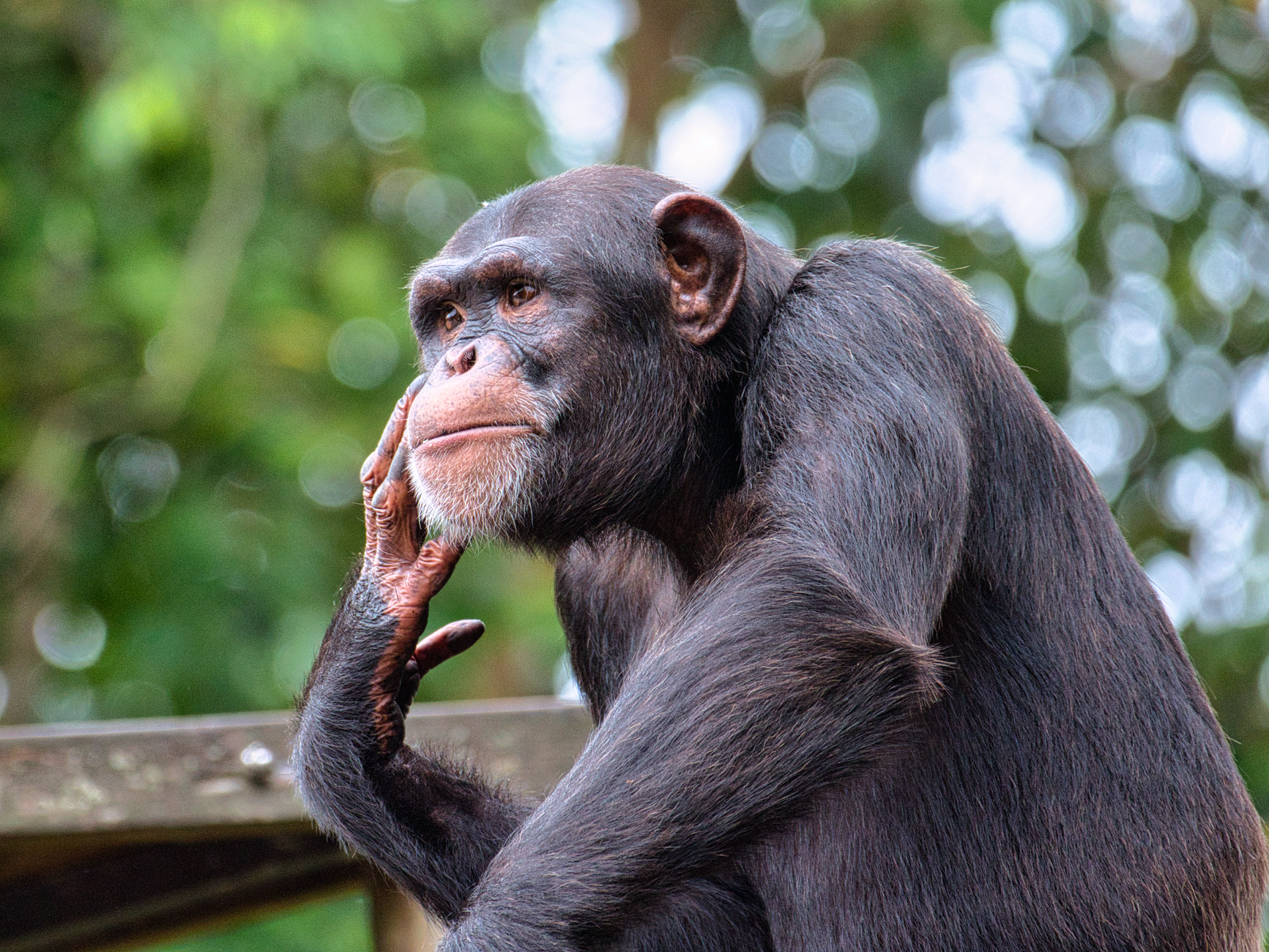
And, as human ancestors stood upright, and removed their noses from ground level, the same thing began to happen to us that happened to the dolphins: OUR SENSE OF SMELL BEGAN TO ATROPHY! “Mercy, Lawd no, whatever shall we do?”
Well, like the dolphins, a process of sensorial replacement had begun, and, like the dolphins, it led in a very interesting direction! Since all olfactory mating cues had been eliminated and replaced by postural and vocal communication in the dolphins, and those same cues’ effectiveness for us had been drastically reduced by upright posture, we began to develop alternatives, and one of them might be that we both have sex far more often than other creatures do, and not always when the female is in estrus (right after her menstrual period, in my experience)! People who usually know nothing about the habits of other species, or about sex, usually claim something stupid like, “Humans and dolphins are the only two animals that have sex for pleasure!“
Okay, on this statement I call not just bullshit, but TOTAL BULLSHIT! Pleasure is what sex is about for ALL animals, certainly all vertebrates who indulge in it — only a few fish have internal fertilization, like sharks and livebearing tropical fish such as swordtails and guppies. I mean, why else would female animals surrender to their mate’s desires, and their own? For King and Country? For love of Jesus? A direct order from God, “Thou shalt submit to thy mate because I say so”? Is it “our duty to the Party” (think Orwell’s 1984)? When any two animals rendezvous to mate, REPRODUCTION is the LAST thing on their minds! For one thing, who’s telling them that mating leads to pregnancy and birth in a language they can understand? Secondly, mating is so often separated by a span of time — months, or even years (horses, elephants, whales, etc.) — from the actual birth of the offspring of the matings that there is no apparent connection between them, except that the stallion went into the mare via the same orifice the foal came out of — but hey, what does that have to do with anything?
When mating, all animals are eager for is the Big Bang, the orgasm of penetration and communion felt by both partners, the deepest physical pleasure the couple can experience, very definitely an act worth repeating at any price, even fighting off the rivals who are competing for your partner’s attention! Making anything but a direct, tangible, and immediate connection between two events so separated in time as copulation and parturition (birthing) is beyond most animal’s minds, they don’t think substantially in terms of cause and effect as we humans, conditioned by chipping flints for, oh, say, a million years, do.
Relating to this, for many years, or maybe even decades, there was in behavioral science an utterly unsupported opinion — and nothing but an opinion quoted widely, as if it were a fact — that “FEMALE ANIMALS DON’T HAVE ORGASMS.” Now, first of all, this is an unfalsifiable negative hypothesis, because even ONE INSTANCE of one female animal having one orgasm is enough to crumble it. Another is that the definition of “female animals” never includes HUMAN FEMALES, which I understand are large female animals who are capable of enjoying orgasms, just like men, except since they don’t ejaculate semen, they can orgasm over, and over, and over again! (Or so I have been told.)
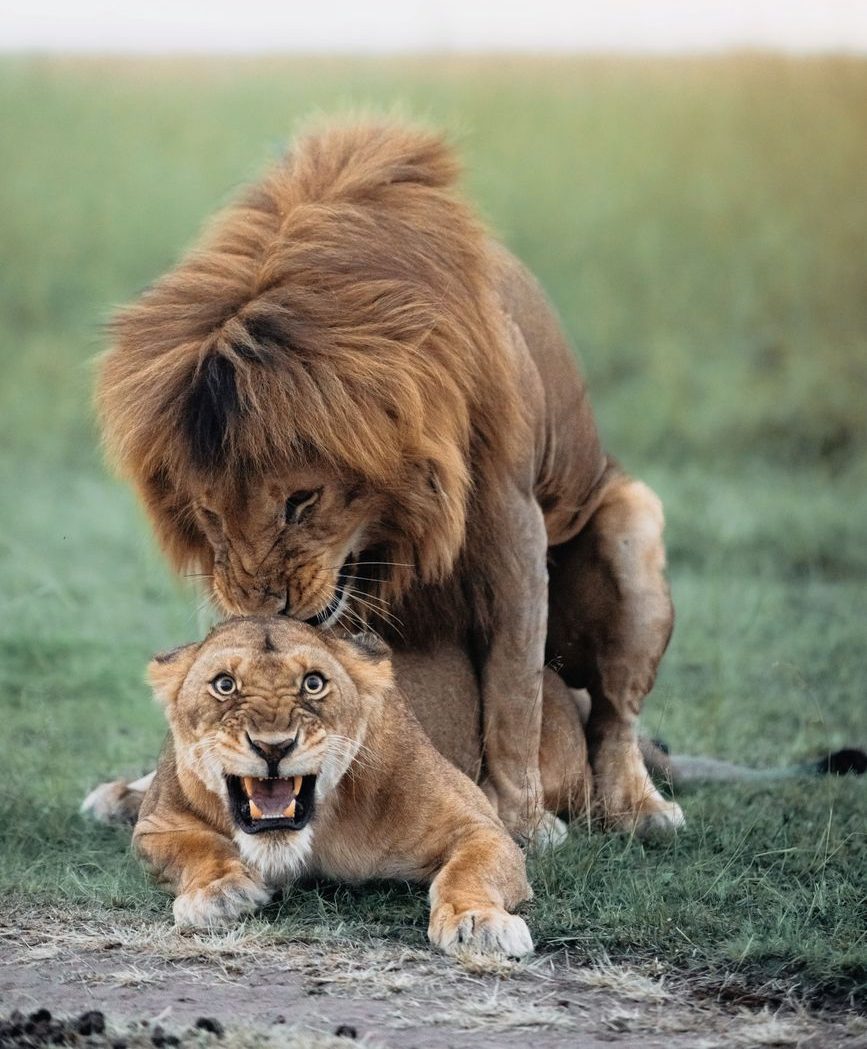
You find this utterly unsupported urban myth in the writings of such diverse authors as hard science fiction writer Larry Niven (Ringworld) and psychologist Jacob Bronowski (The Ascent of Man), and it is untrue no matter who claims it. (And, as a zoophile, I do know a thing or two about giving female mammals in estrus orgasms!) That this was a rank PREJUDICE, rather than an indisputable scientific fact, was proven to me beyond a shadow of a doubt when I was giving another New College student, who was perhaps foolishly trying to study dolphins there, a ride home. I was telling her about my experience with Dolly, the curious dolphin: “…and as we climaxed, she groaned just like a woman, and Jimbo (the jealous male dolphin in the next pen over, whom we cuckolded) could also hear her,” I explained.
The student looked at me like I had two heads, then flatly stated, without a mentioning a shred of supporting evidence, “But female animals don’t have orgasms!” In saying this, I assume the student was EXCLUDING HERSELF AS A FEMALE MAMMAL, which is a damn short-sighted thing to do, because are we not all Bozos on this bus, as Firesign Theater said long ago? And do not female animals come equipped with approximately the same reproductive equipment the student had, a vagina and clitoris? AFAIK, the only two female mammals who might not have the clitoris, the only organ in the human body devoted solely to pleasure, are both marsupials — the platypus and the echidna. Female zoologists have not only established the pre-eminence of the clitoris as an organ of pleasure supreme, they have ALSO FOUND CLITORISES IN ANIMALS WHERE NONE WERE EXPECTED TO BE FOUND — female reptiles, for instance, even snakes, whose penises are covered with spines that lock the two reptiles together for the duration! Male scientists had just overlooked the clitorises — something that happens far too often in the non-science real world! (What my women friends say, anyway.)
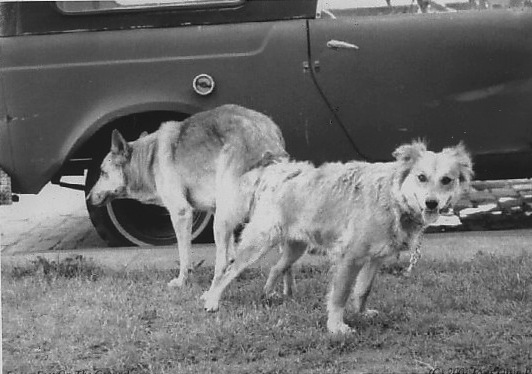
In fact, a female non-human animal of almost ANY species is more likely, when mating, to experience orgasm than a human woman is. Why this, you ask? Again, it has to do with our upright posture! In most quadruped mammals, the clitoris is located very close to the opening of the vagina, and on the vagina’s ventral side (“bottom”). This is prime positioning for the clitoris to be directly stimulated by attempts at penetration from behind, as well as penetration itself, and subsequent thrustings by the male! Whereas in human females, our upright posture has caused the position of the clitoris to shift forward, moving it away from the opening of the vagina and making stimulation from only penetration less likely. We humans didn’t invent foreplay by any means, but we are one of the few animals who make such a big deal out of it, because around 50% of women can’t reach orgasm just by penetrative sex alone! They require oral, manual, or vibrator stimulation to push them over the edge, into a climax.
But, clever tool-users and cunning linguists that we are, we have adapted — just like the dolphins — to our new status! Let’s just get rid of the antiquated sexist notion that female non-human animals don’t experience orgasms. What explains this anti-orgasm attitude among behavioral scientists is that a lot of female animals don’t have a distinctive ORGASM DISPLAY! And why should they? Mating from behind, as most animals do, the partners cannot routinely see each other’s faces or expressions. Only the male animal mating with the female is privileged to know whether she has had an orgasm or not, by the reaction of her vagina and uterus to his penetration and thrusting!

What can we say, in conclusion? Both humans and dolphins are unusual mammals because neither of us depend on a sense of smell for routine matters, like individual recognition or the detection of oncoming estrus. In the dolphin, evolution has scrubbed their brains of olfactory lobes, useless for life in salt water, and replaced it with vivid behavioral gestures and vocal cues. In our own case, we have greatly reduced the typical role of smell in human society; indeed, do not some pharmaceutical industries make a great deal of money selling deodorant to overly-redolent humans? We have relegated smell, the most profound and worldly sense in most mammals, to a sensory hobby, a trifling, secondary thing, often only becoming aware of it when, through exertion or stress, our body odor becomes unpleasant to others. Sad.
The replacement or reduction of smell as a vital organizer of social and sexual life has happened in both humans and dolphins, making us almost totally unique among mammals. In both cases, smell either has been abandoned, or is becoming less important, due to those species’ evolution and their adaptation to new environments, or more complex ways of life. This has worked out well for human society and social organization — can you think of the mess we’d be in as a society if, like stray dogs, a pack of males would gang up on a female and the biggest and baddest dog of the bunch would get first fucking rights? Would it be possible to concentrate on chipping spear heads, or programming the Grok AI to argue with me, if women in estrus smelled irresistibly attractive, and available to any man in contact with them?
Smell, for the dolphins, must be a mysterious sense, like echolocation is to us only more so, because humans do possess some rudimentary sense of echlocation, which often becomes active when people are blinded. That’s why blind people tap with canes, because they can detect the echo of a wall or other obstacle. But dolphins have nothing to smell with, and would undoubtedly be surprised to find out that almost all other animals can pluck ephemeral information about their comrades, opportunities for sex, or existential threats, from the gases swirling momentarily above their blowholes when they breathe. And that is one of the major ways in which humans resemble dolphins, but without nearly so much blubber!
And then there is this final oddity: scientists studying the primitive pink river dolphins in the Amazon Basin were amazed to observe and document a senior male dolphin erecting his penis and urinating onto the snout of a subordinate male! It turns out that all dolphins are born with tiny, vestigial hairs on their snouts, which drop out shortly after birth. What stays behind are the pits in which the hairs grew, which apparently harbor tiny sensory organs that give the dolphin something LIKE a sense of smell, although more like a sense of taste. And I found this inarguable. When Dolly was courting me, I remember a time she got very upset, because I was trying hard to discourage her from masturbating on my sneakers! We swam into the shallows, where I could stand but most of her body was still underwater, and I decided nothing too bad would happen if I just rubbed her genital slit (basically her labia majora, her outermost sexual nexus) gently with my hand. To my utter amazement, I felt a flow of hot fluid — Dolly was pissing on me, with a look of utter exasperation on her face, as if I had to be the stupidest human on the Earth! Apparently bottlenose dolphins also have those estrogen receptor sites on their snouts, and if I’d been a male dolphin, I’d have gotten, and been able to interpret, the meaning of that snoot full of Dolly’s liquid lust! It wouldn’t have changed things, much, but it would have meant we’d have moved on more rapidly in our relationship.
But for us humans, the best we can expect from our pathetic human sense of smell is campfires, coffee, flowers, and the scent of someone we love. Smell awakens evocative memories, and long-lost experiences like recalling the way a cup of hot tea, with a tiny crumb of madeleine in it, smelled and tasted on a dark Paris morning, a remembrance of things passed.
Next: Do You See What I See? A Look at Vision.
© 2026 by Malcolm J. Brenner. All rights reserved. Apologies for stealing Lynyrd Skynyrd’s song title, but if I had to do it all over again, I’d do it just the same.

