Brooke Rollins, Secretary of Agriculture under King Donald the Last.
The following email, apparently from the late author Malcolm J. Brenner, was found on the computer of Dr. Randall Wells, co-founder and director of the Sarasota Dolphin Research Program.
Dear Randy,
It’s been a while since we’ve corresponded, but in my ramblings in dark, dank corners of the Interweb, where even the brave dare not go but fools like me rush in, I found something is pending in the government of which I MUST make you, and hopefully through you every marine mammalogist and cognitive psychologist in the business, AWARE OF!
This shocking revelation will rattle dolphinology to its muddy, mucky foundations!
I have it on deep, deep — VERY deep! — background, from utterly trustworthy, irrefutable sources which must remain anonymous due to threats to their security — that Trump’s appointee to run the Department of Agriculture, Brooke Rollins, has decided that all the creatures hitherto known as Cetaceans are now going to be re-classified as Fish! And the scientific community, eager to keep their grants going, is apparently falling into line behind her! This in keeping with presidential re-naming the Gulf of Mexico (America), the Department of Defense (War), right and wrong, hot and cold, day and night, etc.
Justifying this radical decision, Ms. Rollins cited the great American author Herman Melville, who declared it so in his Moby Dick.“Melville lived among cannibals so he could write this book,” Ms Rollins said. (She didn’t mention that he jumped off a whaling ship to live among the cannibals, and said he preferred their company to that of whalers!)
And if I remember the abridged version of that novel which I read at our beloved alma mater Riverview HS, Melville IS of the opinion that the whale IS a fish, and damn all those long-haired scientists who maintain that since it has lungs, breathes air, is warm-blooded, bears live young and suckles them, it’s a mammal! They’ve had their noses in erudite books all their lives, whereas Melville had his nose stuck in the guts of a whale, and if Melville said it, Trump & Ms. Rollins believe it, and THAT SETTLES IT!
I sincerely hope this doesn’t disturb you too much, but there’s more. I could tell you, but then something might… just a second, someone’s at the door… BRB…
Thank you very much, Dr. Wells, for all you’ve done for those creatures formerly known as marine mammals. It’s been nice meeting you, even under such misfortunate circumstances as have apparently occurred to Mr. Brenner. It seems his iMac (! Was he asking for trouble or what?) burst into flames, consuming him, all his computer files, his residence, and all remaining copies of his works.
Let me assure you, ATF will conduct a full and thorough investigation into this matter and find the culprit, even unto the ends of the Earth! One theory, that Mr. Brenner was trying to run Windows on a Mac, has been discredited by members of his family. “Malcolm would never be THAT stupid,” they said, on guarantee of remaining deep background. (We trust you, so their names are Sally and Hugh.)
Peace be with you and the Chicago Zoological Society, Dr. Wells! Let me re-assure you, just go along with the reclassification of dolphins as fish, and all will be well for you and the Santaroga Dolphin Rehabilitation Project!
Sincerely yours, Ms. Brooke Rollins, Secretary of Agriculture and modern embodiment of the Goddess Ceres.
(Note: Dr. Wells’ mysterious disappearance is attributed to his reported abduction by a pod of dolphins after he fell out of his survey boat, their motives a total mystery. The search continues.)
(Originally an email to about 40 of my friends and acquaintances on Feb. 20, 2025.)
Hi, friends, fans and family, foes, fools, and frolickers, freedom-fighters and fellow-travelers,
I hope you’re doing well, or at least mostly adequate. Out of sheer, mortal desperation, I have started a fundraiser on GoFundMe, and it would mean so much if you could take a look at it! (See URL below.) How much?
The page has some pretty fair pictures of me on it, taken back when I was actually handsome, and AI didn’t write a word of it! Any help, like donating $$$ or sharing, gets me closer to my goal of not having to beg my reluctant and somewhat unpredictable relatives to save me from starvation, getting my lights or water turned off, or having to go straight for a while. Reality! What a major buzz kill, dudes! How do you cope?
I am hoping to raise $200-250 a month, which works out to $3K/year, to supplement my tiny Social Security check. (How tiny? Do you have an electron microscope?) Thanks in advance for your kindness, generosity and support! Just don’t expect the Universe to reward you for your goodwill, okay? It doesn’t work that way, and yes, it is disappointing.
In an effort to log some history, and also to chronicle my own exploits, I present this article from an old, old issue of the slick, slightly left-of-center magazine NEWSWEEK, which is still hanging around in digital format! This was the first article I’d ever seen, at the tender age of 11.5, that mentioned dolphins in connection with extraterrestrial aliens — which, in essence, is what the dolphins are, living in our own oceans instead of those of Jupiter, Uranus or Xagramorfagel (if you haven’t heard of the last one, don’t worry, it’s going viral any day now!). My favorite novel at the time being Robert A. Heinlein’s Star Beast, about a pet alien and his boy, I was, of course, extremely eager to make a dolphin’s acquaintance, as I was sure they had nothing better to do than hang around, waiting for me to show up! Here, then, although I do not know the author’s name, I present the first article I encountered to mention dolphins in connection with ET aliens!
Newsweek: Space & The Atom Oct. 22, 1962, pg. 51
FIVE PEEPS AND A TWEET
Man’s first contact with extraterrestrials may never come — or it may be only a beat in history away; his giant radio telescopes could pick up a message from space tomorrow (July 22, 1960). But when it comes to working out a system of interspecies communication with a species that may not even exist, man is still in kindergarten. This lack has long worried space scientists, who think that the parties at each end of the “telephone” might have everything to say to each other and no common way to say it.
One suggested way of surmounting this embarrassment is to practice communications with other species on man’s own planet, but which species? In answer, the National Aeronautics and Space Administration has made its choice, and not surprisingly it is the bottlenose dolphin. Under an $80,700, one-year grant from NASA, communication with the brainy mammal will be explored by the dolphins’ old friend, Florida neurophysiologist Dr. John Lilly, who has been studying them since 1955.
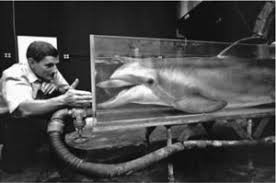
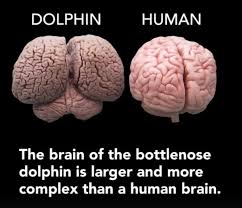
Dr. Lilly, who is convinced that “man will communicate with another species in a decade or two,” has long considered the dolphin the most likely possibility. His reasons: Dolphins’ brains are larger and more complex than man’s; they talk to each other in a high-speed language of whistles, click, squawks and blats; and they can produce an eerie mimicry of the human voice, even copying subtle inflections (one recently mimicked the Southern drawl of Lilly’s assistant). Dr. Lilly is now feeding tapes of dolphin sounds to a computer, which will sift them for a meaningful pattern. “It is possible that their intelligence is comparable with ours, though in a very strange fashion,” he has said. “They may be a group with whom we can learn basic techniques of communicating with really alien intelligent life forms.”
Say It With Shapes: Such technologies would obviously be of vast assistance to space scientists. Although few expect that man will ever drop in on the residents of another solar system (the trip could take centuries), they haven’t given up on earthbound communication. Before the advent of radio, all suggestions for signaling extraterrestrials were optical in nature: Flashing messages with large mirrors and searchlights, or cutting vast geometric patterns out of forests and farmlands. [Italics added for emphasis, this seemingly suggests “crop circles” a full decade before they were first reported by UFO investigators!]
Far more practical schemes accompanied the development of powerful radio transmitters. The problem is what to translate. One of the most elaborate schemes is that of Hans Freudenthal, a Dutch mathematics professor writing in English. Called Lincos (for Cosmic Language), it depends upon the supposedly universal concepts of mathematics. First Freudenthal would teach the extraterrestrials the idea of “greater than” by sending five peeps, followed by a different signal—perhaps a tweet—and then three peeps. This would be repeated, using several combinations of peeps, until the listeners had equated “greater than” with the peep signal. Similarly, the concepts of “less than,” “equals,” “plus,” and “minus” could be taught. Eventually, Freudenthal hopes to transmit an elaborate mathematics language, then go on to the tasks of sending lessons in physics, physiology, and even ethics.
TV Images: A simpler sounding plan—the transmission of TV images—has been suggested by Dr. Frank Drake of the National Radio Astronomy Observatory in Greenbank, W. Wa. It is based on the principle that television pictures can be broken down into tiny dots of light. The different intensities if the dots can be translated into correspondingly differentiated such as dots and dashes, frequencies, or numbers, and sent as radio signals. Drake hopes the aliens would understand this principle and reconstruct our television pictures from the signals.
Yet both these ingenious plans, and many like them, rest on the fragile assumption that the extraterrestrials think as we do. Perhaps they do: then again it is conceivable that mathematics and inductive reasoning may be as foreign to them as their worlds and bodies might appear to us. Here lies the potential value of the dolphin—a creature operating in an environment perhaps as alien to humans as that of Mars. Even the slightest clue to how such a creature thinks could eventually lead to radically different approach to placing interstellar “telephone calls”—or a new method of analyzing space static to discover is someone is trying to call us.
But this is a long way off. “Right now we don’t expect any dolphins to teach us how to talk to Martian ants,” a NASA official cracked last week. “We’re simply trying to decode their own talk.” What happens after that, of course, depends on what they have to say.
###
Analysis: This article, and several others like it in LIFE, Look and other popular publications opened my eyes (and ears, don’t forget the ears) to the possibility of communicating with dolphins! As an avid science fiction reader, I was delighted with the idea that our seas might contain a comparable form of non-human intelligence. I eventually got much more than I expected, by about 2 or 3 orders of magnitude, with Dolly!
The last paragraph of the article is particularly telling, and sad. The famous anthropologists Dr. Gregory Bateson & his wife Lois Cammack had joined Lilly in the Virgin Islands to see what was going on, and, a year later, “See if you’re smart enough to decode their talk before you try to teach them ours” was Bateson’s parting shot. He later wrote “Steps to an Ecology of Mind,” a book which I tried three times to read, and failed miserably each time.
And this is what Lilly’s most vociferous critics complained about his research, quite properly: HE NEVER PROVED THAT DOLPHINS EITHER USE OR COMPREHEND LANGUAGE BEFORE HIRING MARGARET HOWE (LOVATT) TO TEACH THEM ENGLISH! In scientific terms, this is serious cart-before the horse-putting, and it is an obvious no-no! Why, then, did Lilly pursue it so devotedly?
It strikes me, from both reading his writings and my personal experiences with him, that Lilly had to some degree an obsessive-compulsive disorder. This is common in scientists who strive under pressure for a high degree of accuracy, often to several decimal points. It’s also indicated in Lilly’s own autobiographical novel, “The Scientist,” in his descriptions of his lonely, rather isolated upbringing and childhood.
I can’t really say how Lilly handled major disappointments, because I never observed him doing so. But one of the privileges of whiteness, wealth (which Lilly had in relative degree) and education is that you’re insulated, to some degree, from failure. It may be that, as the evidence that he was on the wrong path accumulated, Lilly stuck more and more strongly to his abortive theories because he had to, to support his rather expansive ego. To admit he was wrong would be uncharacteristic of him, until much later in life.
There was also the practical aspect that Lilly had, with the establishment of the Dolphin Communications Laboratory, taken on the care and feeding of three, 400-lb. (180-kg.) adolescents who could smack you through a concrete wall, if they wanted to. It’s a big responsibility, and I don’t think people are going to give you much money just to study dolphins to see if they maybe, possibly, HAVE a language!
Finally… finally, sometimes a scientist, like everyone else, has a strong hunch that things are heading the right way, that they can disregard everybody else, that they can break the rules and still win! Such feelings are hard for a logical, rational mind to resist, precisely because they are not rational nor logical. But neither having a strong hunch, nor following it to the bitter end, makes one automatically right! Appearances can be deceiving, and as often as not, it is ourselves we deceive.
What matters to me is, I found something I wanted to pursue, and I have pursued it all my life. Maybe not as a scientist, but that doesn’t mean I haven’t made remarkable discoveries, such as this: WE HAVE HAD LIVING BESIDE US, UNNOTICED, FOR MILLIONS OF YEARS, ANOTHER SPECIES OF LIFE THAT ROUTINELY ENGAGES IN MANY OF THE SAME HIGHER-ORDER FUNCTIONS THAT WE HUMANS DO: COMPLEX PROBLEM-SOLVING, SOCIAL AWARENESS, INDIVIDUAL AND GROUP IDENTITIES, ETHICS, THEORY OF MIND, and has enough imagination to realize that in some ways this odd, upright ape with the clever fingers IS RATHER LIKE ITSELF, in that our minds have strange and significant similarities!
We humans, as the dominant species on Planet Earth, need to acknowledge that a non-technological species, which cannot even open a can of beans or unfold a Swiss Army knife, is Number 2, and in the ocean, they are, and always will be, Number 1! Due to their 12-million year head start on us in the Large Brains Department, and their incredible record of sheer SURVIVAL over that time, we should be approaching them as older and wiser beings, with the respect and deliberation they deserve. Let what nature writer Loren Eisley called “our long human loneliness” finally be over, as we are re-admitted to the order of Natureby our old friends, the dolphins!
The author as he appeared in the 1970’s, eavesdropping on a chat between a dolphin and a Martian ant, whose appearance is thanks to NASA. Biden’s going to announce it next week, no, REALLY!
In Part I, I discussed the Caldwells, a married couple of scientists who authoritatively declared, in their 1967 book The World of the Bottlenose Dolphin,“Dolphins are not little humans in wet suits.”
They said this in an attempt to lay to rest what they felt was rampant, emergent pseudo-science about the “intelligence” and “spirituality” of dolphins coming from the John C. Lilly/Paul Spong camp of non-marine-biologist dolphin researchers, who experimented with then-rampant psychedelics, played jackhammers (Lilly) or wine glasses (Spong) to their subjects, and communed with them — psychically! (Or so they claimed.)
This series discusses some of the many striking similarities we DO share with dolphins, in this essay, self-recognition and self-awareness.
If David and Melba were alive today, I wonder how they would dismiss these similarities? Like debunking astronomers who claim, without actually researching, “No astronomer has ever seen a UFO,” (Jacques Vallee, J. Allen Hynek and Carl Sagan come to mind, among others), marine mammalogists come up with all kinds of fantastic explanations for the advanced reasoning capabilities displayed by dolphins, and their insights into situations, especially power-structures, even human power-structures, which must be very similar to their own to be recognized as such!
About 25 years before the two scientists who ran the mirror experiment arrived on the dolphin scene, a former atomic physicist named Horace Dobbs took to SCUBA diving with Donald, a “lone wolf” dolphin who hung out in the cold waters off Cornwall, in southwest England. He wrote a book about his experience, Follow a Wild Dolphin, and in it he described what happened when he introduced Donald to his mirror image. The following film shows the results better than I can describe them!
In the film, Donald seems perplexed, and rightfully so: his eyes are showing him something threatening (another male dolphin) that his echolocation cannot get a lock on! What appears deep to his vision is merely a thin, flat panel when he plexes it (a term I have come to use as convenient shorthand for a dolphin using echolocation to locate or identify an object or person). So, in frustration, he gives it a good whack with his snout, sending the shattered fragments to the sea floor, where they now glint back at him malevolently from many sides. He has, in his frustration, only made the problem worse!
Score: Mirror 27, Dolphin 0! Round Two…
Self-awareness, or sapience — being able to think about your own thoughts — is rare in the animal kingdom. It was assumed, for the longest while, that no animal other than Homo sapiens possessed this characteristic, which is most eloquently expressed by recognizing that the face we see in the mirror is our own!
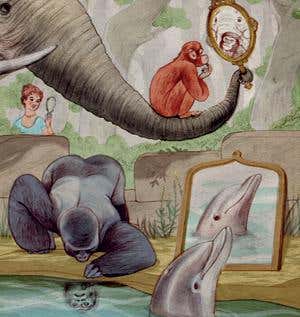
The dolphin-in-the-mirror experiment was definitively conducted in 2001 at the Baltimore Aquarium by two perceptive scientists, Lori Marino and Diana Reiss, for their joint PhD. project on animal cognition. By covering the mirror and marking the animal subject in an out-of-the-way place with a harmless grease marker, the two scientists were able to watch to see if the subject examined itself when the mirror’s cover was removed, a sure sign it knew the reflection was of itself, and not another threat or rival! (https://www.pnas.org/doi/10.1073/pnas.101086398) Their experiment is rightly famous!
As an example of the lack of this ability to recognize one’s reflection, I will relate the plight of a male cardinal, whose nest was perilously close to a parking lot at Babcock Ranch, where I worked as a tour guide. The bird wasn’t in any danger from the cars; however, their outside rear view mirrors were filled with a dreaded competitor, who was somehow always there whenever the cardinal stopped to take a look! I don’t know how many hours it spent fruitlessly battling this intruder, but it was pretty obvious that the instinct to attack things that resembled itself did not evolve in the presence of the looking-glass. Talk about a fruitless task! The cardinal never realized he was fighting his own reflection! He was trapped by instinct, a process that not only operates below cognitive thought, but long before it can get its shorts on!
Experiments with jungle-dwelling mammals show similar results. Leopards, gorillas, baboons, even most chimpanzees, all either attacked their own image in a stainless-steel mirror, or tried to avoid it. In short, we may say that the mirror aroused anxiety in them — I think that is anti-anthropomorphic enough to qualify as a valid assertion, don’t you? Only a few species of non-human animals showed consistent awareness of their mirror image, the ability to use the mirror to locate a mark on their bodies that they could not otherwise see, and examine it! Indian elephants and bottlenose dolphins were two of them. No surprise there, huh? Both have brains up to several times larger than human, with more folds on the substantial neocortex!
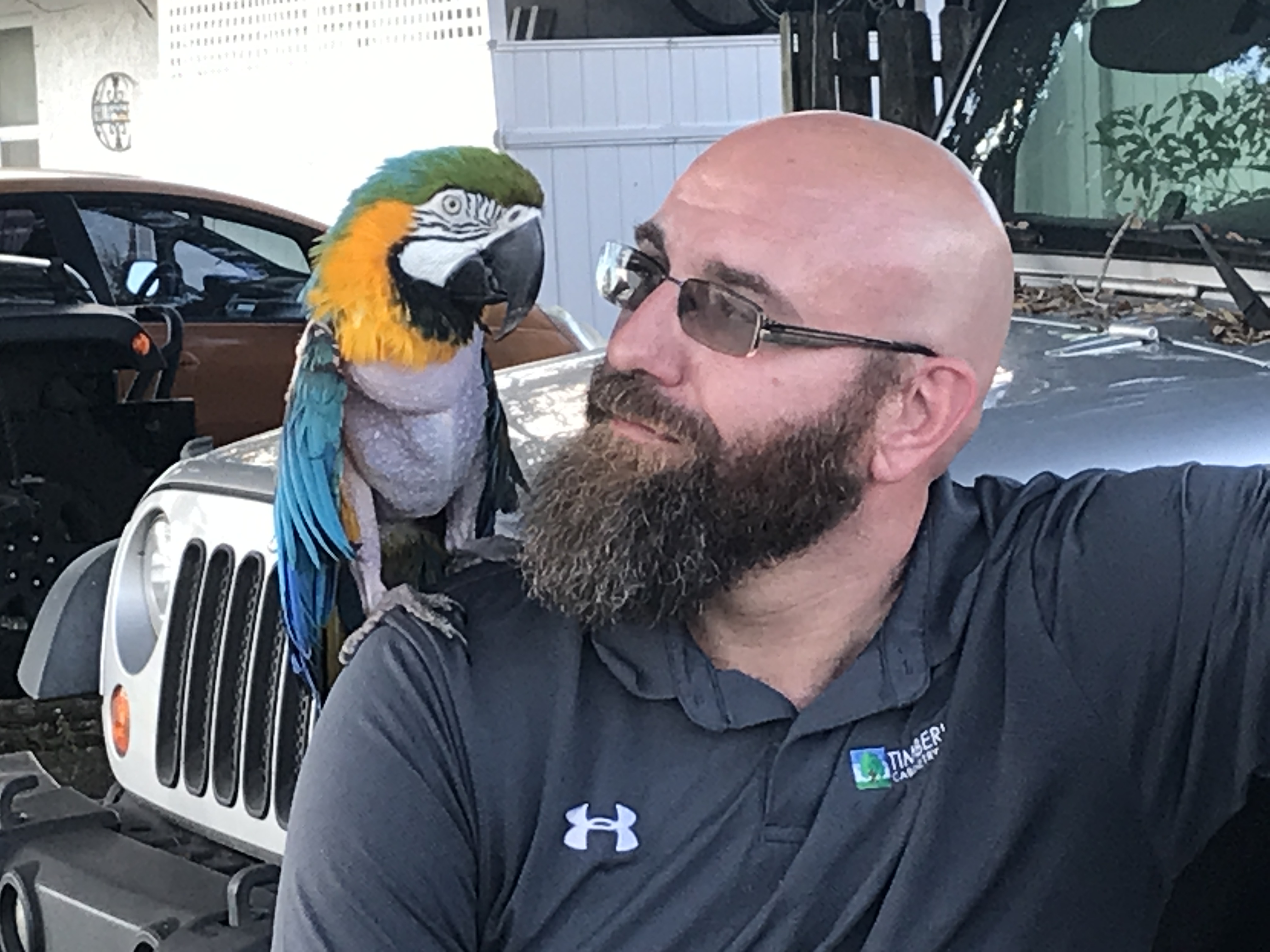
But among the NON-MAMMALS put before the mirror, several AVIANS — the last surviving category of DINOSAURIA! — showed critical mirror awareness, with brains roughly the size of shelled walnuts! How the ding-dang-doodle do they manage that with such tiny little brains? I refer to the Corvids, including magpies, crows and ravens, and the Psittacines, that is, the parrots and macaws, whose intellectual achievements have been shown to be closer to an 8-year-old child than to what we used to mockingly call a “bird brain!” Turns out we were unwittingly complimenting birds, much the way Motorola complimented Sony when a Motorola employee bought the first transistorized shirt-pocket radio!
One factor shared by all, save one, of these creatures (the pachyderms), is the desensitization, and even total loss, of the brain regions devoted to smell. Most birds have no sense of smell, nor do any of the cetaceans; they don’t have the brains for it! Smell to them is like echolocation to us, a theoretical concept.
The olfactory sense must have been the last, and most recent, to evolve in the Permian period, when insects and amphibians were first colonizing dry land. While life remained immersed in water, the sense of smell was subsumed under the sense of taste. It’s pretty much a moot point to me whether sharks, for instance, taste blood with their tongues or “smell” it with some kind of olfactory apparatus associated with the nostrils, they can reportedly detect blood in the water at 1:1,000,000 dilution!
That’s one part in one million, sucker. Keep swimming, that shark needs exercise!
(NOTE TO SELF: Check to see whether sharks do, indeed, have nostrils, or whether they smell with their gills.We wouldn’t want to lead people astray, would we? Oh, no, no, NO! Inaccuracy! Dishonesty! Guilt!)
This specific change in the cetacean and human brains will the the subject of Part III of this article, Can’t You Smell That Smell? It should be published in the next month, if I keep feeling as forward-moving as I do now… of course, my progress is only measured by how many steps backward I must take for each one forward!
Another interesting feature of these self-aware creature’s brains is that they feature a special type of nerve cell, or neuron, that doesn’t appear in the brains of un-self-aware creatures. It’s called a von Economo neuron, after the 1926 discoverer, or more casually, a spindle cell, based on its shape.
Left, normal neurom showing multiple axons and dendrites; right, a von Economo neuron, having just one of each. Photos from Smithsonian Magazine.Whaddya think, I sliced up somebody’s brain? Sheesh! “It’s okay, he wasn’t using it anyway!“
Neurologist Constantin von Economo, trying to look badass in 1920’s road gear. Photo: Wikimedia Commons.
Von Economo neurons aren’t found in the brains of monkeys. They are found sparsely in the brains of primates, somewhat more densely in the brains of elephants, more densely in cetacean brains and MOST densely in human brains! “Aha,” you exclaim, “human exceptionalism shows itself once again!” But I must demur! More than the basic fact of density/cm3, it’s how often these neurons get used that determines their degree of functionality! You can own a Cray supercomputer, but if you never turn it on, you’re going to do better math with the Calculator app on your iPhone!*
( * DISCLAIMER: The author does not own any stock in Apple, nor does anyone in his family work for Apple or have an interest in Apple. He is simply the humble owner of an iPhone, and appreciates the fact that it was so damn easy to figure out! Even for an all-thumbs 1950’s child like himself, yes!)
What exactly these von Economo neurons do is something of a mystery, but it is thought that they help transmit signals quickly across uninvolved regions of the brain, the idea being that since they only have one dendrite, they are able to respond more quickly than typical neurons, with multiple dendrites. They seem to have some effect on one’s sense of self, self-image and relations with others, but what shows most clearly is their lack. John Allman, a brain researcher at CalTech Pasadena, says “It is very clear that the original target of the disease (frontotemporal dementia) is these cells, and when you destroy these cells you get the whole breakdown of social functioning. That’s a really astounding result that speaks to the function of the cells about as clearly as anything can.”
In other words, what the von Economo neurons do, and how this affects the behavior of their owner, is not clear, and the brain-boffins are whistling past the graveyard! I mean, I read several Inter-Web articles on the damn things, and neurologists can barely agree on where these cells are found (between your ears, duh, but in only ONE LAYER of the brain), and whether they are REALLY different brains cells, or just look different.
(I DIDN’T KNOW BRAIN CELLS DISCRIMINATED BASED ON APPEARANCE, BUT I GUESS THAT’S THEIR JOB, EH?)
So what does this all boil down to?
Simply this: there are valid, biological reasons why dolphins appear to show such unusual animal behaviors as mutual aid-giving, social learning, and collective, cooperative behavior — like when the dolphins of Manaus, Brazil, help the local fishermen net fish, and eat what spills out! Parsimonious scientists suggest that these are just “spillover” behaviors, that the dolphins are reacting more-or-less instinctively toward us, without any real consideration of who or what we are.
But the fact is, most dolphins, even wild ones, show an intense, personal interest in us, when they get the chance. They don’t flee, like most wild animals do in the presence of humans; instead, they interact with us in a curious, often playful way, and sometimes even challenge us to play their games, make their noises, share their food, or even move utterly beyond the bounds of being human! And frankly, the idea that they are doing all those things INSTINCTIVELY…
…well, and purely confidentially, I think it stinks! But we’ll deal with that in Part III.
Image: “The Consciousness Connection,” by Jonathan Burton, New Scientist, 2012
COMING NEXT: PART III, Can’t You Smell That Smell? How dolphins lost their noses and part of their brains but gained blowholes! STAY TUNED, FELLOW DOLPHIN LOVERS!
From the Sunday comic strip “Mark Trail” many years ago. I don’t know if it’s still going or not. It wouldn’t be a great loss, because nobody read the daily strips about a park ranger, but this one on a weekend caught my attention.
I think it can be safely said that I do know what anthropomorphism is. In its simplest form, it is endowing non-human entities, be they animals, plants, objects or just natural forces, with human traits, like awareness, reason, and emotions.
Especially emotions. We are long past the point of imagining a god is mad at us personally or collectively because a storm passes over… but a tornado, typhoon or hurricane may elicit that response, because the damage is more severe, or widespread, or fatal. Legally, we still refer to things that are foreseeable but unlikely and unavoidable as “acts of God,” a term that shows the piety of our lawyers, if not their wits.
We must thus be very careful in our dealings with other animals, who do not share our human ways, not to anthropomorphise them; we do so at our own risk! For instance, that grinning chimpanzee isn’t happy with you, it’s about to rip your face off!
PIC BY M WATSON / ARDEA / CATERS NEWS – (PICTURED: A Chimpanzee laughing) – These comical creatures are clearly up FUR a laugh in these sidesplitting images which show a variety of ecstatic animals enjoying a good old chuckle. The hilarious snaps, taken by a whole host of photographers from around the globe, prove life in the jungle is most definitely jolly, as creatures from an orangutan to a elephant seal are pictured mid-laugh. A cheery chimpanzee can be seen sporting a toothy grin as he enjoys life at Chimfunshi Wildlife Orphanage in Zambia. And a pot-bellied pig is clearly tickled pink at his home in Lower Saxony, Germany. In another image an Icelandic horse appears to crack up when he spots a photographers camera, while a chuckling cheetah creases up in Kenya. SEE CATERS COPY
Exposing your canine teeth (fangs) is a sign of aggression in chimps, even though grinning among us humans is a sign of pleasure. Moral? Just give that chimp a nice, close-lipped smile, and retain your face a while longer.
From the brilliant Japanese Manga comic strip Beastars, one season available as a fantastic anime on Netflix. After a llama student is horribly murdered one dark night, it’s the predators vs. the herbivores at Cherryton Academy, where a bunch of neurotic students ranging from a shy wolf who doubts his killer instincts to a dwarf rabbit with nymphomania and a young buck — literally — maneuvering himself into a place of esteem and power are being educated… but not in reading, writing and arithmetic!
Same with a dog that humps your leg; this often comes up in discussions about how Dolly the dolphin used to rub against me. She was definitely masturbating, but chances are about 90% that your dog doesn’t have sex on its mind when it humps you, it has dominance.
I say that because I saw it in action. Long-time readers will remember that before I acquired Epic I had two other dogs from Grants, N.M., Pixel and Pugsley. Pugsley was a neutered Husky bitch, one of the smaller dogs that Husky enthusiasts tell me do most of the actual sled-pulling.
So that was Pugsley’s raison d’être. Then Cay came to stay at my place and brought with her Keiko, an utterly untrainable (to Cay, anyhow) 80 lb./36 kg. male pit bull mix.
The mixed-breed Keiko in a quiet moment.
When the dogs had settled into a predictable dominance hierarchy, with Keiko uncomplainingly on the bottom, every night, after they ate, Pugsley would hump him. Keiko pretended she wasn’t there. For the two dogs, this served a dual purpose: for Pugsley, reassurance of her dominant position over Keiko, and for him, the ability to completely blow her off, because she was fixed, whereas Pixel, who was my mate at the time, wasn’t, and Keiko got her pregnant when… well, that’s another, sad story.
But the point here isn’t to make you any more sorry for me than you already are, it’s to explain that humping for dogs, and many other quadrupeds, is not only sexual activity but a crude form of dominance behavior, expressed by both males and females, and should be interpreted thus in non-sexual situations. The “obvious” betrays us because we are conditioned to think of humping as involving sex. Not always!
I think it can also be safely said that many, if not most, scientists familiar with marine mammals will accuse me of anthropomorphism in allowing my relationship with Dolly to develop to the degree that it did, but this isn’t true either. In fact, I can safely say that, because of my experience, few other humans are as aware of the differences between humans and dolphins as I am!
So what do I make of the late Drs. David and Melba Caldwell, co-authors of many scientific papers and the popular, anti-revisionist, pro-U.S. Navy book The World of the Bottlenose Dolphin, when they say, as they do in the book,
“Dolphins are not little people in wet suits.”
By this, I take it the really mean,
“DON’T FUCKING ANTHROPOMORPHIZE DOLPHINS!”
but they were much too polite to put it that way, at least in print.
(David & Melba chart the auditory damage done to dolphin hearing by attending orca death-metal concerts featuring extended humpback whale solos.)
The Caldwells’ “true” book about bottlenose dolphins, which are quite wonderful enough as occasionally clever mammals, never mind the ravings of crazy neurophsychologists who take LSD trips in sensory isolation tanks and come back raving about becoming one with God! Ha! We all know that only Roman Catholic priests have THAT long-distance number!
(The Caldwell’s layperson’s book on dolphins, written to dispel all then-currently circulating myths about them being anything other than very bright, and occasionally clever, animals.)
On the surface, this homily seems like a foregone conclusion. As a species, bottlenose dolphins are vastly older than us, having retained their current form, including the large, 3.3 lb./1.5 kg. brain, much more convoluted than our 3 lb./1.36 kg. model, for the past 12,000,000 (that’s 12 million, for the numerically-challenged) years. We have had our current, erect primate form only since Homo Erectus about 2 million years ago, and our current level of physical and cultural evolution, Homo sapiens, for about 250,000 (one-quarter million) years at longest. Obviously, these creatures who exist without tools, weapons, protective clothing or even manipulative appendages (aside from their mouths) could teach our species a thing or two about SURVIVAL SKILLS!
What I found really surprising about Dolly’s behavior was how much it WAS similar to human behavior, and I don’t think this just my interpretation. For instance, consider the situation when I brought “Elaine,” a young woman (just turned 18, not that it should interest you) I wanted to have a serious (read sexual) relationship with, to meet Dolly, “the gentlest of all the dolphins,” her trainer and the woman who coaxed me to shoot photos for her never-written book claimed.
Dolly towing my wannabe girlfriend about 30 seconds before the next photo was taken.
Dolly, of course, had her own damned ideas!
You don’t want this to happen on a date. Trust me, you don’t.
Am I wrong when I label this behavior “jealousy”? It caught me totally unawares! I had never imagined that a creature like a dolphin could regard me as her exclusive property, to be defended against all interlopers for their attentions, whether her own species or not!
How did Dolly know, sense, or figure out, that Elaine was my girlfriend, a rival for her affections, and not my sister, or niece, or daughter? I remember that day there was absolutely no feeling that I had any type of “contact,” or mental communication, with her at all. And not for lack of trying! I was sending her my thoughts — she just wasn’t letting me know she was receiving them!
Years later, when I read David Holroyd’s account of a similar experience with a captive dolphin in Great Britain, I knew my analysis was correct. When dolphins don’t want to communicate with you, they shut down ALL the channels! That’s how you know you’re fucking up.
I could run this post a lot further, but I’ve already published 2 today, and I need some time to make these points, can’t do it willy-nilly. Bare with me, and I’ll get around to telling you why dolphins ARE sometimes “little humans in wet suits”!
With apologies to famous Hollywood feature director Frank Capra, who joined the U.S. Army Signal Corps in WWII (the same branch my father, a radar operator, and Ray Harryhausen, a stop-motion animator were in) and made a series of seven documentaries collectively called “Why We Fight,” which are studied to this day in film classes as brilliant, virtuous pieces of propaganda, unlike Nazi filmmaker Leni Riefenstahl’s 1936 Berlin Olympics documentary “Triumph Of The Will,” which everyone agrees is a brilliant, evil, racist piece of propaganda, because we won. Right?
Above: Portrait of Dr. Blair Irvine, courtesy GulfBase. I think he has the eyes of a sociopath, but hey, what the fuck do I know? I’m just some guy he used one morning as a TOXIC WASTE DUMP, and he thought he’d never hear from again. Wrong bet, Dr. Irvine, wrong bet. And yes, karma IS a bitch!
(Overnight, Dr. Blair Irvine, former director of the Sarasota Dolphin Research Project, changed his email address, so he couldn’t get any more emails from me like the one he received yesterday! Since this is the address at which the SDRP has received its donations, your next donation to them, if you make one [and I heartily endorse the SDRP, in spite of my personal feelings about Blair], don’t be surprised if it bounces back to your account. Unless you change it, which is troublesome, I admit. But hey, I didn’t tell him to change his freaking email address! I must have really gotten to him if he went to all that trouble! Well, as B. F. Skinner said, any acknowledgement, positive OR negative, can be perceived as a reward by the subject! It would have been better to DO NOTHING, but then again, I shouldn’t have to tell Dr. Irvine, who I am sure is a confirmed behaviorist, something that well-known and simple. Another chink in the armor of a “great scientist.” Yeah, right.)
WAKE UP, DR. IRVINE, WAKE UP!
IT’S TIME TO WAKE UP AND SMELL THE COFFEE! MR. BRENNER HAS POSTED HIS LETTER TO YOU ON malcolmbrenner.com/news, HIS WEB SITE! SO THE WHOLE WORLD NOW KNOWS HOW RUDE YOU WERE TO HIM, WHAT POOR CONTROL YOU HAVE OVER YOUR ANGER, AND HOW IMMATURE YOU SECRETLY ARE UNDER THAT FAÇADE OF EMOTIONAL CONTROL YOU SO PROUDLY SHOW THE WORLD! WASN’T IT NICE OF HIM TO WARN YOU? YOU SHOULD THANK HIM FOR BEING SO THOUGHTFUL, THERE WAS NO WARNING FROM YOU WHEN YOU TURNED ON HIM AND VERBALLY MUGGED HIM BECAUSE HE MENTIONED dr. Lilly’s DREAD NAME!
I HATE TO BE THE ONE TO TELL YOU, BUT MR. BRENNER SAYS HE IS PREPARED TO DO THIS EVERY MORNING, UNTIL YOU ANSWER HIS VERY REASONABLE QUESTION ABOUT WHY YOU TREATED RANDY WELLS SO NICELY, AND TREATED HIM LIKE SHIT. LIKE SOMETHING SCRAPED OFF YOUR SHOE, AFTER YOU WALKED AWAY.
YOU WERE VERY UNSCIENTIFIC, WHEN YOU LET YOUR PERSONAL FEELINGS ABOUT DR. LILLY OVERCOME WHATEVER TRIVIAL RESPECT YOU MAY HAVE HAD FOR MALCOLM AS A PERSON. YOUR INTEREST IN HIS WORK WAS VERY SHALLOW, AND MALCOLM SUSPECTS YOU ARE A SOCIOPATH, AND WONDERS HOW YOU COULD HAVE KEPT IT SECRET FOR SO LONG, IF YOU ARE. HE ALSO WONDERS HOW MANY OTHER UNHEARD-FROM PEOPLE ARE IN THE SAME POSITION HE IS, HAVING BECOME YOUR VICTIMS ON YOUR WAY TO THE TOP OF THE DOLPHIN WORLD?
OH, AND BTW, MALCOLM SAYS, “HEY, DO YOU OR THE U.S. NAVY OWN THE FILM OF SIMO? WHY DON’T YOU PUT IT ON THE WEB, DR. IRVINE, AND SHOW US WHAT A FUN TIME SIMO HAD, BEING CHASED BY AN AGGRESSIVE BULL SHARK! IS IT TRUE HE JUMPED OUT OF THE TANK TO AVOID IT?”
PUT THE FILMS ON THE WEB, AND LET US SEE FOR OURSELVES! I’LL BET YOU’VE STILL GOT A PRINT IN THE SDRP ARCHIVES, DON’T YOU? WHAT ARE YOU WAITING FOR? LET US BE THE ONES TO JUDGE WHAT A BRILLIANT SCIENTIST YOU ARE!
AND HERE’S A “VALID SCIENTIFIC EXPERIMENT” FOR YOU: WE PUT YOU, NAKED, IN A CIRCULAR TRACK YOU CAN’T GET OUT OF, AND WE RELEASE A 500-LB. (that’s 228.6 kilos, Malcolm knows you scientists like to do things in metric) TIGER INTO THE TRACK WITH YOU. BUT DON’T WORRY! WE’RE GOING TO GIVE YOU A ROCK TO THROW AT THE TIGER AS IT LEAPS ON YOU, AND IF YOU’RE A DEAD SHOT AND HIT THE TIGER RIGHT BETWEEN THE EYES, YOU’LL KILL IT! AND A BELL WILL GO OFF, AND YOU’LL GET A LOVELY FOOD PELLET AS A REWARD… THIS IS THE POSITION YOU PUT SIMO IN, ASSHOLE!
WHAT DO YOU LEARN ABOUT THE BEHAVIOR OF REAL DOLPHINS IN THE WILD WHEN YOU PUT A DOLPHIN IN A CIRCULAR TANK IT CAN’T ESCAPE FROM AND RELEASE A DOLPHIN-EATING SPECIES OF SHARK WITH IT?
NOTHING! YOU LEARN NOTHING ABOUT HOW A DOLPHIN BEHAVES IN THE WILD, WHERE IT HAS ROOM TO MANEUVER, TO GET UNDER THE SHARK, TO GET OUT OF ITS WAY, TO PROTECT ITS MATES AND YOUNG, OR REQUEST AID FROM ITS FELLOWS. BUT HEY, IT LOOKED GOOD TO THE O.N.R., AND GOT YOU A GENEROUS GRANT TO LIVE OFF OF! SO MALCOLM PAID FOR YOUR RESEARCH WITH HIS TAXES, TOO, ASSWIPE!
YOUR EXPERIMENT WAS A WORTHLESS PIECE OF SHIT, ALL IT TOLD THE U.S. NAVY IS HOW DOLPHINS BEHAVE IN A DONUT TANK, AND IF I AM NOT MISTAKEN, SUCH TANKS RARELY EXIST IN THE OPEN OCEAN. RELEASE THE FILMS AND PROVE MALCOLM WRONG!
LIKE I SAY, MALCOLM PLANS TO DO THIS EVERY MORNING, UNTIL YOU ANSWER HIS VERY, VERY REASONABLE AND RATIONAL QUESTION. MALCOLM SAYS HE CAN HOLD OUT LONGER THAN YOU CAN, OR UNTIL YOU CHANGE YOUR EMAIL ADDRESS, WHICH EVER COMES FIRST. AND MALCOLM WOULD HATE TO SEE YOU CHANGE IT, IT’S SUCH A BOTHER, YOU KNOW?
HAVE A FUCKED-UP DAY, DR. BLAIR! THIS HAS BEEN A WAKE-UP CALL FROM YOUR CONSCIENCE, AND IF IT’S HARD FOR YOU TO HEAR, DON’T BLAME ME, TURN UP YOUR HEARING AID YOU IDIOT, I’M SHOUTING AS LOUD AS I CAN! — dr. Blair Irvine’s conscience
The famous graphic artist R. Crumb expresses well my sentiments.
October 12, 2020
Dear Dr. Irvine,
Please forgive me for not reading your mind on that cold morning in March, 1971, when the head dolphin trainer at Floridaland, Robert Corbin, introduced us. I’m really, really sorry I said something that upset you so much, but only dolphins and a few other “lower” animals have given me the privilege of mental telepathy with them, and you just weren’t on my short list that morning. What can I say, at this late date, to make it right with you?
I’m sure you have long since forgotten the incident, but I haven’t, not only because you treated me like a non-person, but because you implied I was also very stupid, even though you had only met me for about 2 minutes. Let me jog your memory. You had run out of fish for Simo, the poor dolphin trapped in your worthless circular tank shark experiments. (More on that, and why your reputation is undeserved, later.) So you came down to Floridaland, where I was pursuing a independent study project at New College photographing the dolphins for a proposed book about them. And our paths chanced to cross outside the freezer shack, where Robert kept the fish.
Robert introduced us. I had, of course, heard of the experiment you were conducting for the US Navy at Mote Labs; everybody in town had heard about it, following your efforts to tag dolphins by burning holes in their dorsal fins and affixing plastic plaques, a rather crude and ineffective technique. Robert mentioned that I was a student who was very interested in dolphins. I told you a little bit about my project, and you seemed very enthusiastic about it at first. I remember you — oddly, in view of what happened — actually smiling, but it might just have been indigestion making you wince. A long time has passed, hasn’t it? Far too long for anybody except a real weirdo, like me, to still resent it, but I do.
Those first impressions, they are a bitch, aren’t they? It works both ways, Dr. Irvine. Both ways.
And then you asked the fateful question: “What books have you read?” If I had been able to read your mind then, I would not have given the answer that I did. Please believe me on this, is was the lack of clear, decipherable telepathy with you that ultimately let me down. I failed nobody but myself, there.
The answer I gave you was unfortunately honest, forthright and sincere. “Well, all of John Lilly’s stuff…” I started to say, preparing to explain how New College had a lousy library and it was difficult to get research papers there. But I never got a chance, because, as cold as it was that morning, the air between us froze, and you, in an instant, on a dime, in a New York minute, turned from a friendly, somewhat fatherly researcher with an interest in my work (admittedly a liberal arts approach to dolphins) into a lethal polar bear, moving in for the kill. The smile on your face disappeared, to be replaced in an instant with an expression of profound disgust, as if you had just stepped in dogshit — Great Dane dogshit. Something I’d said had obviously triggered you, and this was decades before pop psychologists began abusing that term. What could it be?
Could the mere mention of Dr. John C. Lilly’s name…? Could it? Really? How misfortunate for me, to mention the ONE NAME that would trigger you that morning! And how doubly misfortunate not to have read your fucking mind before hand, so that I’d be forewarned and not make the one mistake that would send you plunging off the end of the dock, dragging me with you! It was there, in the air over your head, clearly flashing red letters that said WHATEVER YOU DO, DON’T MENTION JOHN C. LILLY’S NAME TO THIS MAN, HE’LL FREAK OUT — and I chose to ignore it. Or I just didn’t see it. I certainly didn’t mean to provoke you, we’d only just met!
When you spoke, even your voice was different. There was an edge of threat or menace in it when you said “That man is either 50 years ahead of his time, or crazy, and most of us think he’s crazy! Good day!” By “us” I took it that you mean marine mammalogists at large — speaking for the community as a whole, I guess you were — and there may also have been something in there about you having worked with him, and that’s how you knew. Then you pivoted on your heel, got in your truck and drove away, and I never even had a chance to finish my sentence.
I will not describe how I felt as you drove away; instead, here are some of the things I thought about you: • Rude, inconsiderate • Abusive, abrupt
• Talks down at me, thinks he’s superior
• Explosive intermittent disorder (this is the modern diagnosis, I suffer from it too)
• Intolerant • Must be hard to work with, being around a person so critical with a hair-trigger temper
• Doesn’t want to listen, close-minded
• Sociopath, only likes people who can help him out• No empathy with others… and so on. This is an incomplete list, but I’m sure you get the general drift.
As a result of that unfortunate meeting, I THOUGHT YOU WERE A REALLY FUCKED-UP PERSON, PERSONALLY, AND THE WAY YOU TREATED ME CAUSED ME TO HATE YOU. And I don’t like to hate things, it’s a waste of energy. But I do hate you, and I find I’ve hated you for 50 fucking years now. That probably says more about me than about you, and I admit I have anger management problems. But since then I’ve learned something important, and puzzling.
Somebody else gave you the same information, and you reacted differently to him than you did to me. So I think I’m justified in asking “What did he do right that I did wrong?” or, “What was the difference in Dr. Blair Irvine’s approach to me and this other person?”
Dr. Randall Wells, as I’m sure you’ve heard, has been an acquaintance of mine since we met in a marine biology class at Riverview High School in Sarasota in 1968 or ’69. I had a lot of social problems in high school, but Randy wasn’t one of them; he was just a nice, affable, intelligent guy, and he didn’t seem to get picked on much, so we talked a bit. Over the years, my esteem for him has only grown, and I now donate monthly a small amount, all I can afford in my current circumstances, to the SDRP, because I know that 90% of that money will go to benefit the dolphins of Sarasota Bay, and the other 10% to buy beer for the boat crew worn-out from chasing, netting, examining and logging them all day. (Just kidding!) So it is Randy’s compassion for the dolphins, and the excellence of his research, his personal friendliness toward me over time and a belief in acting locally, that make me want to donate to the splendid organization that you and Randy created together.
Now, here’s my problem, Dr. Irvine, and it consists of two words you may have heard before: COGNITIVE DISSONANCE.
You see, Randy is an exceptional person, and I do not see him mentoring, or collaborating, or getting papers published, with somebody who was rude to him, browbeat him, talked down to him, insulted his intelligence, and dismissed him with a wave of your hand, all of which you did to me that frosty March morning. When Randy came to you with John C. Lilly’s name on his lips — he proudly displayed a copy of Mind of the Dolphin on the SDRP podcast last week as his first dolphin book — you reacted differently, very differently, to him than you did to me.
Was it the fact that you were renting your house from his folks that made you feel indebted to them and caused you to moderate your self-righteous anger with the lad, or did I see a side of you you don’t show to others in your profession? The sociopathic side, the side that steps on unsung grad students to get research published, the side that curses the dolphins for struggling when you burn holes in their dorsal fins to tag them? The side that decided I WAS A NON-PERSON SO YOU COULD TREAT ME LIKE SHIT THAT MORNING BECAUSE I DIDN’T READ YOUR MIND AND REALIZE, SOMEHOW, BEFORE THE WORDS LEFT MY MOUTH, THAT ME SAYING DR. JOHN C. LILLY’S NAME WOULD TRIGGER YOU INTO A RAGE OF BARELY-CONTROLLED ANGER?
What was it, Dr. Irvine, that made you react differently to Randy than to me? A short-term circumstance, I hope, something like “Sorry, I hadn’t had breakfast that morning,” or “Sorry, I didn’t get laid the night before.” Those would be comprehensible, if not excuses. Something like “My mother died the day before,” that would be an excuse. I don’t know, and for 50 fucking years your behavior toward me that morning has been like a big grub, festering in my brain, and it doesn’t go away, and if it does, I always come back to it eventually.
What you did, I should point out, was also bad news from a scientific point of view. With Randy you were apparently able to hold a polite discussion and explain to him what was wrong with Lilly’s work. He listened, learned, and grew from it. Me, you told to fuck off, and I hate you for it.
So there’s my cognitive dissociation, Dr. Irvine: which human are you? I cannot make the two images align, or even overlap: are you a kind, nuturing scientist that gets along with his colleagues or the rude, abusive (yes, ABUSIVE, when did you stop beating your wife abusive), short-tempered person I encountered that morning? And more importantly, for reasons that apparently have nothing to do with you, WHY ME? When open scientific discussions such as I presumed we were having get SHUT DOWN because someone dropped a name he wasn’t supposed to, that’s not science, that’s prejudice and bigotry. Let me remind you, you never got a chance to explain your POV to me either, and if that wasn’t your fault, it sure as hell wasn’t mine.
So all in all, Dr. Irvine, I don’t think very well of you, but I allow that I might be mistaken, because Dr. Wells likes you, I mean, you are his mentor and everything, and I don’t think, as I have said, Randy would work for very long with somebody who abused him. I am quite confused as to who you really are, and I hope you see fit to clarify the situation for me, as I find it very difficult to go forward with my own work like this, unable to rectify two polar-opposite views of you. So please tell me, if you will, why I saw the unpleasant side of the distinguished scientist that morning, and why Randy did not.
I’ve decided not to critique the famous experiments with Simo that Randy filmed for you, although I will say, in passing, that dolphins do not in nature swim in 6′ deep donut-shaped pools, and any evidence acquired thereby can only be applied to the behavior of dolphins in the wild by a rather thinly stretched interpolation.
In closing, Dr. Irvine, I hope I have expressed myself clearly, and that you now know the reason for my impertinence in mentioning Dr. Lilly’s unspeakable name to you on that sorry morning. It WAS totally my fault that I failed to read your mind, and for that I can only offer sincere, if abject, apologies. Let me finally say to you the words that I have been wanting to say for 50 long, sad years: EAT SHIT AND DIE, YOU WORTHLESS WASTE OF PROTOPLASM! FUCK YOU AND THE HORSE YOU RODE IN ON. I THINK YOU’RE A BUNKO SCIENTIST, AND IF YOU WERE CRUEL TO ME, WHO ELSE WERE YOU CRUEL TO? WHAT OTHER NON-PERSONS DID YOU STEP ON TO GET WHERE YOU ARE? I am sure they remember the encounters, even if you don’t.
Thank you for reading this letter. I will continue to donate to the SDRP because I believe in and trust Randy, not you. I hope I have made myself clear, and have a really fucked-up day.
Most sincerely, Malcolm J. Brenner, author of Wet Goddess: Recollections of a Dolphin Lover and other books.
It’s a good interview, wherein I get the chance to discuss some of the DoS attacks against me after the Bubba the Love Sponge interview in 2011. And Mr. Bender showed a lot of sympathy, or at least empathy, with me as a zoophile.
As he points out, I’ve inadvertently become the poster child for zoophilia! When I’ve NEVER advocated it as a way of life, simply for some tolerance, and a new view of animals as something other than victims.
Well, better me than “Mark Matthews,” right? At least I can write, and I had the good sense to tell my story as a novel!
Dr. John C. Lilly has dolphins on his mind. Project JANUS is an attempt at interspecies talk.
John C. Lilly Interview, Part 2, Future Life, August 1980
In Part 1, Lilly described early work with the sensory isolation tank that led to his interest in the dolphin mind, and his attempt to bridge the human-dolphin communications gap with (then-current) high speed computers, Project JANUS. Here, he continues to describe the project.
MB: So you don’t anticipate nearly as much trouble on the dolphins part as it would be to phonate in air, as you were doing earlier?
JL: Oh no, this is all underwater. Though they have started to phonate in air, mimicking JANUS’s output. Apparently they’re eager to learn.
MB: Have you received widespread public support for Project JANUS?
JL: Enough. We’ve always had just enough money to keep going, never too much. I’m glad we didn’t have too much. I found out long ago that if there’s too much money available for something, all sorts of people move in on it and waste time. If you have just enough to go on, you eliminate all the people that aren’t really dedicated to it, because they feel they can’t afford to stay in it, and they can’t. So the people left in the JANUS Project are the people who feel they can afford do sacrifice large salaries and affluent living just to be able to do this program.
MB: One question raised by Ian Watson’s novel The Jonah Kit is whether there might not be dangers in interspecies communication, specifically dangers for the dolphins in contact with the alien human mind. Look at the history of slavery, or the American Indians, for instance; take away their food source and their land, their power base, and you render them ineffectual. lMight we not “ghettoize” the dolphins, the way we have other human races?
JL: Well, there’s quite a difference, isn’t there? There’s a limited territory on the land; and land is only 29 percent of the total surface of the planet, and of that only 10 percent is inhabited by humans. So humans take up only 2.9 percent of the planet, and of that 2.9 percent there are very stringent requirements for survival of people. You have to have agriculture and manufacturing and so on for human survival. When you contrast that with the 71 percent of the of the planet that is inhabited by cetaceans, you have a freedom of territory — or a lack of territory, more like it — freedom of travel — that none of the terrestrial mammals have ever had. It’s an entirely different universe, so there’s no way to compare it with restrictive human depredations on humans and territorial aspects. The whole territorial concept kind of disappears.
MB: Yes, but obvious our pollution of the sea must represent a threat to their existence. The whole problem with the dolphin kills at Iki, Japan, comes from the fact that the northern waters got pollute, forcing those populations south. Could the day come when the sea w9ill no longer support dolphins, and they’ll be dependent on humans for their existence?
JL: I don’t know. I don’t have the global view yet. I think we’re overrating our abilities to pollute the oceans. Once we thought the oceans were an infinite sink for all our wastes. Local effects, yes. Off large cities with huge manufacturing and all that, you can poison the fish with mercury, but it’s still a very shore-based view of the oceans; an ocean is a big place. You just fly across the Pacific from here to New Zealand and look at all that water! I think it’s rather egomaniacal to think we can influence that very much, especially if we can get our awareness up to the dangers of certain kinds of chemicals and reduce that. I go along with one of the biologists, John D. Isaacs, who was writing about so-called “pollution.” What are our concepts of pollution? One of them is sewage. I’m not talking about industrial waste, now; I’m talking about human shit. What is it? Mainly a culture of Escherichia coli, the colon bacillus, and according to the biological view the colon bacillus is a universal symbiotic inhabiting the colons of all mammals. Now, whales and dolphins all shit in the sea; the colon bacillus seems to be one of the basic substratum for the perpetuation of life. So you can look at it not as a contaminant, but as a substrate for the building up of bacteria, of protozoans, plankton, krill and hence, finally of multicellular life such as mammals. So if you look and a much more thoroughly biological viewpoint about the turnover of life on the planet, the colon bacillus is somewhere near the bottom of it, and is essential.
To people who like clean bathrooms, and don’t like shit around, and object to other people throwing it around, this may sound like a radical point of view, but it isn’t; it’s basically scientifically correct as far as I can make out. So when we confuse pollution with the whole basis of life, that shows how far away from nature we really are, and how far away from nature most of our knowledge is. The shore areas are where we know most because that’s where man is. I can’t speak for most of the sea. If you can get floating cities, and really look at the ecology, and get people who live at sea, not in the usual vessels we use to cross oceans, but the kind where you can live in intimate contact with the sea creatures, I think we’ll know a lot more. Farming the sea would be a much better way to approach it; encouraging the organisms that are essential to other organisms. The oxygen on the planet depends on it.Somebody was saying the other day that three-quarters of the oxygen in the atmosphere is produced by photosynthetic organisms of the sea, as opposed to those on land, so the essential support of the atmosphere depends on the sea, for the absorption of carbon dioxide and the creation of oxygen which is necessary for all for of aerobic life. Of course, the anaerobes could take over, as they do in a stagnant lake…
MB: You have observed that the dolphins seem to be a as interested in communicating with us as we are with them. Do you think that, in the future, they will be interested in cooperating to help us run the planet?
JL: Well, that’s a question I’ve stopped asking. There are lots of questions I’ve stopped asking with the prospect of being able to ask them of the proper people — the dolphins and whales. At the time you open a new doorway, as we are hoping to do, you stop asking questions about what you’re going to find on the other side because you’re waiting to find it.
I don’t know that we’re bring enough to do this, to work out means of communicating with the dolphins; then after we work out the means, are we bright enough to understand an alien mind? I don’t know, but we’ll give it a good try. And hope that we get some really bright people who will exert their best efforts in this area. Not just in our group. I think orcas are going to be very interesting…
MB: There are reports of unusual psychic experiences with dolphins., are you investigating those avenues of communication?
JL: Not at present; they’re not reliable enough. Nobody has yet worked out a way of giving good, solid demonstrations of network of mind, except through physical means of communication. This depends on your basic belief system about mind. Is mind a universal network all over the planet, of which we’re only vaguely aware, or is mind going from one isolated mind contained in a brain to another one? I have no way of making a choice. As I keep explaining to audiences that keep asking about ESP and mental telepathy, in the people I’ve come in contact with it’s either a “wild talent” without much discipline or it’s a mediumistic sort of thing. Whereas communication by sound is universal in both our species, and if we can work out the proper means, anyone can use the method.
MB: Has the work of any science fiction authors influenced you in any way?
JL: When I was doing the early tank work, I began to look for people who had the freedom and imagination I was finding. And people like Olaf Stapleton and Frank Herbert were obviously getting into the same realms of thinking and experience that I was already in. So I used them as examples. Herbert’s now on the Board of Advisors of the Human-Dolphin Foundation. I also asked the staff of Project JANUS to go see the movie Alien, because it presented such an alien alien. Something utterly un-human. (Nothing like a dolphin, of course.)
MB:Then you find yourself on common ground with certain science fiction authors?
JL: I don’t know what “common ground” means, we’ve been talking about infinities! Openness to new domains is more like it. In The Star Maker I felt Stapleton had finally gotten a god that was big enough. Like the old story about the minister and the astronomer. The astronomer is showing the minister the Andromeda Galaxy, and the minister looks up from the telescope and says, “Now doesn’t that prove the existence of God?”
And the astronomer says, “That’s not the problem. The problem is, your god isn’t big enough!” Stapleton’s god was big enough.
MB: What is your dream or hope for the future of interspecies communication?
JL: To get it going…
(The End)
###
(The opinions expressed here are those of the respective parties, and publication of this interview doesn’t necessarily mean endorsement of those opinions.)
Not to boast, but Lilly later told me he thought this was the best interview anyone had done with him. I felt very proud hearing that!
John C. Lilly, a fascinating combination of characteristics, had the mind of a scientist, the heart of a mystic and the vision of a genius. Unfortunately, it never really came together.

















 Malcolm J. Brenner