
(This is an article I wrote for Future Life #2, May 1978, and illustrated with my own photos. I’ll get them posted here when I can find them. Meanwhile, it’s surprising how little has changed in the dolphin world.)
THE WET ALIENS
By MALCOLM BRENNER
Suppose you are tuning your radio,
hunting for your favorite music,
when the following blood-curdling
announcement comes on:
“NEWS FLASH: Scientists report
the Earth is about to be invaded by
extraterrestrial aliens. The invaders
range in length from six to thirty feet,
and their brains, much larger than ours,
suggest a fantastic degree of intellectual
development. They are so strong they
can leap twenty feet into the air or travel
two hundred and fifty miles a day for
days at a time without sleep! Their jaws
are filled with needle-sharp teeth, and
their tails can break bones with a single
blow. Furthermore, these aliens possess
an unusual ‘sixth sense’ which enables
them to look into our internal organs,
uncovering our hidden strengths and
weaknesses! Their cryptic language,
undeciphered by scientists, allows them
to communicate ten times faster than we
do. They can hear the sound of a single
drop of rain falling fifty feet away! And
latest reports indicate they possess
highly developed psychic abilities which
allow them to read our minds and
second-guess our thoughts. Prepare
yourself!”
“What is this?” you might wonder.
“Another War of the Worlds prank?
Should I get a gun; clean out the old
fallout shelter? Or should I pray?”
But wait! Before you can stir, the
announcer’s back on the air.
“NEWS
FLASH: More on those alien invaders.
Scientists report that they are not
warlike, but peaceful! Their astounding
powers are used only for gathering food
and for protection against their
enemies. Despite their great strength,
they are helpless under Earth ’s gravity
and can exist only in a weightless environment. Our air is corrosive to their skin and will kill them in twenty-four hours unless they are constantly bathed in fluids from their home world. Their
huge brains have produced no form of
technology, and many scientists believe
them to be no smarter than dogs. They
lack clothes, shelter, and even the most
rudimentary tools. They have rescued
humans from mortal danger, on occasion, and they have built-in smiles! Congress has imposed fines up to $20,000
and jail penalties up to one year for killing or injuring them; but scientists
studying the aliens report several thousand are being held captive around the
world, and despite government protection more than fifry thousand of them
may be killed next year — accidentally!”
By now you’d know it was a hoax — but you’d be wrong! These aliens are not the dream of a science-fiction
writer, nor the creation of some Hollywood special-effects department. They
are real. They have existed on Earth for
over thirty million years, their form unchanged, their roots going back before
the beginning of human evolution. We
call them dolphins.
All of the above statements about
dolphins are true, including those that
seem contradictory — depending on
whom you choose to believe. They
reflect the current scientific confusion
about dolphins, but it’s nothing new.
Throughout history, dolphins have
either been worshipped as demigods, or
devoured as delicacies, with no middle
ground. Prehistoric Norwegian hunters
carved them on the walls of caves. The
author of the biblical Book of Job held
a creature called Leviathan in high
esteem; we now call the same creature
orca, or killer whale, an overgrown
dolphin with an overblown reputation
for ferocity.
The Nabataeans, a pre-Christian
race of Bedouin merchants, were so
fond of dolphins they carved them into
the statutes of their gods, posing a riddle to the archaeologists who discovered
their crumbled temples — in the middle
of the Negev desert! The Greeks were
infatuated with them; killing a dolphin,
the sacred beast of Sun-God Apollo,
was an unforgivable sin. Greek authors
told stories of their friendliness which
were considered fantasy until well into
the 20th century.
Pliny the Elder, a Greek naturalist, is credited with
discovering that they are not fish but
warm-blooded, air-breathing mammals,
like ourselves. The Romans and Polynesians ate them, but the Chinese and
Vietnamese held them to be divine.
The truth about dolphins is no less astounding than the many myths surrounding them, but until the 1950s
almost nothing was known about them.
Dolphins had been kept in oceanariums
since the early 1900s, but not until
World War II and the development of
underwater microphones was their
astonishing sense of echolocation (or “sonar,” to use a military term)
discovered.
Like bats, dolphins emit high-pitched
clicks, which sound like a door with
rusty hinges. Originating in the larynx
and in nasal sacks below the blowhole
(nostrils), these clicks are reflacted off
the dolphin’s concave skull and through
an oil-filled ‘acoustic lens’ in its domed forehead. By varying the shape of this
lens, the dolphin can spread a wide beam
of sound for miles under the sea, or
focus it with laser like intensity to nearby objects. The “sonar” pulses are ultrasonic to humans, but the dolphins hear
their echoes bouncing off objects. By
listening carefully, a dolphin can determine the size, distance, and shape of an
object; what it is made of; whether it is
alive or nonliving; whether it is approaching or retreating, and how fast;
whether it is hollow or solid, textured or
smooth — everything but its color! Since animal flash is 75% saltwater, dolphins
can “X-ray” each other — or humans –
with harmless beams of sound.
A dolphin’s enormous and complex
brain enables it to process all this information instantly. The brain of a
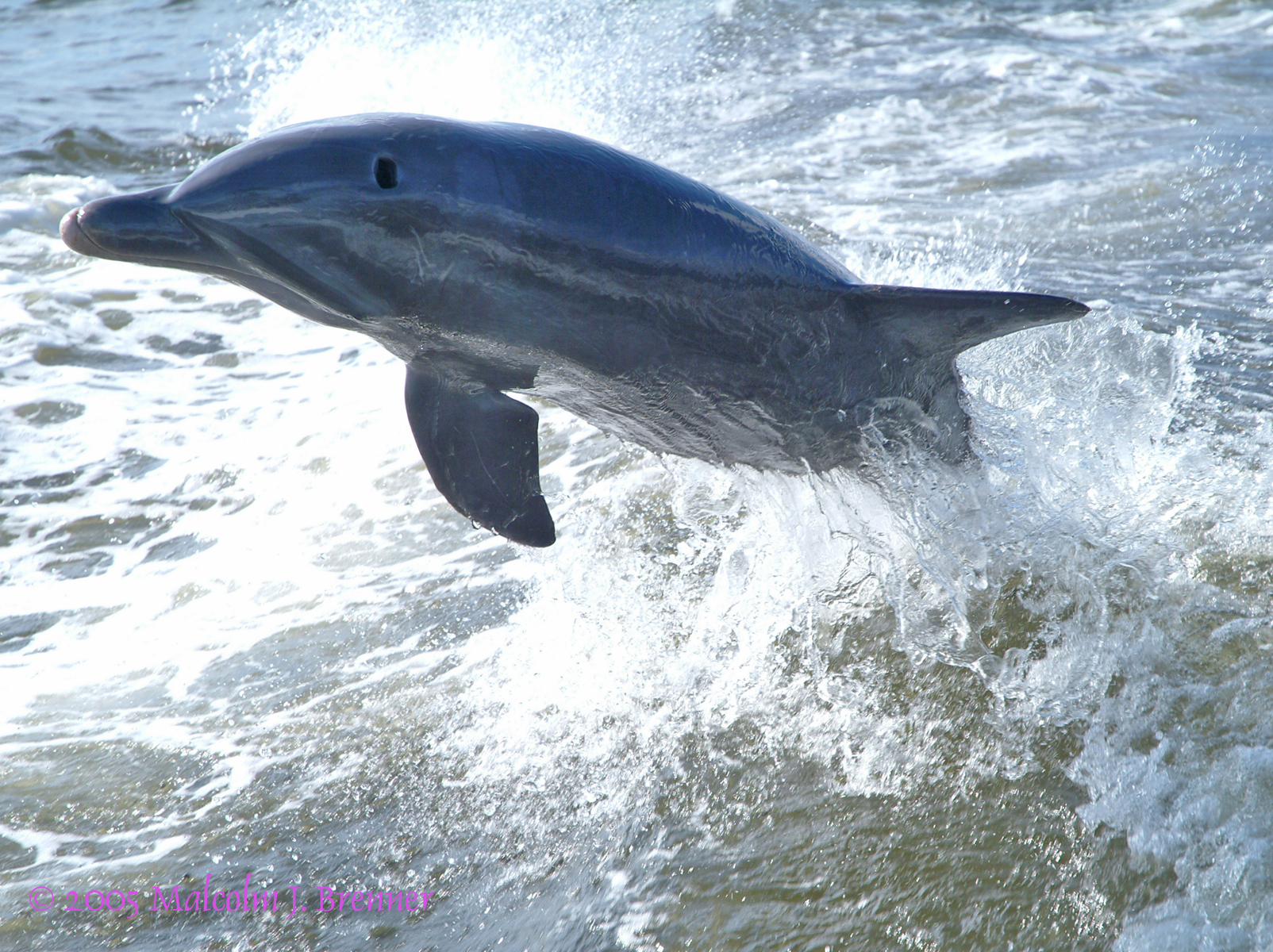
bottlenose dolphin — the species seen
in oceanariums and on TV — is about
10% larger than a human brain, and appears to be superior to ours as a
thinking machine. It has more folds on
the neocortex, where rational thought
originates, and the density of its
neurons is greater. The only animals
with larger brains are elephants and
some whales, the dolphins’ distant
cousins. Some scientists believe the extra brain matter is occupied with controlling the dolphin’s large bodies, or analyzing their complex echolocation.
But whale sharks and dinosaurs possessed huge bodies and very small
brains, and bats are able to use their
“sonar” with brains that fit on a dime!So these theories do not wash.
Given this fantastic biological computer, you might think scientists would
have long ago recognized the dolphin as
a creature of unique intelligence. Not
so! Dolphins lack hands and, being self-
sufficient, have no need for human
technology. Their oceanic lifestyle
makes them difficult to observe. Not
until 1955 did anyone wonder what the
dolphins might be doing with all those
brains, aside from chasing fish. In that year Dr. John C. Lilly, a young psychiatrist and neurophysiologist, was conducting sensory-isolation experiments
for the Air Force to determine what
would happen if an astronaut were cut
off from contact with Earth. Lilly
simulated weightless outer space by immersing himself in a tank of warm sea-
water. Breathing through a facemask,
isolated from all sensory inputs, Lilly experienced incredible hallucinations
and proved that the brain can generate
its own ghostly form of reality from
within. He also began to wonder what
the mind of a creature living under such
conditions would be like.
He conducted a series of experiments
on the dolphins at Marineland near St.
Augustine, Florida. While anesthetizing
them to implant electrodes he made his
first startling discovery — when a dolphin loses consciousness, it stops
breathing! Unlike other animals, each
breath for a dolphin requires an act of
will. His first few experiments proved
fatal to his subjects and angered the
Marineland staff, some of whom have
not yet forgiven him. After developing
more humane techniques, he was able to
“map” the dolphin’s brains and determine which areas controlled what
behavior.
During these experiments, Lilly
noticed that the dolphins in his laboratory behaved more like curious humans than white rats or rhesus
monkeys. They second-guessed his experiments and tried to imitate the voices of his assistants! Fascinated, Lilly ended his brain research and began studying the dolphin’s sound emissions.
He found they produce complex trains
of whistles and squawks with which they
communicate. In 1961, convinced of the
existence of a dolphin “language,” Lilly
received a NASA grant on the ground
that his research might help us better
understand communications from other
planets — when we receive them.
He quickly encountered hostility
from other scientists. Like early UFO
investigators, Lilly found himself up
against a wall of mockery and prejudice. His recordings of dolphins mimicking human speech were not convincing to untrained ears. His remarks
were sensationalized by a press more eager for headlines than the plodding
methodology of science. His stories of
“intelligent” behavior were laughed at
by cetologists familiar only with
robotized oceanarium dolphins. Even the basic premise of his research was
challenged; any idiot could see that
human beings were the most intelligent
creatures on earth — otherwise the
dolphins would be keeping us captive!
Undaunted, challenged by the alien
mind of the dolphin, Lilly began a series
of experiments on his own mind, using
sensory isolation and the then-legal drug
LSD. Tripping among his dolphins, he
realized that, if he was right, keeping
them captive was not just an insult; it
changed them, in the same way involuntary imprisonment changes a free man
into a slave. The dolphins locked in his
lab were not the same creatures as those
roaming the wild seas; they were products of his experimental parameters.
“I
felt,” he has since admitted, “like I was
running a concentration camp for dolphins.”
As he considered closing the lab
and setting his subjects free they began
to die mysteriously, starving or drowning themselves. In 1967 he released the
survivors, ending his research.
Lilly remains much-hated among professional cetologists, partly for his
“unscientific” theories, partly for his
early brain-probings, and partly for his
drug experiments, which nearly cost him
his life on two occasions. If he were the
only person to report such experiences with dolphins one might well doubt
him, but a small number of scientists
and laymen, fascinated by the idea of an
Earthly non-human intelligence, began
their own investigations. Some supported Lilly’s theories; others sought to
disprove them. Still others wavered.
This is typical of the problems scientists encounter when they attempt to
measure the dolphin’s intelligence.
Its sense and thought processes are so
different from ours that it’s hard to
develop a meaningful test! But there are
still profound mysteries surrounding
them. For almost every fact postulated
by a respected dolphin researcher, an
equally illustrious scientist can be found
to contradict it!
For example, Lilly
claims that dolphins can produce a
“distress whistle” when in danger or
pain. This call, described by him as a
whistle of rising, then falling pitch (like
an inverted V) brings other dolphins to
the rescue. Rene-Guy Busnel, a French
cetologist who works with Jacques
Cousteau, agrees about the “distress
whistle” but insists it’s exactly the opposite — falling, then rising in pitch
(like an upright V)! The Caldwells,
equally respected, maintain there is no
such thing as a distress whistle. According to them, dolphins have only one
whistle apiece, which they repeat over
and over to tell other dolphins “here I
am,” like Kurt Vonnegut’s mythical
Mercurian harmoniums.
Are you sufficiently confused?
One person who shares Lilly’s views is
Ric O’Barry, formerly a trainer for
Ivan Tors’ Flipper TV series. After
working with dolphins for years,
O’Barry concluded that the dolphins
were not only smarter than he was –
they were sometimes able to read his
mind, learning complicated tricks faster
than seemed possible. He now devotes
his time to saving the whales and
dolphins from extinction.
Another believer is Michael Greenwood, formerly dolphin trainer for the
U.S. Navy and CIA. Greenwood
became interested in marine mammals during the Navy’s Sea Lab program.
Dolphins can dive to 600 feet and return
in three minutes without being crushed
by the pressure, equal to 200 atmospheres, or dying from the bends.
Having gained some experience training sea lions, Greenwood was asked to take
over a top-secret dolphin project in the
Florida Keys. The mission, under a conservationist cover story, was to train
dolphins to run intelligence missions
against communist Cuba, planting instruments on atom-powered Soviet warships which would transmit data on the
size and power of their nuclear reactor.
The CIA and Navy factions on the project were warring with each other; the
electronic equipment malfunctioned;
and the dolphins were poorly trained! Greenwood became convinced it was immoral to train such intelligent and
friendly creatures for warlike ends. He,
too, came to believe they could telepathically read his mind. He now fears
they are facing a slaughter by the
world’s naval powers, who are unable
to tell an innocent dolphin from one
trained for espionage.
But the dolphins are already facing a
wipeout. For the past fifteen years,
tuna fishermen have been killing hundreds of thousands in the huge purse-seine nets used to trap yellowfin tuna,
which are packaged for sale as “chunk
light.” The dolphins and tuna stick
together — no one knows why — and
when the fish are netted the dolphins
panic. Their “sonar” beams pass uselessly through the net’s mesh, and in their
confusion they may become tangled and
drown, or, worse yet, be dragged on
board and crushed in the machinery. In
1971, an estimated 320,000 were killed.
Since then the numbers have been dropping, thanks to new types of nets, new
catching techniques, and the Marine
Mammal Protection Act, which sets
yearly quotas on the number killed. But
the battle isn’t won: the tuna fishermen,
chafing under what they feel are unfair
restrictions, talk of taking their boats to
nations without quotas.
Dolphin ESP is a highly puzzling
issue, one that is infrequently discussed. Studies on humans
show that, contrary to most science fiction, strong emotions, rather than powerful intellect, are responsible for telepathy, and this also seems true in human-dolphin mental contacts. People who see dolphins as highly intelligent are more open to psychic contacts than those who regard them as big fish; familiarity with dolphin ways also increases the likelihood of interspecies ESP. People who have had psychic experiences with dolphins find them difficult to describe.
Don’t rush down to your local oceanarium expecting to pick up dolphin brainwaves, however. While you might, it is highly unlikely, unless you’re exceptionally psychic. As Dr. Lilly discovered, captive dolphins are a different breed from their wild counterparts. While some thrive in captivity, many more have died from it, and the survivors frequently display spirits broken by the rigorous behavior-modification techniques used to produce oceanarium shows. Conditions vary greatly from one establishment another: some take great pride in maintaining healthy, happy specimens, while in others the death rate is staggering. Stories of trainers mistreating their dolphins out of malice or ignorance are confined to backroom discussions, where the public can’t overhear.
Sometimes the dolphins bear mistreatment
stoically; sometimes they retaliate!
Some dolphins have been kept for years
in lagoons with nothing more than a line
of floats keeping them in; others have
ripped steel fences apart to escape! It’s
impossible to generalize about dolphins
for the same reason it’s impossible to
generalize about humans: no two are
alike.
But there is no doubt that the “happy
dolphin” image perpetuated by
oceanariums and the media is a lie.
The
Flipper series shows them as happy-go-lucky types, fawning all
over their human masters, Kenny and
Bud. The movie The Day of the
Dolphin, while somewhat more
realistic, still showed dolphins as being
childlike, naive, and gullible. Trainers
know better: dolphins can be sweet,
even sexy, but they can also be deceptive, arrogant, and demonically cunning. The recent movie Orca, the Killer
Whale did little to change the image of
the most maligned creature since the
snake. Although the orca saves the
heroine, Rachel Bedford (a sympathetic
biologist played by Charlotte Rampling)
from a shark at the beginning, and
spares her life at the end, in between
these chivalrous deeds it devours Jack
Campbell’s (Richard Harris’) crew,
sinks a fishing fleet, sets a town on fire,
and rips a woman’s leg off! Dino De Laurentiis would be well advised to restrict his swimming to pools from now on.
Paul Spong, a Canadian biologist who has studied orcas for the past six years, knows better. When a group of orcas swim by his research station in Alert Bay, Spong may hop into a one-man kayak and paddle out to meet the “deadly” killer whales. When he plays his flute to them, the whales stop roaming and listen raptly. If we stop to think about it, aren’t humans the real monsters? Orcas are captured for oceanariums with concussion grenades, and catchers show no qualms about breaking up pods that may have existed for centuries.
The future holds greater promise for interspecies communications. While the scientific community wrangles, several groups are planning to decipher the dolphins’ language. The Dolphin Embassy Project, based in Australia, is headed by Doug Michaels, of San Francisco. This group is building a ferroconcrete “floating embassy,” loaded with electronics, which will function as a meeting place where humans can observe and interact with wild dolphins along the Great Barrier Reef. Plans call for the expedition to begin in April, 1978.
Members of the Canadian Greenpeace Project have, for the last several years, been literally laying their lives on the line to save the great whales. Using rubber Zodiac boats operating from a converted fishing vessel, Greenpeacers have been harassing Soviet and Japanese whaling fleets in the North Pacific, gathering evidence of illegal undersized kills and producing a documentary film. On two occasions Russian whalers have fired harpoons at whales the group was guarding, narrowly missing the humans!
Dr. Lilly, too, is returning to the dolphins with a new plan. He is programming a sophisticated computer to act as a human-dolphin translator, linked by radio to communications equipment in a sailboat. Lilly hopes that, by working with wild dolphins, he will both avoid the problems that plagued his earlier work, and vindicate his theories.
If any of these groups are successful, the benefits to humanity could be endless. We will have established communication with minds perhaps greater than our own; we will receive an outside view of ourselves from creatures who watched us evolve. The dolphins and whales could help us control ocean pollution and aid in the search for undersea energy sources. They might be able to shed some light on the persistent myth of Atlantis. And who knows? By the time we encounter real aliens from outer space, we humans might be able to say “Hello!” to them in their own language — with the smiling dolphins by our sides.
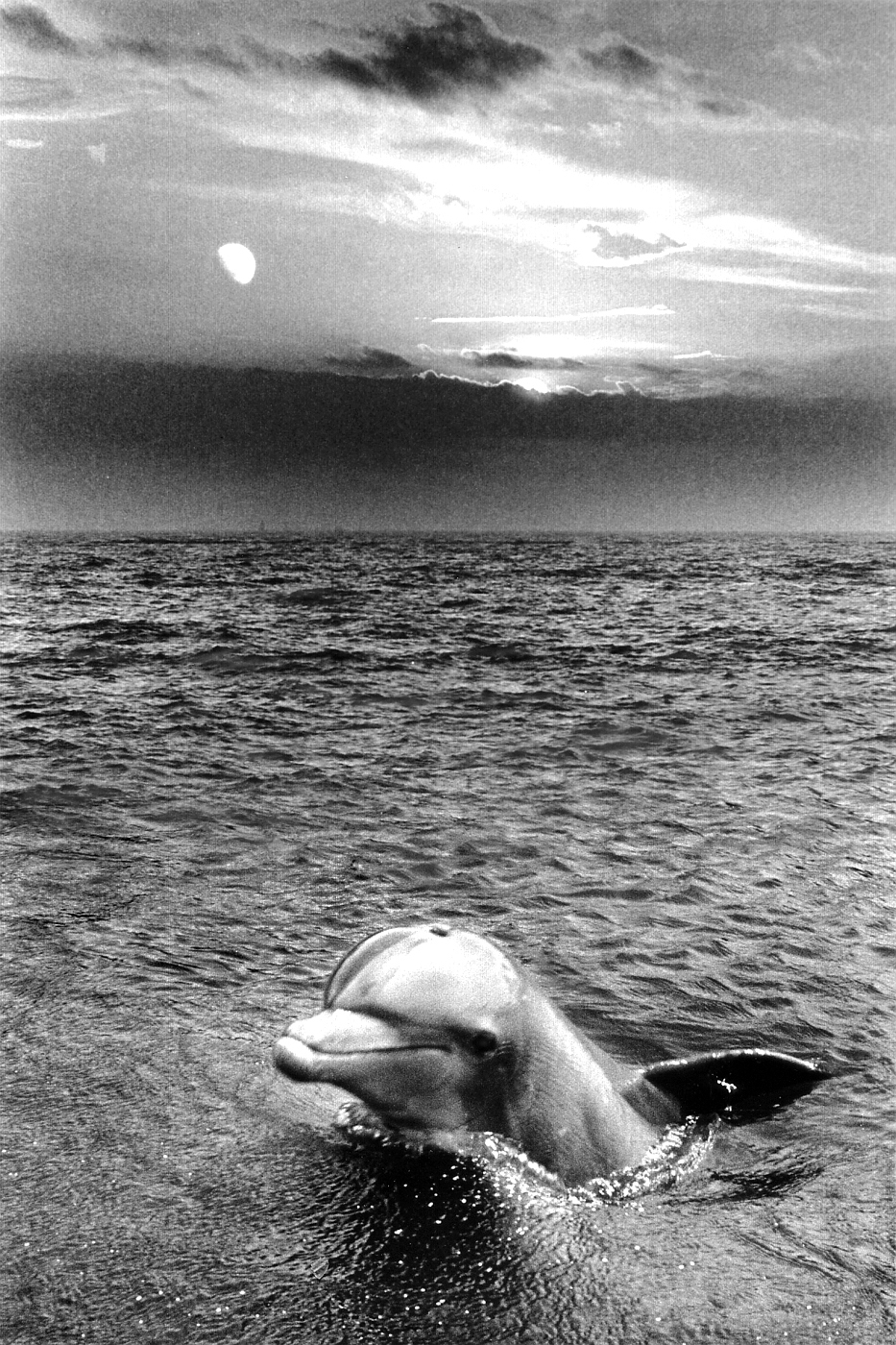
The Greeting, © 1970, 2010 Eyes Open Media.









 Malcolm J. Brenner