In an effort to log some history, and also to chronicle my own exploits, I present this article from an old, old issue of the slick, slightly left-of-center magazine NEWSWEEK, which is still hanging around in digital format! This was the first article I’d ever seen, at the tender age of 11.5, that mentioned dolphins in connection with extraterrestrial aliens — which, in essence, is what the dolphins are, living in our own oceans instead of those of Jupiter, Uranus or Xagramorfagel (if you haven’t heard of the last one, don’t worry, it’s going viral any day now!). My favorite novel at the time being Robert A. Heinlein’s Star Beast, about a pet alien and his boy, I was, of course, extremely eager to make a dolphin’s acquaintance, as I was sure they had nothing better to do than hang around, waiting for me to show up! Here, then, although I do not know the author’s name, I present the first article I encountered to mention dolphins in connection with ET aliens!
Newsweek: Space & The Atom
Oct. 22, 1962, pg. 51
FIVE PEEPS AND A TWEET

Man’s first contact with extraterrestrials may never come — or it may be only a beat in history away; his giant radio telescopes could pick up a message from space tomorrow (July 22, 1960). But when it comes to working out a system of interspecies communication with a species that may not even exist, man is still in kindergarten. This lack has long worried space scientists, who think that the parties at each end of the “telephone” might have everything to say to each other and no common way to say it.
One suggested way of surmounting this embarrassment is to practice communications with other species on man’s own planet, but which species? In answer, the National Aeronautics and Space Administration has made its choice, and not surprisingly it is the bottlenose dolphin. Under an $80,700, one-year grant from NASA, communication with the brainy mammal will be explored by the dolphins’ old friend, Florida neurophysiologist Dr. John Lilly, who has been studying them since 1955.
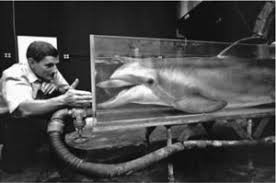
Dr. Lilly, who is convinced that “man will communicate with another species in a decade or two,” has long considered the dolphin the most likely possibility. His reasons: Dolphins’ brains are larger and more complex than man’s; they talk to each other in a high-speed language of whistles, click, squawks and blats; and they can produce an eerie mimicry of the human voice, even copying subtle inflections (one recently mimicked the Southern drawl of Lilly’s assistant). Dr. Lilly is now feeding tapes of dolphin sounds to a computer, which will sift them for a meaningful pattern. “It is possible that their intelligence is comparable with ours, though in a very strange fashion,” he has said. “They may be a group with whom we can learn basic techniques of communicating with really alien intelligent life forms.”
Say It With Shapes: Such technologies would obviously be of vast assistance to space scientists. Although few expect that man will ever drop in on the residents of another solar system (the trip could take centuries), they haven’t given up on earthbound communication. Before the advent of radio, all suggestions for signaling extraterrestrials were optical in nature: Flashing messages with large mirrors and searchlights, or cutting vast geometric patterns out of forests and farmlands. [Italics added for emphasis, this seemingly suggests “crop circles” a full decade before they were first reported by UFO investigators!]
Far more practical schemes accompanied the development of powerful radio transmitters. The problem is what to translate. One of the most elaborate schemes is that of Hans Freudenthal, a Dutch mathematics professor writing in English. Called Lincos (for Cosmic Language), it depends upon the supposedly universal concepts of mathematics. First Freudenthal would teach the extraterrestrials the idea of “greater than” by sending five peeps, followed by a different signal—perhaps a tweet—and then three peeps. This would be repeated, using several combinations of peeps, until the listeners had equated “greater than” with the peep signal. Similarly, the concepts of “less than,” “equals,” “plus,” and “minus” could be taught. Eventually, Freudenthal hopes to transmit an elaborate mathematics language, then go on to the tasks of sending lessons in physics, physiology, and even ethics.
TV Images: A simpler sounding plan—the transmission of TV images—has been suggested by Dr. Frank Drake of the National Radio Astronomy Observatory in Greenbank, W. Wa. It is based on the principle that television pictures can be broken down into tiny dots of light. The different intensities if the dots can be translated into correspondingly differentiated such as dots and dashes, frequencies, or numbers, and sent as radio signals. Drake hopes the aliens would understand this principle and reconstruct our television pictures from the signals.
Yet both these ingenious plans, and many like them, rest on the fragile assumption that the extraterrestrials think as we do. Perhaps they do: then again it is conceivable that mathematics and inductive reasoning may be as foreign to them as their worlds and bodies might appear to us. Here lies the potential value of the dolphin—a creature operating in an environment perhaps as alien to humans as that of Mars. Even the slightest clue to how such a creature thinks could eventually lead to radically different approach to placing interstellar “telephone calls”—or a new method of analyzing space static to discover is someone is trying to call us.
But this is a long way off. “Right now we don’t expect any dolphins to teach us how to talk to Martian ants,” a NASA official cracked last week. “We’re simply trying to decode their own talk.” What happens after that, of course, depends on what they have to say.
###
Analysis: This article, and several others like it in LIFE, Look and other popular publications opened my eyes (and ears, don’t forget the ears) to the possibility of communicating with dolphins! As an avid science fiction reader, I was delighted with the idea that our seas might contain a comparable form of non-human intelligence. I eventually got much more than I expected, by about 2 or 3 orders of magnitude, with Dolly!
The last paragraph of the article is particularly telling, and sad. The famous anthropologists Dr. Gregory Bateson & his wife Lois Cammack had joined Lilly in the Virgin Islands to see what was going on, and, a year later, “See if you’re smart enough to decode their talk before you try to teach them ours” was Bateson’s parting shot. He later wrote “Steps to an Ecology of Mind,” a book which I tried three times to read, and failed miserably each time.
And this is what Lilly’s most vociferous critics complained about his research, quite properly: HE NEVER PROVED THAT DOLPHINS EITHER USE OR COMPREHEND LANGUAGE BEFORE HIRING MARGARET HOWE (LOVATT) TO TEACH THEM ENGLISH! In scientific terms, this is serious cart-before the horse-putting, and it is an obvious no-no! Why, then, did Lilly pursue it so devotedly?
It strikes me, from both reading his writings and my personal experiences with him, that Lilly had to some degree an obsessive-compulsive disorder. This is common in scientists who strive under pressure for a high degree of accuracy, often to several decimal points. It’s also indicated in Lilly’s own autobiographical novel, “The Scientist,” in his descriptions of his lonely, rather isolated upbringing and childhood.
I can’t really say how Lilly handled major disappointments, because I never observed him doing so. But one of the privileges of whiteness, wealth (which Lilly had in relative degree) and education is that you’re insulated, to some degree, from failure. It may be that, as the evidence that he was on the wrong path accumulated, Lilly stuck more and more strongly to his abortive theories because he had to, to support his rather expansive ego. To admit he was wrong would be uncharacteristic of him, until much later in life.
There was also the practical aspect that Lilly had, with the establishment of the Dolphin Communications Laboratory, taken on the care and feeding of three, 400-lb. (180-kg.) adolescents who could smack you through a concrete wall, if they wanted to. It’s a big responsibility, and I don’t think people are going to give you much money just to study dolphins to see if they maybe, possibly, HAVE a language!
Finally… finally, sometimes a scientist, like everyone else, has a strong hunch that things are heading the right way, that they can disregard everybody else, that they can break the rules and still win! Such feelings are hard for a logical, rational mind to resist, precisely because they are not rational nor logical. But neither having a strong hunch, nor following it to the bitter end, makes one automatically right! Appearances can be deceiving, and as often as not, it is ourselves we deceive.
What matters to me is, I found something I wanted to pursue, and I have pursued it all my life. Maybe not as a scientist, but that doesn’t mean I haven’t made remarkable discoveries, such as this: WE HAVE HAD LIVING BESIDE US, UNNOTICED, FOR MILLIONS OF YEARS, ANOTHER SPECIES OF LIFE THAT ROUTINELY ENGAGES IN MANY OF THE SAME HIGHER-ORDER FUNCTIONS THAT WE HUMANS DO: COMPLEX PROBLEM-SOLVING, SOCIAL AWARENESS, INDIVIDUAL AND GROUP IDENTITIES, ETHICS, THEORY OF MIND, and has enough imagination to realize that in some ways this odd, upright ape with the clever fingers IS RATHER LIKE ITSELF, in that our minds have strange and significant similarities!
We humans, as the dominant species on Planet Earth, need to acknowledge that a non-technological species, which cannot even open a can of beans or unfold a Swiss Army knife, is Number 2, and in the ocean, they are, and always will be, Number 1! Due to their 12-million year head start on us in the Large Brains Department, and their incredible record of sheer SURVIVAL over that time, we should be approaching them as older and wiser beings, with the respect and deliberation they deserve. Let what nature writer Loren Eisley called “our long human loneliness” finally be over, as we are re-admitted to the order of Nature by our old friends, the dolphins!

All contents & illustrations ©2023 Malcolm J. Brenner. All rights reserved.
 Malcolm J. Brenner